If you’re traveling solo from Seoul to Jeju, the single most useful thing you can do before you buy a ticket is read the carrier’s or booking agent’s change and cancellation policy top-to-bottom. Policies vary by airline, fare class and booking channel: some low-cost fares limit changes or allow only credit vouchers, while higher-tier tickets usually permit free or low-cost date changes and refunds. Knowing the exact conditions that apply to your booking—who charges the penalty, whether taxes are refundable, and the final step to get a refund—lets you pick the ticket that matches the uncertainty of your trip. Below I outline which policy details matter most, how to compare direct and connecting options, and practical tradeoffs so you can make a confident choice for a solo trip to Jeju.
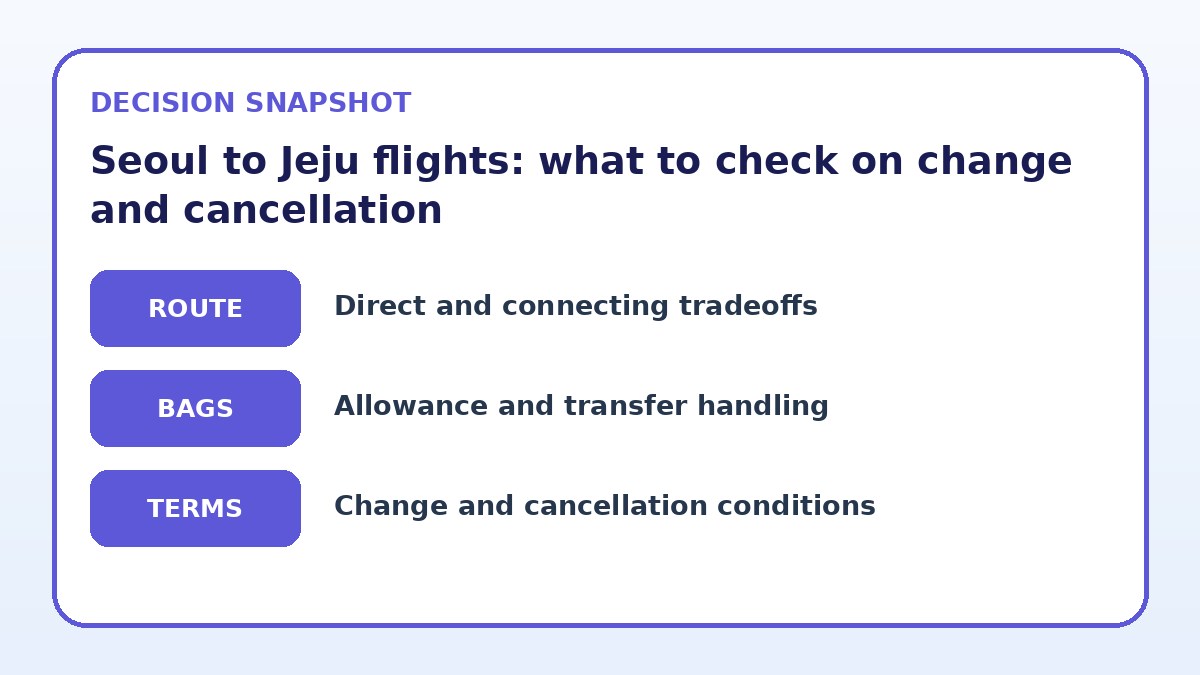
See current options before you compare the details
Availability and final conditions change. Open Trip.com now or keep reading for the practical comparison.
Which parts of a policy actually affect solo travelers
For a solo traveler, the most important lines in a change or cancellation policy are the conditions around refunds, changes to dates or passenger names, and how fees are calculated. Focus first on whether the fare is refundable, whether the fare class permits date or time changes without penalty, and whether changes can be made online or must be done through a phone agent. Also note cut-off times for free changes or refunds; some fares require you to cancel a certain number of hours before departure to qualify for any refund or voucher.
Taxes and carrier-imposed fees can behave differently from the base fare. Some tickets refund government taxes even when the fare itself is nonrefundable; others deduct a processing fee before returning any balance. If you expect mobility needs, tight connections, or last-minute schedule risk, pay special attention to whether the airline charges for name corrections or same-day standby—changes that are common for solo travelers adjusting plans on the go.
How direct and connecting options change your flexibility
Direct flights are often simpler to change: a single carrier or booking class determines the rules, and you only need to manage one departure time. But don’t assume every direct option has the same flexibility—low-cost carriers and legacy airlines both offer restricted basic fares on direct routes. When comparing direct departures, check whether the fare you select allows free or low-cost date changes and whether seat changes or carry-on policies affect the overall value for your itinerary.
Connecting itineraries introduce complexity because each segment may be booked under different fare rules or even different airlines. When a trip is sold as one ticket, the most restrictive change policy might apply to the whole itinerary, or the airline may handle rebooking differently for each leg. If you assemble connecting flights yourself on separate tickets, you lose protection for missed connections and must juggle changes with two providers. For solo travelers who value simplicity and a predictable change process, a single-carrier direct booking often reduces administrative hassle.
| Approach | Best for | Tradeoff to check |
|---|---|---|
| Book the cheapest nonrefundable fare | Travelers with fixed plans and low tolerance for higher upfront fares | Lower price now but limited or expensive change and refund options later |
| Buy a flexible or refundable ticket | Solo travelers with uncertain dates who want predictable rebooking | Higher initial cost that may be unnecessary if plans remain fixed |
| Purchase a basic fare and add change waiver or insurance | Those wanting a middle ground between cost and protection | Additional fees may not cover all scenarios; read waiver or policy limits carefully |
| Book through a single-carrier direct itinerary | Travelers prioritizing simple changes and single-point customer service | Potentially higher fare than piecing together separate segments |
Ready to check the option that fits your plan?
Use your exact dates and traveler details so the provider page can show the current total and conditions.
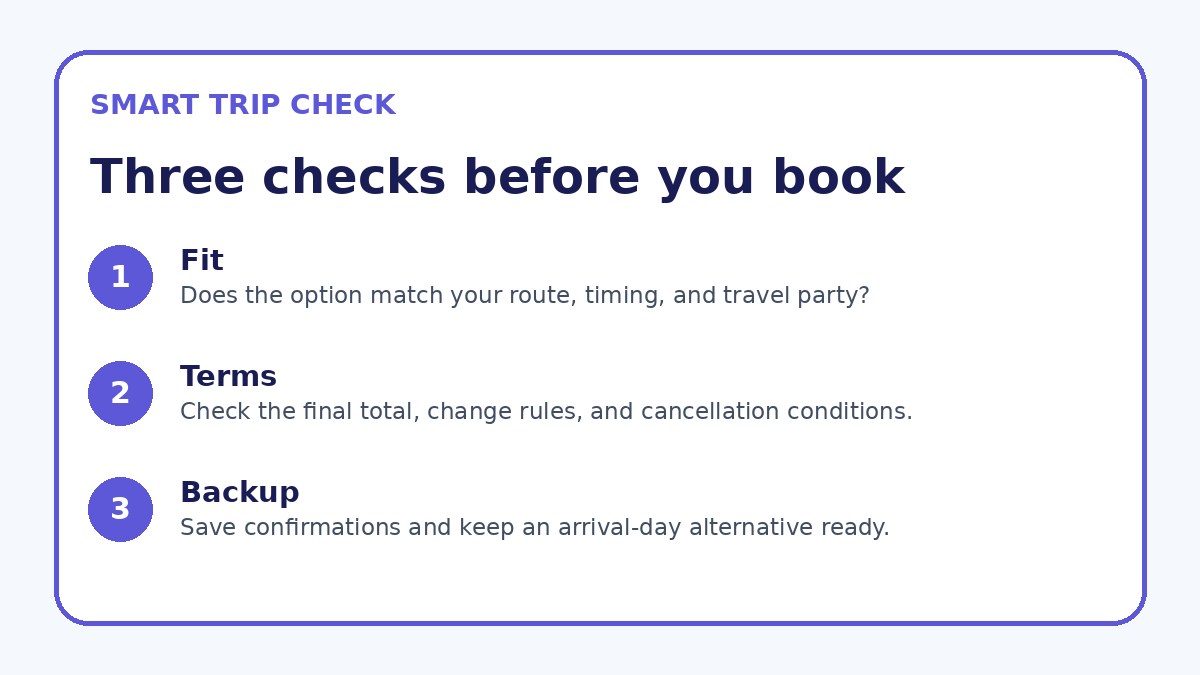
Decision criteria: when to pay for flexibility
Decide how much uncertainty you face. If your plans are firm—firm meeting dates, prebooked tours, or family commitments—you can usually accept stricter nonrefundable fares to save money. If your schedule is fluid, consider the margin you’d pay to avoid stress: refundable fares, flexible-change options, or travel insurance that covers penalty gaps. Estimate the break-even: how likely a change is, and whether that probability justifies the additional fare premium. Remember that fees charged at the airline’s end can differ from those shown on a booking site, so verify final change penalties on the carrier’s booking page before purchase.
Check payment and refund mechanics. Some flexible fares permit fee-free changes but only offer a voucher for the fare difference; others allow refunds to your card minus a service fee. If you might need a cash refund, prefer fares explicitly labeled refundable and confirm whether taxes and carrier surcharges will be returned. Also verify the timeframe for refunds—some carriers process refunds quickly, others take weeks—and whether there are exceptions for schedule changes initiated by the airline itself, which often allow free rebooking or full refunds.
Before you book
- Read the full fare rules on the airline or agent booking page before you click buy and take a screenshot of the rules shown.
- Confirm whether refunds go to your card, to an airline voucher, or to the booking account and note any processing timeline.
- Check cut-off times and whether same-day or within-24-hour changes are allowed without penalty.
- If booking a connecting itinerary, verify which carrier’s change policy applies and whether the booking is protected as a single ticket.
- Compare the total cost difference between a flexible fare and a nonrefundable fare plus a change waiver or insurance policy.
- Save booking confirmations, fare rules, and any agent correspondence in one folder for quick reference if you need to change or cancel.
What to verify on the booking page and after purchase
On the airline or agent’s final booking page, look for the exact fare rule code, the change and cancellation fee table, and the refund method (card, voucher, or account credit). If the page shows only a short summary, click to expand full fare rules or the ticketing conditions. Note any special clauses such as nonrefundable taxes, name-change restrictions, or limitations on voluntary changes within 24 hours of departure. If you see unclear language, take a screenshot of the quoted terms and confirm them with customer service before you pay.
After purchase, immediately save the e-ticket, fare rules, and booking confirmation. Register your contact details with the airline, and check the reservation within 24 hours to ensure the correct fare class was ticketed. If you bought through an online travel agency, confirm who you must contact for changes—sometimes the airline requires changes to be handled directly and sometimes the agent must modify the booking. For any future change, document dates, confirmation numbers, agent names, and the stated fees so you have a clear record if disputes arise.
Frequently asked questions
Can I always get a refund if I cancel a Seoul to Jeju flight?
Not always. Refund eligibility depends on the fare rules tied to your ticket: refundable fares explicitly allow refunds, while nonrefundable fares often only offer vouchers or partial refunds (for taxes and fees). If the airline cancels or materially changes the scheduled time, most carriers provide rebooking or refunds, but you must confirm the carrier’s policy on the final booking page. If you booked via an agent, verify whether refunds are processed by the airline or the booking agent and what documentation they require.
How do change fees and fare differences work for a rebooked flight?
When you change a ticket, carriers commonly charge two things: a change penalty and any difference between the original fare and the new fare. Some flexible fares waive the penalty but still require payment of any fare increase. Others issue a voucher for the remaining value if the new fare is lower. Always confirm on the booking page whether penalties are flat, percentage-based, or waived, and whether taxes or carrier surcharges are refundable or applied to the new booking.
Is travel insurance a substitute for refundable tickets on the Seoul–Jeju route?
Travel insurance can cover specific cancellation reasons depending on the policy, such as illness or certain emergencies, but it rarely reimburses voluntarily changed plans or simple change-of-mind scenarios. Policies vary widely in what they cover, the required documentation, and how they interact with the airline’s own rules. If you consider insurance, compare the insurer’s covered reasons with the airline’s change penalties to see whether insurance fills the protection gap effectively.
Final planning note
For solo travelers on the Seoul to Jeju route, the right ticket depends on how much uncertainty you can tolerate and how much administrative friction you want if plans change. Start by reading the full fare rules on the carrier or agent booking page, note refund mechanics, and decide whether a refundable or flexible fare is worth the extra cost compared with a cheaper nonrefundable option plus insurance or a waiver. When in doubt, prefer a single-carrier direct ticket for simpler rebooking, and keep meticulous records of your booking and fare rules after purchase. If you want to compare current availability and provider policies side-by-side, consider checking a mainstream booking site such as Trip.com, but always confirm the definitive conditions on the issuing carrier’s official booking page.
Continue planning
Check current options and final conditions
Use the provider page to confirm live availability, the final total, cancellation terms, and every condition that matters to your trip.
This evergreen planning guide was created with AI-assisted drafting and a structured quality review. It does not display live prices, schedules, availability, visa guidance, or provider rankings. Verify current details before booking. Some links are affiliate links; we may earn a commission at no additional cost to you.