
Practical answer up front: when booking Singapore to Bangkok flights as a couple, prioritize the ticket’s change and cancellation policy more than the headline fare. Choose a fare class or add a flexible bundle that lets at least one alteration be free or low-cost, and confirm whether both passenger names can be adjusted on a single reservation. Also check whether same-day name corrections, travel credit expiration, and refund processing are covered, and make sure you know which fees apply to changes made within 24–72 hours of departure. Finally, capture screenshots of the final booking page showing the exact change/cancellation rules and any quoted fees — the airline or booking site’s live page is the authoritative source for firm terms.
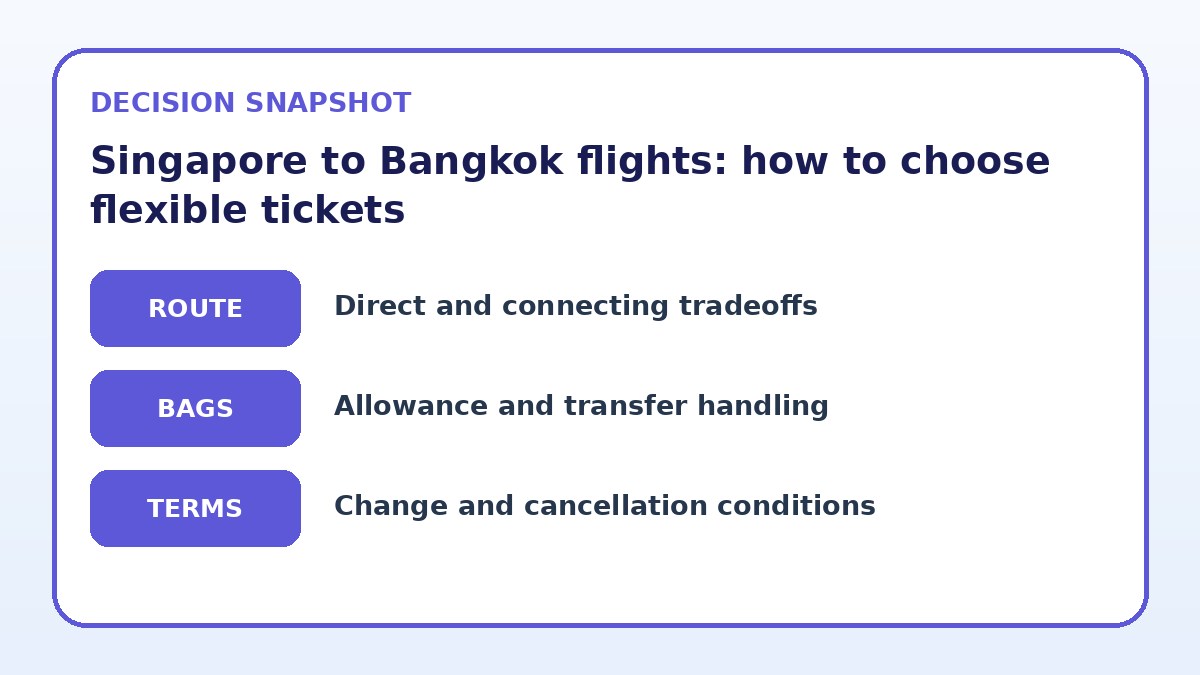
See current options before you compare the details
Availability and final conditions change. Open Trip.com now or keep reading for the practical comparison.
Why change and cancellation terms matter more for couples
Couples often travel with intertwined plans: shared hotel bookings, joint tours and schedules that depend on two people. A single date change for one partner can force a rework of the whole trip. That’s why the financial and administrative friction of changing a flight matters as much as the ticket price. When both names are on the same reservation, some airlines treat changes differently — a change of travel date may be permitted for one passenger but not for both, or one name correction might be processed as a full ticket reissue. Understanding how an airline or agent processes linked bookings avoids last-minute surprises and extra costs.
Look beyond the headline fare: the real cost of a ticket includes potential change fees, reissue costs, and any penalty differences between name corrections and date changes. For couples, the ideal policy balances low or waived change fees with clear, transparent credit issuance. Timing rules are crucial: some carriers allow complimentary changes up to a certain window before departure, while others charge for last-minute adjustments. Confirm whether a fare’s flexibility covers itinerary changes, name corrections, refunds, or only travel credits — and whether credit expiry aligns with your likely rebooking timeline.
How to compare direct and connecting options for flexibility
Direct flights reduce one variable: fewer segments generally means fewer potential fees and simpler change processing. If both travelers prioritize a single convenient hop, a direct Singapore to Bangkok flight can be easier to change or cancel because it’s a single ticket record. However, direct flights may offer fewer fare buckets or limited flexible fares at the price points you want. When comparing options, check whether the carrier’s flexible fare applies equally to nonstop and connecting services and whether connections involve different airlines that each impose separate rules.
Connecting itineraries sometimes let you save money or open more flight times, but they can add complexity if a change affects only part of the route. If your connection involves codeshares or separate tickets, a date change may require altering multiple bookings, each with its own fee and time limit. When you see connecting options, note which carrier issues the ticket (the “ticketing carrier”) since its policy usually governs changes. Also confirm whether the transfer window is refundable or changeable as a single operation, especially for couples who may need to split or reschedule one passenger independently.
| Approach | Best for | Tradeoff to check |
|---|---|---|
| Book a single joint flexible ticket | Couples planning to travel together with minimal independent changes | Easier management but any change may require adjusting both passengers and could be costlier if one needs to change only. |
| Buy two separate flexible tickets | Partners who expect to make independent changes | More autonomy; managing two reservations and possible higher combined cost if both change dates. |
| Purchase low-fare tickets plus change-protection add-ons | Couples wanting lower base fares with a safety net | Saves on initial cost but add-on rules and claim processes vary; could be less transparent than refundable fares. |
| Book refundable or fully flexible fares | Travelers who need maximum flexibility and quick refunds | Higher upfront cost; often the simplest option for avoiding reissue fees and lengthy refund processing. |
Ready to check the option that fits your plan?
Use your exact dates and traveler details so the provider page can show the current total and conditions.

Key policy features to read line-by-line
When you reach the provider’s final booking page, read the change and cancellation sections word for word. Look for explicit language about free changes, penalty amounts, credit vouchers versus refunds, name corrections, and how fees vary by how close to departure you change the booking. Pay special attention to whether a change fee is waived only for specific classes or if you must pay a fare difference in addition to any fee. Note any requirements to change both passengers together, or whether a single passenger can be modified without affecting the co-traveler’s ticket.
Also verify operational details that affect usability: how credits are issued (voucher code, electronic credit, or travel bank), whether credits are transferable between passengers, and the expiration period. Check processing timeframes for refunds — some carriers take weeks or months to complete refunds — and whether refunds are returned to original payment or issued as travel credit. If booking through an online travel agency, confirm whether the OTA handles changes directly or passes you back to the airline, and whether the OTA charges its own service fee on top of airline penalties.
Before you book
- Screenshot the final booking page showing exact change, cancellation, and refund wording before you complete payment.
- Confirm whether one reservation allows you to change or split passengers without reissuing both tickets.
- Note how credits are issued (voucher, travel bank, or refund) and record any expiration or transfer restrictions.
- If using an OTA, find and save the OTA’s specific policy and any additional service fees for changes or cancellations.
- Compare the total cost of a flexible fare versus a low fare plus an add-on by simulating a single change to calculate likely fees.
- Add the airline’s customer-service contact and the OTA booking reference to your phone, and verify reply channels for change requests (phone, chat, or email).
Practical couple-centered booking strategies
Split vs joint reservations: couples should weigh whether to book a single joint reservation or two separate tickets. A shared booking makes seat selection and itinerary management easier, but any change may require adjusting both travelers together. Separate tickets give each person autonomy but risk higher aggregate change costs if both need to change independently. Consider your travel style: if the couple is highly flexible, separate refundable fares or flexible bundles might make individual changes cheaper; if the couple travels together for most of the trip, a joint flexible fare could be simpler.
Use change-protection add-ons wisely and document everything. Some carriers and third-party sellers offer add-on protections that reduce change fees or extend refundability. Compare the add-on cost with the likely fee if you change once. Whatever you purchase, take screenshots of the final terms and your confirmation emails showing the exact wording about changes, credits, expiration, and name correction policies. This documentation can be critical if an agent later interprets a policy differently when you request a change.
Frequently asked questions
Can one partner change their flight on a shared Singapore–Bangkok reservation without affecting the other?
It depends on the airline and fare class. Some carriers allow one passenger on a shared PNR to be rebooked independently, while others require reissuing or adjusting the full reservation. The final booking page will say whether changes can be made per passenger and list resulting fees. When you need that flexibility, either buy fares that explicitly permit single-passenger changes or consider separate tickets. Always capture the exact wording and confirmation codes so an agent can process the change according to the documented policy.
Are flight credits commonly transferable between two passengers traveling together?
Policies vary widely. Many carriers issue credits tied to the original ticket or the name on the booking, which can mean credits are non-transferable. Some airlines allow name changes or transfer under specific conditions but often with a fee. If transferability of credit matters to you as a couple — for example, if one partner cancels and the other wants to reuse credit — verify the carrier’s rules on the booking page and ask customer service to confirm how credits will be applied and whether names on credits can be changed.
If we book with an OTA, who handles refunds and changes for our Singapore to Bangkok flight?
OTAs and airlines often share responsibilities: the airline’s policy governs the ticket, but the OTA may handle the administrative side of changes or charge an extra service fee. Some OTAs permit online changes; others require you to contact their support, which may add processing time. Always check the OTA’s stated change/cancellation process and any service fees on the final booking page, then confirm whether you must work through the OTA or can approach the airline directly for faster resolution. Keep all references and booking numbers for both parties.
Final planning note
For couples booking Singapore to Bangkok flights, the smartest move is to treat change and cancellation terms as a core part of the decision, not an afterthought. Start by deciding how independent each partner needs to be: that will drive whether you book joint or separate fares. Then compare the net cost of flexible fares versus low fares plus add-ons, and scrutinize the provider’s live booking page for exact rules on name changes, credits, and refund timelines. Document everything, save confirmation screenshots, and know who—airline or OTA—will process changes. These steps will reduce friction and unexpected costs if travel plans shift.
Continue planning
Check current options and final conditions
Use the provider page to confirm live availability, the final total, cancellation terms, and every condition that matters to your trip.
This evergreen planning guide was created with AI-assisted drafting and a structured quality review. It does not display live prices, schedules, availability, visa guidance, or provider rankings. Verify current details before booking. Some links are affiliate links; we may earn a commission at no additional cost to you.