If you and your partner need flexibility, start by confirming change and cancellation rules before choosing any Tokyo to Sapporo flights. Practically: pick the fare type that lets you change dates or names with acceptable fees or offers a refundable option, and make sure both travelers are covered on the same reservation to simplify changes and refunds. Review the carrier’s published deadlines for changes and cancellations, how refunds are issued (credit, voucher, original form), and whether partner airlines or codeshares inherit the same terms. Once you have those basics, compare flight durations, connection risk, and travel protection to decide whether a slightly higher flexible fare is worth it for your plans and peace of mind.
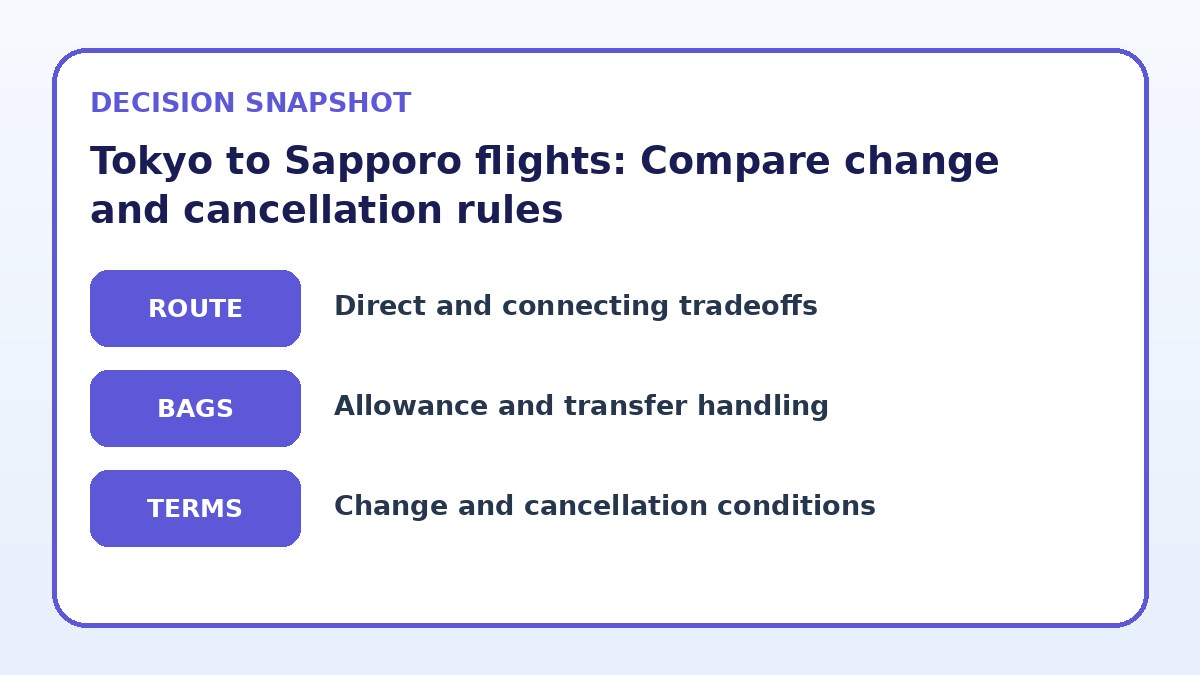
See current options before you compare the details
Availability and final conditions change. Open Trip.com now or keep reading for the practical comparison.
How to read change and cancellation rules
Airlines and OTAs display fare rules that look similar but hide key differences. Start with the fare conditions on the final booking page: that is the contractual language you will rely on if plans shift. Look specifically for the change fee amount, whether changes can be made online or require an agent, whether changes are permitted only up to a deadline (for example, before departure), and if a fare difference will be charged. Also confirm whether the policy applies per passenger or per reservation—some carriers allow one passenger to change without affecting the other, while others treat the PNR as a unit.
For cancellations, determine whether the fare is refundable, refundable minus a fee, or non-refundable with a travel credit. If a credit is issued, note the validity period, any restrictions on rebooking, and how unused taxes and fees are handled. Be careful with third-party booking sites: always verify the exact wording of the airline’s policy via the airline link on the booking page because OTAs sometimes show aggregated or simplified rules. If a codeshare or partner segment is involved, check the operating carrier’s rules too—interline fares can inherit a different set of conditions.
Choosing between flexible and lower-fare options
Flexible fares give you easier changes and clearer refunds, but they cost more upfront. For couples who have uncertain dates—celebrations, seasonal events, or variable work schedules—this can be a sensible trade: pay extra for the ability to move both tickets together without large penalties. If both travelers are willing to accept some risk to save money, cheaper non-refundable fares can be an option, but factor in potential change fees, rebooking fare differences, and the headache of reconciling two separate reservations if you book separately.
When weighing cost versus flexibility, run a few comparison scenarios before booking: check the cheapest flexible fare, the cheapest basic fare, and the gap you’d pay if you changed dates at different timepoints. Also consider travel protection that covers cancellations for specified reasons; such insurance can sometimes be less expensive than the fare premium for full flexibility. Remember to check whether your credit card offers trip cancellation or interruption coverage that would supplement or replace bought flexibility.
| Approach | Best for | Tradeoff to check |
|---|---|---|
| Book a fully flexible fare for both travelers | Couples needing high schedule certainty or who may change dates | Higher upfront cost but lower hassle and predictable rebooking terms |
| Book low-cost non-refundable fares and add insurance | Price-sensitive couples with stable plans | Lower ticket price but insurance may not cover all change reasons |
| Buy basic fares and pay for changes if needed | Couples willing to accept uncertainty to save now | Potentially high change fees and fare differences later |
| Mix tickets: one flexible, one cheap | Couples with different flexibility needs | Complicates joint changes and could increase total cost if both must be moved |
Ready to check the option that fits your plan?
Use your exact dates and traveler details so the provider page can show the current total and conditions.

Direct vs connecting flights: change and risk considerations
Direct flights reduce the number of segments that can be disrupted, which simplifies changes and reduces exposure to missed connections. If a direct Tokyo to Sapporo service is available, verify whether it is operated by a carrier whose change/cancellation terms suit your needs. For connecting itineraries—especially if connections are on separate tickets—you’ll need to read each segment’s rules. If you book two separate tickets, a change or delay on the first can leave you responsible for missed connections and additional costs on the second ticket.
If you choose a connecting itinerary with the same carrier or as a single-ticket codeshare, the airline typically accepts responsibility for rebooking you onto the next available flight; however, the applicable fare rules remain the same and can still require fees or fare differences. Check whether the carrier offers re-ticketing protections for missed connections and how they process refunds or reissues when a schedule change affects part of the itinerary. For couples, a single combined booking is usually easier to manage than two solo bookings when connections are disrupted.
Before you book
- Confirm change fee amount, deadline for free changes, and whether fare differences apply on the airline’s final booking page.
- Verify cancellation outcomes: full refund, refund minus fee, or travel credit, and note the credit’s validity and restrictions.
- Make sure both travelers’ names are on the same reservation unless you intentionally want separate tickets.
- Check whether segments are direct or connecting and read the operating carrier’s rules for each segment.
- Save or screenshot the fare rules and booking confirmation that displays change and refund terms.
- Compare travel insurance and credit card protections against the airline’s policy to identify gaps or overlaps.
How to verify policies and what to bookmark before booking
Before you commit, capture screenshots or save the exact fare rules and the final page text that shows change and cancellation terms. Confirm the refund path (original payment method, voucher, or credit) and whether fees are refundable. If you plan to rely on an OTA or aggregator to compare options, use it to find candidate fares but click through to the airline’s final booking page and read the policy there; Trip.com can be one place to compare availability, but always verify on the airline’s official booking page before paying.
Also collect contact paths (phone, chat, or in-airport desk) and note whether changes can be made online. If you have special circumstances—pregnancy, military orders, or medical needs—look for explicit waivers in the fare rules or ask the carrier directly. Finally, if you’ll be traveling internationally between Tokyo and Sapporo with additional inbound/outbound flights, check how multinational itineraries affect refunds and whether the same carrier is responsible for your entire journey.
Frequently asked questions
Can I change dates for only one traveler on a shared reservation?
It depends on the airline and the fare conditions. Some airlines allow individual passenger changes on a multi-passenger reservation, while others require changing the entire PNR. Always check the fare rules for both change permissions and fee structure on the final booking page. If the online interface won’t let you edit one passenger alone, contact the airline to confirm whether an exception exists or whether agent assistance is necessary. Booking both travelers on separate tickets can allow individual changes but creates complications for coordinated travel.
If a schedule change forces cancellation, how will I be refunded?
Airlines typically offer options when they adjust schedules significantly: rebooking on an alternate flight, accepting a travel credit, or requesting a refund. The exact remedies and deadlines are defined in the airline’s contract of carriage and the fare rules shown at booking. Verify on the carrier’s final booking page what constitutes a significant schedule change, how long you have to elect a remedy, and whether refunds return to the original payment method or as vouchers. If you booked through an OTA, confirm whether they or the airline will process the refund.
Should couples book together or separately to keep options open?
Booking together simplifies joint changes, refunds, and seat selection, because the reservation is managed as a single record. However, separate bookings may be appealing if one traveler needs absolute flexibility and the other does not. Separate tickets can complicate joint rebooking after disruption, and airlines may treat them independently for refunds and recovery. Consider your tolerance for coordination, the potential extra costs, and whether you want both names on one PNR to avoid mismatched policies during changes.
Final planning note
For couples flying Tokyo to Sapporo, the most practical step is to decide how much schedule flexibility you actually need, then confirm the exact change and cancellation language on the airline’s final booking page before paying. Flexible fares reduce stress but cost more; low-cost fares save money but can become expensive if plans shift. Always save the fare rules, ticketing confirmation, and carrier contact options. If comparing many options, use an aggregator as a starting point and then verify rules with the operating carrier; Trip.com is one such place to compare availability, but the airline’s booking terms are the final authority. A little advance document-checking will save time and arguments later.
Continue planning
Check current options and final conditions
Use the provider page to confirm live availability, the final total, cancellation terms, and every condition that matters to your trip.
This evergreen planning guide was created with AI-assisted drafting and a structured quality review. It does not display live prices, schedules, availability, visa guidance, or provider rankings. Verify current details before booking. Some links are affiliate links; we may earn a commission at no additional cost to you.