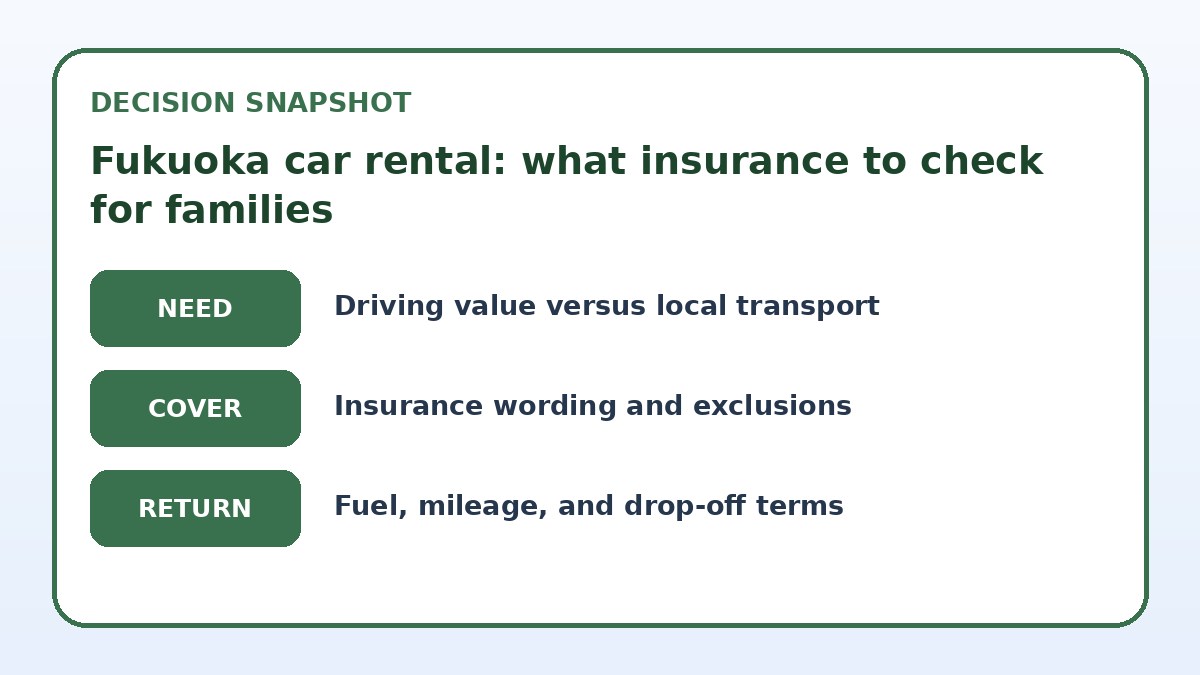
If you’re planning to rent a car in Fukuoka with children, the practical head start is this: focus on liability limits, collision damage waiver (CDW)/LDW wording, excess (deductible) amounts, and how supplemental personal accident or passenger insurance applies. Those four items determine whether a fender-bender becomes an expensive hassle or a straightforward claim. Read the rental contract lines that describe ‘third-party liability’, ‘deductible’ or ‘excess’, and what conditions void a waiver — for example driving on unpaved roads or using a different driver than named. Before you book, compare those precise phrases across options and verify exclusions and claim procedures on the rental supplier’s final booking page. If you use a credit-card or travel policy for coverage, check how the supplier’s terms interact with that policy to avoid gaps.
Know the insurance terms that change the cost of a claim
The words in the rental agreement shape financial exposure more than the product names (CDW, LDW, super CDW). Focus on the deductible or excess amount — the fixed sum you pay if damage occurs — because lowering the deductible usually costs less than buying blanket cover but gives more immediate protection. Also compare whether the waiver covers glass, tires, undercarriage, and theft; many waivers exclude these items unless you pay extra. Look for explicit language about whether damage caused by driving on gravel, crossing riverbeds, or poorly maintained roads is excluded, because family plans that include beach or rural drives often run into those clauses.
Another crucial term is ‘third-party liability’ — this covers damage or injury you cause to others. The rental contract will state limits and may defer to national minimums; those limits are the maximum the supplier’s insurances will pay. If those limits seem low, confirm whether your credit card or personal auto policy supplements liability. Finally, check how and where to report incidents: some suppliers require immediate police reports or specific repair centers, and failing to follow those steps can void coverage even if you paid for a premium waiver.
How family needs change what wording you should prioritize
Traveling with children shifts priorities: child-seat-related exclusions, authorized driver rules, and rapid claim handling matter more than roadside assistance in many cases. Verify whether child seats are listed as an included accessory or merely rentable items, and whether damage to or theft of a child seat is covered. If multiple adults will drive, check whether every occasional driver must be named and meet age requirements — a common restriction is higher minimum ages or surcharges for younger drivers that can affect insurance validity.
Consider scenarios where you might need immediate replacement or medical support — for instance, a minor collision with children aboard. Read the personal accident and medical assistance wording closely: some supplier products only give limited medical reimbursement or require you to submit extensive documentation. If peace of mind matters, prioritize policies that outline fast claim contact numbers, multilingual support, and whether the supplier handles direct payment to repairers to avoid upfront costs you must reclaim later.
| Approach | Best for | Tradeoff to check |
|---|---|---|
| Buy supplier zero-excess coverage at pickup | Families wanting minimal out-of-pocket stress and local claims handling | Higher daily cost and possible overlap with card or travel insurance |
| Keep standard CDW and rely on credit-card coverage | Cardholders with strong collision coverage who prefer lower rental rates | May require upfront payment and later reimbursement; verify card terms carefully |
| Purchase a third-party liability top-up | Families concerned about injury or damage to others beyond supplier limits | Adds cost but does not reduce your excess for vehicle damage |
| Accept high excess and add only roadside assistance | Short city trips where minor scrapes are unlikely and immediate help is valued | Greater financial exposure if a collision or theft occurs |
How to compare supplier wording with card and travel-policy coverage
Many families rely on a credit card or separate travel insurance for parts of a rental claim. First, read the rental supplier’s exclusions to ensure they don’t require you to buy their own waiver to accept external coverage. Some suppliers explicitly state that certain waivers void the card benefit or that card protection applies only if you declined the supplier’s CDW. Document what the card issuer or travel policy covers — liability, theft, collision, or loss-of-use charges — and check whether the external coverage requires you to pay the supplier and claim reimbursement afterward.
Ask the card issuer or insurer about required documentation and claim timelines: police reports, repair invoices, and a signed rental contract are common requirements. If your external cover reimburses rather than pays directly, confirm your family can handle temporarily covering costs. When comparing options online, you can use aggregator tools like Trip.com to view supplier terms, but always open the actual rental terms on the provider’s page to verify exclusions, excess amounts, and the exact steps needed to file a claim.
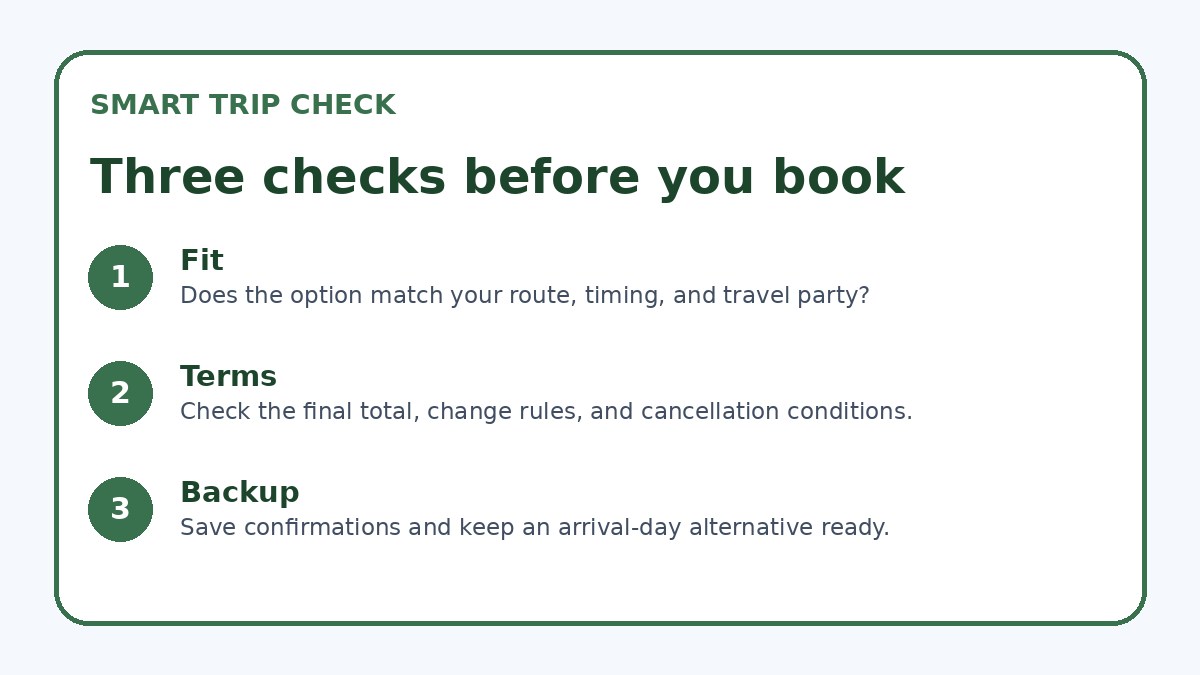
Before you book
- Read the exact wording for ‘excess’ or ‘deductible’ and note the amount you would pay after an incident.
- Verify which drivers are authorized under the policy and add any occasional drivers before pickup.
- Confirm that child seats and their theft/damage are included or separately covered by insurance wording.
- Check the supplier’s exclusions for road types, off-road driving, and prohibited uses that could void coverage.
- If using a credit card policy, get written confirmation from the issuer about coverage limits and required claim documents.
- Take photos of the vehicle at pickup and return, and save the rental contract and insurer/card policy pages as screenshots or PDFs.
Deciding what to buy at booking and what to risk later
At booking you must balance predictable costs against uncertain risks. If your family plans include short urban drives in Fukuoka proper, a moderate excess and solid third-party limits may be acceptable. For excursions to rural Kyushu roads, beaches, or narrow mountain passes, prioritize waivers that explicitly include gravel and undercarriage protection. Think about how much you can pay out of pocket immediately: a high deductible reduces daily rental cost but can become a cash burden if an accident happens far from your bank.
Also weigh the hassle factor: some families prefer to eliminate uncertainty by buying the supplier’s lowest-excess or zero-excess package to ensure claims are handled locally and swiftly. Others prefer to rely on credit-card collision coverage and a robust travel medical policy to save on daily rental costs. Whatever you choose, make a clear checklist of the exact wording that matters to you and keep screenshots or PDFs of the rental terms and any card policy language — that documentation is crucial if you need to file a claim after returning the car.
Frequently asked questions
Does a rental company’s CDW replace my credit-card collision coverage?
Not necessarily. Many credit cards offer collision coverage only if you decline the supplier’s CDW, while others allow stacking. The key is the rental supplier’s terms: some companies state that buying their CDW voids external coverage. Before you decide, read both the rental agreement and your card’s benefit guide. If the card requires you to decline supplier waivers, verify that doing so won’t create a separate liability requirement, such as naming an authorized driver or meeting age restrictions that the card’s coverage also requires.
What should families do if the rental policy lists exclusions for gravel or beach driving?
If exclusions cover the roads you plan to use, ask the supplier for a waiver that specifically includes undercarriage and gravel damage or purchase a separate policy that covers those risks. If that option isn’t offered, consider changing routes or choosing a different vehicle better suited to the terrain. Always get any exception or waiver in writing and save it with the rental contract. If you plan beach visits with children, confirm whether sand-related mechanical issues or tow fees are covered so you won’t face unexpected expenses.
How should families document an incident to protect insurance claims?
Immediately call the local emergency number and the rental supplier’s incident line, then obtain a police report if required. Photograph all damage from multiple angles, the surrounding scene, and any relevant road signs. Collect contact details from other parties and witnesses, and keep copies of repair invoices, tow receipts, and any hospital or medical reports. Submit documents within the insurer’s required timeframe and keep copies of every communication; insurers often reject claims lacking required official reports or timely notice.
Final planning note
For families renting a car in Fukuoka, the smartest decision comes from reading wording, not product names. Prioritize deductible/excess amounts, third-party liability limits, exclusions for road types and child-seat coverage, and how supplier terms interact with any credit-card or travel policy you plan to use. Balance cost against the stress of paying upfront and filing a later claim: buying down excess buys local convenience, while relying on external coverage can lower daily costs but usually requires more documentation. Before booking, open the supplier’s final rental terms and your card or insurer’s benefit guide and save screenshots. That preparation keeps your family focused on the trip, not on paperwork after an incident.
Continue planning
Check current options and final conditions
Use the provider page to confirm live availability, the final total, cancellation terms, and every condition that matters to your trip.
This evergreen planning guide was created with AI-assisted drafting and a structured quality review. It does not display live prices, schedules, availability, visa guidance, or provider rankings. Verify current details before booking. Some links are affiliate links; we may earn a commission at no additional cost to you.