
If you and your partner are booking Paris to Rome flights, the practical question is simple: how flexible do you need to be and which ticket features give you that flexibility? Start by deciding whether you value low upfront cost, the ability to change plans without heavy fees, or the reassurance of refundable fares. For couples, combining schedules and preferences raises special issues: different passengers on one reservation share the same change/cancellation rules, and add-ons like seat selection and baggage can have separate policies. Before you put down payment, check the airline’s or travel agent’s full fare rules, what constitutes a change, who pays the fee, and whether refunds are issued as money or travel credit. Below you’ll find tradeoffs, decision criteria, and a practical checklist so you can compare options and pick the right balance of cost and flexibility for your trip together.
Understand the booking-level basics
When you book Paris to Rome flights together on a single reservation, the airline treats that PNR (passenger name record) as a single legal contract. That means if you need to change dates or cancel, the change or cancellation rules apply to the entire reservation and fees or refunds are usually calculated from that booking. Couples who anticipate different needs—one partner needing a refund while the other is certain—often consider separate bookings. Splitting reservations can let each person use the fare rules that suit them, but compare total cost, seat selection, and how it affects seating together before choosing this route.
Airline fare rules specify what qualifies as a change (date, time, routing, or name correction) and whether changes are permitted at all. Some fares allow free date changes within a window; others require a fee plus any fare difference. For cancellations, read whether the fare is refundable, refundable with a penalty, or nonrefundable with a credit or voucher issued instead. Always verify whether taxes and airport fees are refunded if the base fare isn’t—those components can be handled differently by carriers and booking platforms.
Comparing direct and connecting options
For this route, you’ll usually see direct flights and connections; both have different implications for change and cancellation. Direct flights simplify change logistics because there’s one itinerary segment, and if the airline cancels the direct flight, they generally rebook you on the next available service or offer a refund. Connecting itineraries can complicate rebooking: a change on one segment may cascade, and if different carriers operate each leg under separate tickets, you might face separate policies and additional fees for each leg or risk losing protection for missed connections.
When comparing choices, look at whether the itinerary is sold on one ticket across both legs or split between carriers. A single ticket gives better protection for missed connections and unified change rules, while separate tickets may be cheaper but can leave you rebooking independently if a delay affects the first leg. Also verify how long layovers are and the carrier’s policy for schedule changes: short connections are more likely to be disrupted, so a slightly more flexible fare could be worth it for peace of mind.
| Approach | Best for | Tradeoff to check |
|---|---|---|
| Single reservation for both travelers | Couples wanting simple coordination and shared support | Both are bound by same rules; one person’s change affects both and fees apply to entire booking |
| Two separate tickets (one per traveler) | Pairs needing independent flexibility | More control for each traveler but higher combined fare and possible seating separation |
| Higher fare class or flexible ticket | Couples prioritizing stress-free changes and refunds | Higher upfront cost, though may save in change fees if plans shift |
| Basic fare + add-on change protection | Couples seeking lower base fare with optional flexibility | Adds extra fee for protection and terms may limit refund or transferability |

Fees, refunds, and how they’re issued
Different fare types and sales channels handle fees and refunds in distinct ways: an airline may refund a refundable fare to the original payment method, while a nonrefundable fare might only earn a travel credit. Third-party sellers sometimes process changes and refunds differently—some have their own service fees or voucher policies—so check whose terms govern the transaction. For couples, confirm whether refunds or credits are issued per passenger or per reservation, and whether credits can be transferred between travelers; some vouchers are nontransferable.
Also clarify timing and documentation required for refunds: how long after cancellation until money is returned, and whether you need to submit receipts or forms. If a schedule change by the carrier forces you to change plans, many airlines offer free rebooking or full refunds; however, what qualifies as a significant schedule change varies by carrier. Always save email confirmations and fare rule screenshots in case you need to escalate the request or dispute a charge.
Before you book
- Compare the fare rules line-by-line on the airline or OTA final booking page before payment.
- Decide whether to book one reservation or two separate tickets and seat together only if feasible.
- Confirm how refunds, credits, or vouchers are issued and whether they are transferable or have expiry dates.
- Verify the difference between voluntary changes and airline-initiated schedule changes and the remedies offered for each.
- Check ancillary item policies (baggage, seats, upgrades) for whether they are refundable or transferable with cancellations.
- Document and screenshot fare rules and confirmation emails; save contact details for customer service and the booking reference.
What to verify on the final booking page
Before you confirm payment, use the final booking page to verify the full fare conditions. Look for explicit language about change fees, cancellation penalties, whether refunds are allowed, and the validity period of credits or vouchers. For couples, confirm whether both passengers are covered by the same fare rules and whether ancillary purchases—baggage, seats, upgrades—are refundable or transferable. If anything is unclear, use the booking platform’s help chat or call the airline; get any exceptions or waivers documented in writing.
Don’t forget to check the small print on name corrections, passport mismatches, and how schedule changes are handled. If you’re booking via an online travel agency, the OTA’s cancellation and refund policy may add another layer; find that policy on the final page as well. If you plan to use travel insurance, make sure policy terms don’t require a refundable fare to claim certain benefits, and that the insurer accepts vouchers or credits when counting reimbursable losses.
Frequently asked questions
Should couples book one combined reservation or two separate tickets for Paris to Rome flights?
There’s no one-size-fits-all answer: a single reservation simplifies seat assignments, joint check-in, and protection for missed connections because the airline treats both travelers as one contract. That’s convenient if you want to guarantee sitting together and prefer unified customer service. Two separate tickets give each person independence to change or cancel without affecting the other, which can be valuable if one partner’s plans are more uncertain. Before splitting, compare total price, seating availability, and whether splitting causes loss of perks like hold baggage discounts or priority seating.
How do I tell if a fare is refundable or only gives travel credit?
The clearest place is the fare rules on the airline’s or OTA’s final booking page: look for the words refundable, nonrefundable, credit, voucher, or travel bank. Refundable fares explicitly state refund to the original payment method; nonrefundable fares usually offer a voucher or credit for future travel, sometimes minus a cancellation fee. If the language is ambiguous, ask customer service and request written confirmation. Also verify how long credits are valid, whether they can be used by someone else, and whether taxes and fees are refundable separately from the base fare.
What should couples check about ancillary services when considering flexibility?
Ancillary items—checked bags, seat assignments, priority boarding, and extras—often have separate rules from the base fare. Confirm whether purchased ancillaries are refundable or transferable if you cancel or change the flight; some airlines keep these fees nonrefundable. For couples, check if seats can be re-assigned together when changing dates and whether pre-paid baggage is honored on the new itinerary. If you depend on specific seats or baggage allowances, factor the potential loss of these purchases into the overall cost of changing or canceling.
Final planning note
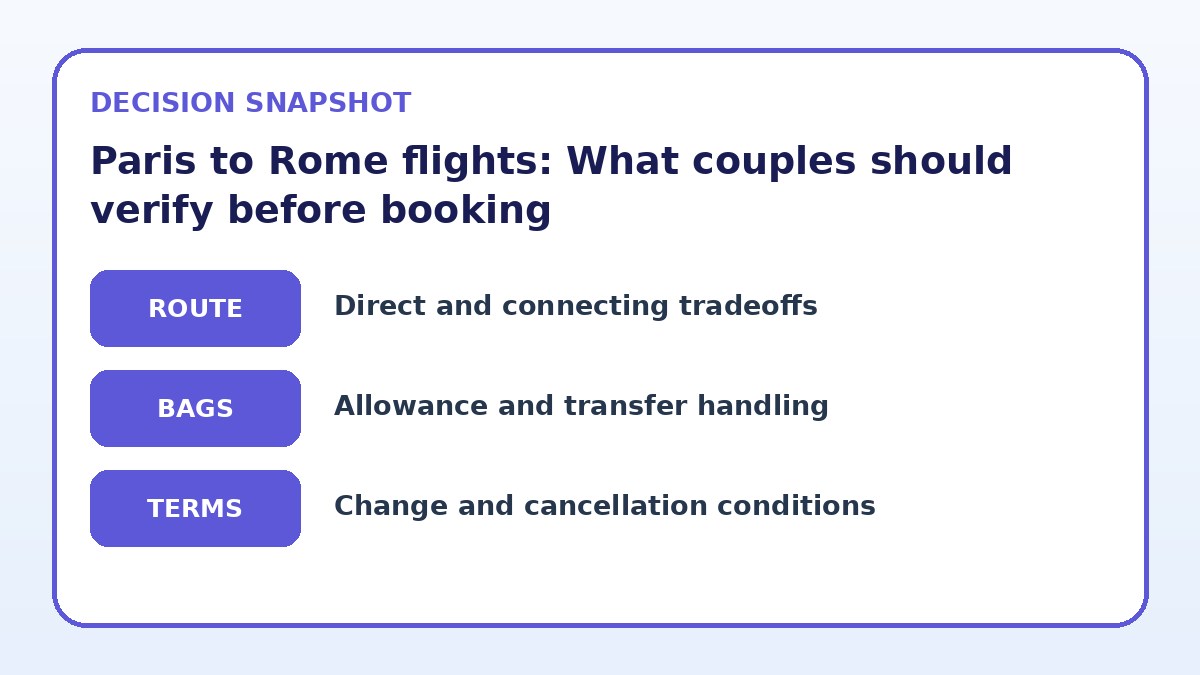
Planning Paris to Rome flights as a couple is mainly about balancing upfront cost against the level of flexibility you need. Decide together whether you want shared convenience on one reservation or individual freedom on separate tickets; each approach has real tradeoffs around fees, seating, and post-booking administration. Focus on three checks before paying: the fare’s change and cancellation language, how refunds or credits are issued, and the ancillary rules for baggage and seats. If anything is unclear on the booking page, get written confirmation from customer service. Finally, consider modestly higher flexibility if your plans might change—sometimes a bit more peace of mind is worth the extra cost.
Continue planning
Check current options and final conditions
Use the provider page to confirm live availability, the final total, cancellation terms, and every condition that matters to your trip.
This evergreen planning guide was created with AI-assisted drafting and a structured quality review. It does not display live prices, schedules, availability, visa guidance, or provider rankings. Verify current details before booking. Some links are affiliate links; we may earn a commission at no additional cost to you.