For many families arriving in Melbourne for three to five nights, the most useful decision is less about luxury and more about logistics: pick a hotel that keeps transit simple, offers family-size rooms or interconnecting options, and gives quick access to at least one kid-friendly neighbourhood. A practical base reduces wasted time, lets you rest between activities, and makes mornings less stressful when toddlers or school-age kids are involved. This guide focuses on tradeoffs you’ll face—central versus inner-suburban, apartment-style versus hotel rooms, and priorities like parking, kitchen facilities, and quiet at night—so you can match a property to the rhythm of your group. Read on to learn how to compare options, what to check on booking pages, and which neighbourhoods frequently work best for short family stays in Melbourne.
Deciding what ‘practical’ means for your family
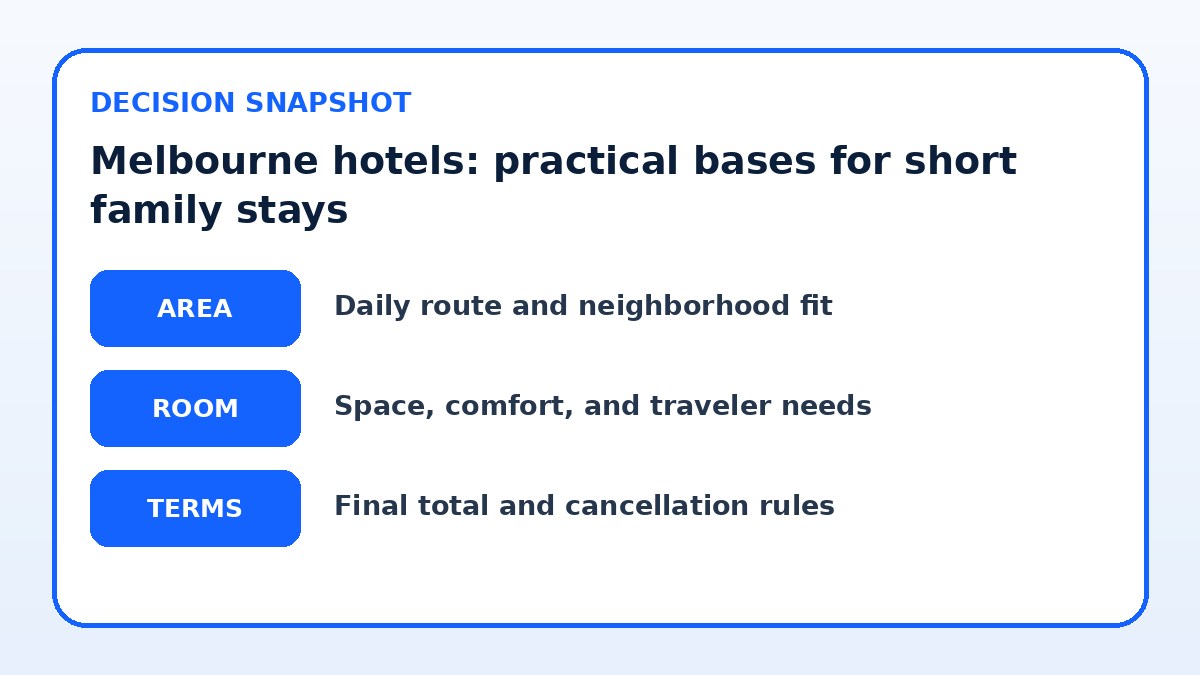
Practicality varies by family: a couple of adults with a stroller will judge convenience differently from a group with teenagers who want evening activities. Start by listing three non-negotiables—examples include a kitchenette, an extra bed or cot, and either a lift or ground-floor room. Rank them, then treat every hotel search as a filter exercise: eliminate options that lack top priorities. This keeps your shortlist manageable and shifts energy from browsing to verifying the few remaining properties against real photos and room plans.
Also think about daily rhythm: will you be sightseeing all day and returning late, or needing mid-day breaks for naps and meals? If you expect downtime during the day, look for hotels with decent in-room amenities, helpful staff for local logistics, and nearby green space. Conversely, if your days will be packed, prioritise walking distance to major sights or a tram stop to avoid repeated short trips that consume time.
Where to place your base: central city vs inner suburbs
A CBD (central business district) hotel places you within easy walking distance of museums, galleries, Federation Square, and many tram routes. It’s ideal when you want to minimise commuting for a compact stay. However, note that city hotels often trade space for location: rooms may be smaller, and streets can be busier in the evenings. For a short family stay, a compact city hotel works well if you plan mostly daytime outings and will be out for dinner rather than preparing meals in-room.
Inner suburbs such as South Yarra, St Kilda, Fitzroy, or Carlton offer a different balance: quieter residential streets, parks for play, and local cafés geared to families. These neighbourhoods typically require a short tram or rideshare into the CBD but give more breathing room and a calmer night’s sleep. For families who prefer leisurely mornings and want to spend time in neighbourhood playgrounds or markets, an inner-suburb base can make the stay feel less rushed while still keeping most attractions within 15–30 minutes by public transport.
| Approach | Best for | Tradeoff to check |
|---|---|---|
| Central CBD hotel | Families prioritising walking access to major attractions and museums | Smaller rooms and busier streets at night; fewer kitchenette options |
| Inner-suburb apartment or aparthotel | Families wanting space, a kitchen, and easy access to parks | Short commute to the CBD and possible extra travel costs |
| Hotel with family rooms/interconnecting rooms | Groups needing flexible sleeping arrangements without booking multiple properties | May cost more than a single standard room; interconnecting rooms can be limited |
| Hotel with secure parking | Families planning to drive or use a hire car frequently | Properties that include parking can be pricier or located slightly outside the most walkable zones |

Room type and amenities to prioritise
For short stays, the most helpful room features are flexible bedding arrangements, a functioning kettle or small kitchenette, and laundry options. Flexible bedding lets you avoid booking multiple rooms; pull-out sofas or interconnecting rooms are worth searching for when you have more than two adults and a child. When a kitchenette is important, confirm whether the unit includes at least a fridge and microwave—booking pages and guest photos usually show these, but verify the exact description before finalising.
Other practical amenities include onsite or nearby parking if you’ll rent a car, easy elevator access if you have a stroller, and free or child-friendly breakfast options that simplify mornings. Family programs or kid-friendly toiletries are bonuses but not essential; instead, focus on what saves time daily: a laundry facility if you’re travelling light, secure storage for daypacks, and clear cancellation or late-arrival policies you can accept without stress. Always read the policy notes on the hotel’s booking page for these specifics.
Before you book
- Check the room layout photos for bed configuration and ask the hotel to confirm interconnecting rooms or cot availability in writing.
- Verify parking details—onsite vs nearby, reservation required, and any height or size restrictions—on the hotel’s booking page.
- Confirm whether the listed kitchenette includes a fridge, microwave, and cookware if you rely on self-catering.
- Map travel time from the hotel to your two top attractions during morning and evening hours using a transport app.
- Ask the hotel about elevator access, stroller storage, and whether rooms are on ground level for easier access.
- Note the hotel’s cancellation and late-arrival policies and save confirmation and messaging screenshots before travel.
Booking checks and tradeoffs to confirm
Before you click confirm, verify a handful of provider-specific facts on the hotel’s official booking page: room layout (not just star rating), bed types, whether interconnecting rooms are guaranteed or subject to availability, parking terms, and any extra fees for cots or rollaway beds. Hotels sometimes list amenities in bullet points that don’t reflect the single-room layout; look for floorplans or guest photos and, where unclear, message the property directly. If you find conflicting info across sites, trust the property’s official description but keep screenshots and reservation numbers.
Decide which tradeoffs you accept: smaller room but prime location, or larger room with a short commute. If transport is a concern, map travel times from the property to your top two attractions at likely travel times (morning and evening) to spot hidden delays. Use public-transport apps to compare tram and train options and consider how much walking children will manage. Trip.com can be helpful to compare current availability alongside other booking platforms, but always verify final terms with the hotel itself.
Frequently asked questions
Is it better to stay in central Melbourne with kids or choose an inner-suburb?
There’s no single right answer; it depends on your family’s priorities. Staying in the CBD minimises walking distances to museums, the aquarium, and many trams—handy if you have only a couple of days and want to reduce transfers. An inner-suburb base gives you more space, quieter nights, and local parks where kids can run off energy between activities. For short stays, consider how much walking children will tolerate each day: if you expect many attraction visits, a central location reduces transit overhead; if you want relaxed mornings and neighbourhood time, choose a nearby suburb and accept short tram rides.
What room features in Melbourne hotels make short family stays easier?
Look for flexible bedding (sofas or rollaways), a small kitchenette or at least a fridge and microwave, and laundry access for quick clothing refreshes. Ground-floor rooms or reliable elevator access are helpful with strollers. Also prioritise hotels that clearly state cot or extra-bed policies and whether those options are guaranteed in advance. Finally, check for simple family conveniences like early breakfasts, baby supplies on request, or secure luggage storage for late departures—confirm these on the hotel’s official booking page.
How should I compare hotel locations against Melbourne’s attractions and transport?
Start by listing the two or three attractions you’ll visit most, then map each candidate hotel against those points and nearest tram or train stops. Compare actual travel times at the hours you’ll be travelling rather than relying on straight-line distances—peak trams and walking routes with children can change expectations. If driving, check parking and likely routes to attractions; if using public transport, make sure the hotel is within a short walk of a frequent tram or train. Use the hotel’s booking page for final address details and cross-check with local transport maps.
Final planning note
Choosing a practical base in Melbourne for a short family stay comes down to matching daily rhythms to a property’s strengths. If you plan many downtown visits and want to cut commuting time, a central hotel makes sense despite smaller rooms. If you prefer restful evenings, nearby parks, and space to spread out, an inner-suburb aparthotel or family room is often the better pick. Prioritise the few features that will save time—bed configuration, kitchenette or breakfast options, parking, and verified elevator access—and check those specifics on the hotel’s booking page before you confirm. Use comparison sites like Trip.com as a starting point for availability, but always verify layout, policies, and fees directly with the property to avoid surprises.
Continue planning
Check current options and final conditions
Use the provider page to confirm live availability, the final total, cancellation terms, and every condition that matters to your trip.
This evergreen planning guide was created with AI-assisted drafting and a structured quality review. It does not display live prices, schedules, availability, visa guidance, or provider rankings. Verify current details before booking. Some links are affiliate links; we may earn a commission at no additional cost to you.