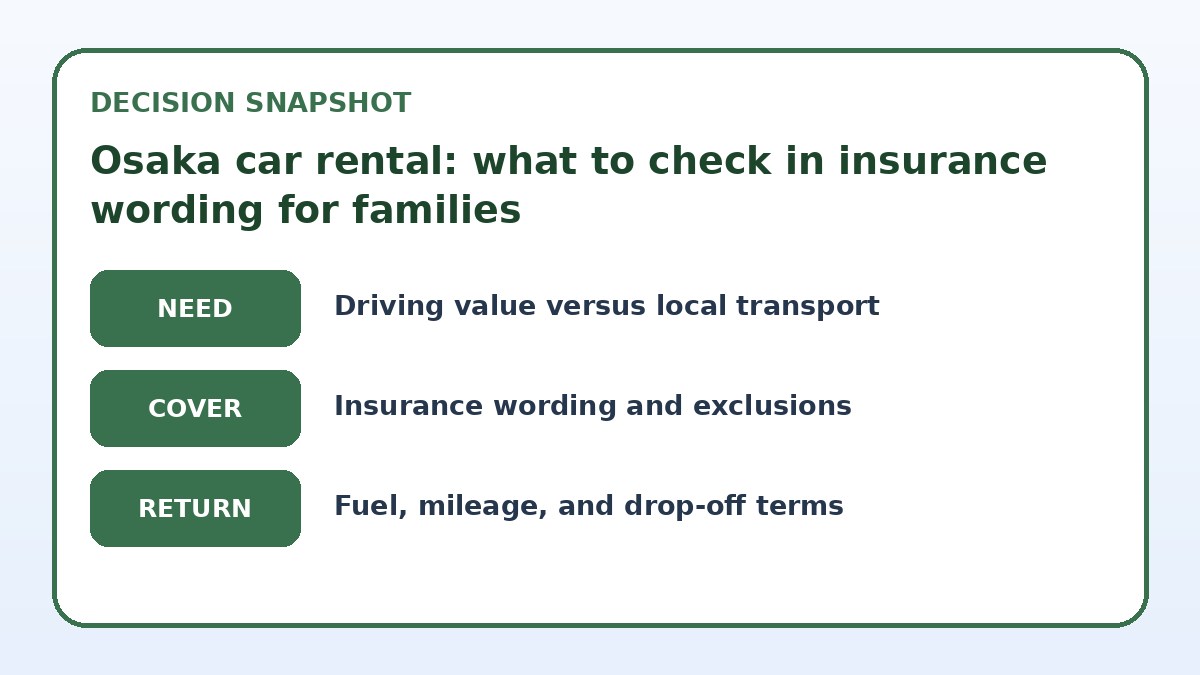
Short answer: read the policy definitions, driver eligibility, liability limits, and exclusions before booking an Osaka car rental for a family. These four elements determine whether an accident, theft or medical claim will be covered and who must be listed on the contract. Japanese rentals often have compulsory basic cover plus optional collision and theft waivers; however, the wording — not the names of options — shows key differences: whether “loss damage waiver” removes excess, whether third-party liability meets legal needs, and whether family members or occasional drivers are eligible. For families, pay special attention to passenger injury cover, child-seat damage, motorway or toll restrictions, and cross-prefecture use. This article explains the important clauses, trade-offs between cheaper policies with narrow wording versus more expensive, broader cover, and precise checks to make on the rental provider’s booking page and insurance documents.
Decode the core policy words families must know
Insurance paperwork uses specific terms that change how a claim plays out. ‘Collision Damage Waiver’ (CDW) or ‘Loss Damage Waiver’ (LDW) usually reduces or removes the renter’s financial responsibility for vehicle damage, but the wording will say whether it removes the deductible (excess) entirely or only partially. ‘Third-party liability’ covers damage to other people or property; check whether it is stated as a minimum legal level or a higher contractual limit. ‘Personal accident insurance’ typically addresses passenger medical costs — crucial for families — but the scope, per-person caps and age limits will be in the definitions.
Also watch for definitions of ‘driver’ and ‘authorized driver’. Some agreements automatically include spouses or family members, while others require each driver to be listed and pay an additional fee. If grandparents, older teens, or non-Japanese family members will drive, confirm age and license restrictions. Finally, note how ‘accident’ and ‘damage’ are defined: does the policy cover damage from weather, sliding on wet roads, or vandalism in a parking lot? Those details determine whether a real-world event will be accepted as a covered claim.
Practical trade-offs: cheaper cover vs broader wording
A lower-cost rental with the basic named protections can look attractive, but families should weigh the trade-off between headline price and restricted wording. Basic policies often carry a higher excess and more exclusions — for example excluding damage while driving off paved roads or on certain expressway sections. This means you might pay less upfront but face a substantial bill after an incident. Conversely, pricier bundled options commonly reduce or eliminate the excess and add passenger injury cover and roadside assistance. The difference in wording about ‘excess waiver’ is where the practical value lies, not in the label.
Decide based on your itinerary and driver mix. If you plan only short city trips in central Osaka with experienced, narrowly defined drivers, a basic policy with a moderate excess might be acceptable. If you’ll make longer drives, cross-prefecture day trips, or let several family members drive (including occasional drivers), prioritize wording that explicitly names multiple drivers, removes excess for typical claims, and covers passenger injuries. That broader wording reduces post-accident dispute risk and the administrative hassle families want to avoid while traveling.
| Approach | Best for | Tradeoff to check |
|---|---|---|
| Minimum legal cover with high excess | Budget-conscious short city rentals with a single experienced driver | Lower upfront cost but higher financial risk and likely exclusions for family scenarios |
| Standard rental insurance with moderate excess | Small families wanting balanced price and protection for typical day trips | Good baseline cover but may exclude multiple or occasional drivers and some passenger claims |
| Full excess waiver and passenger cover | Families planning long drives, multiple drivers, or with young children | Higher rental cost but reduces dispute risk and out-of-pocket expenses after incidents |
| Third-party top-up with medical protection | Families concerned mostly about liability and passenger injury rather than vehicle damage | Protects people and others, but you may still bear vehicle repair costs unless waived |
What to verify on the booking page and rental contract
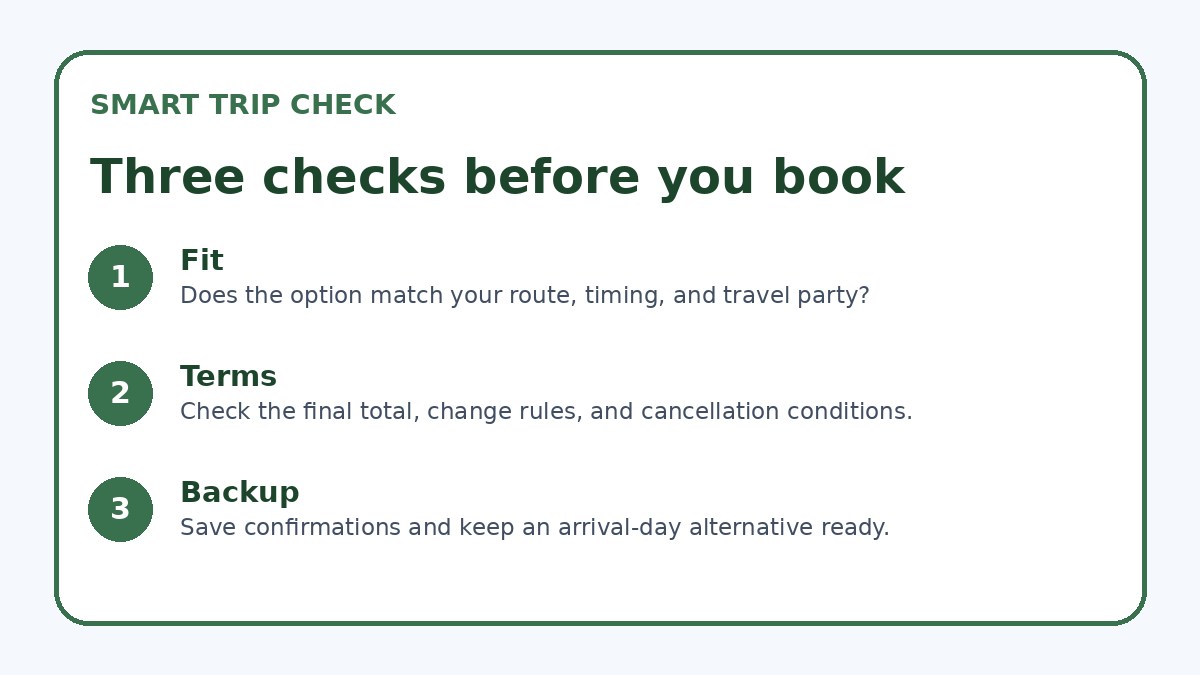
When booking, don’t rely on checkbox names alone. On the provider’s final booking page and the rental agreement you will sign, look for the exact phrases: ‘excess’, ‘excess waiver’, ‘collision damage’, ‘loss of use’, ‘third-party liability limit’, and ‘personal accident insurance’. If the page mentions a waiver, confirm whether it removes the excess entirely or only reduces it. If roadside assistance is included, verify what response time and services are promised, whether towing or replacement vehicle costs are covered, and how claims are initiated if you don’t speak Japanese.
Also confirm driver eligibility rules, listed under ‘authorized drivers’ or similar. Note minimum and maximum ages, license-country requirements, and whether additional drivers must be registered in advance. Check geographic limits — some policies prohibit taking vehicles to remote islands or across prefecture borders without explicit permission. Finally, before signing, screenshot or save the booking confirmation and the full terms PDF so you have the exact wording to refer to in a claim.
Before you book
- Save and read the full rental terms PDF; note the exact wording for ‘excess’, ‘waiver’, and ‘authorized driver’ before confirming.
- Confirm whether each family driver must be listed and meet age/license requirements; add them to the booking if required.
- Screenshot the booking page and insurance wording shown at purchase, including coverage limits and exclusions, for claims evidence.
- Ask the provider how to report an incident in English and whether roadside assistance contact numbers are reachable from your mobile.
- Check accessory and child-seat clauses: who pays for damage or replacement and whether cleaning fees are chargeable.
- Verify geographic and road-use restrictions (islands, unpaved roads, toll lanes) and don’t assume nationwide coverage without confirmation.
Family-specific clauses and practical scenarios to test
Think through likely family scenarios and match them to policy wording. For example: if a toddler causes a spill that stains a rented child seat, does the insurance or rental provider’s accessory policy cover cleaning or replacement? If an older child borrows a parent’s driving privileges to run an errand, will the occasional-driver wording void cover if that driver isn’t registered? Policies often exclude damage caused by improperly installed child seats or leave accessory damage as renter responsibility, so check the accessory clauses and whether there is a separate fee for children’s equipment.
Run through accident scenarios too: if the car is hit while parked, does the policy require filing a police report in a specified format or within a given timeframe? Many Japanese insurers require immediate notification plus a police record for third-party claims. Also confirm if the insurer covers medical treatment for non-national family members and how reimbursements are handled if you pay locally and claim later. These practical tests help you choose wording that prevents common claim denials and keeps your family trip on track.
Frequently asked questions
Does a collision damage waiver (CDW) remove all financial responsibility for families?
Not always. A CDW or LDW often reduces financial responsibility, but the policy wording decides whether it removes the excess fully or only partially. Many agreements still leave an excess for certain types of damage (windshield, tires, undercarriage) or incidents occurring during excluded activities, like driving off-road. Families should check if child-seat damage, accessory loss, and towing or replacement-car costs are included. If the waiver doesn’t remove the excess, consider topping up or buying a full excess waiver with clear wording that lists covered claim types.
Will a child or spouse driving casually be covered automatically on an Osaka rental?
It depends on the contract’s definition of ‘authorized driver’. Some rentals include immediate family members automatically, while others require every driver to be registered and may charge an additional fee. Age restrictions and license-country requirements also matter: teenagers, learners, or drivers with non-standard licenses may be excluded. Always confirm on the booking page whether occasional drivers need to be added in advance; if the wording requires registration, failing to do so can void cover after an incident, leaving the family financially liable.
How should families handle an incident in Osaka to protect a future claim?
Follow the procedure the rental policy specifies: secure safety, exchange details with other parties, and file a police report if required. Many insurers in Japan require an official police record for third-party or theft claims, so get a copy and the incident number. Photograph damage and the scene, collect witness names, and contact the rental company and roadside assistance immediately using the numbers provided. Keep receipts for any emergency payments (medical care, towing) and save all documentation; delay or missing paperwork is a common reason claims are denied.
Final planning note
For families renting a car in Osaka, the decisive factor is the insurance wording, not marketing labels or a lower headline rate. Read definitions for excess, authorized drivers, passenger injury, and exclusions, and map those clauses to your family’s likely scenarios. Choose broader wording if you’ll have multiple drivers, long day trips, or young children; accept a smaller package if driving is short and tightly controlled by one experienced driver. Before you finalize a booking, verify exact terms on the provider’s final page, screen-capture the document, and confirm emergency procedures and language support. That careful diligence prevents surprise bills and keeps your family trip running smoothly.
Continue planning
Check current options and final conditions
Use the provider page to confirm live availability, the final total, cancellation terms, and every condition that matters to your trip.
This evergreen planning guide was created with AI-assisted drafting and a structured quality review. It does not display live prices, schedules, availability, visa guidance, or provider rankings. Verify current details before booking. Some links are affiliate links; we may earn a commission at no additional cost to you.