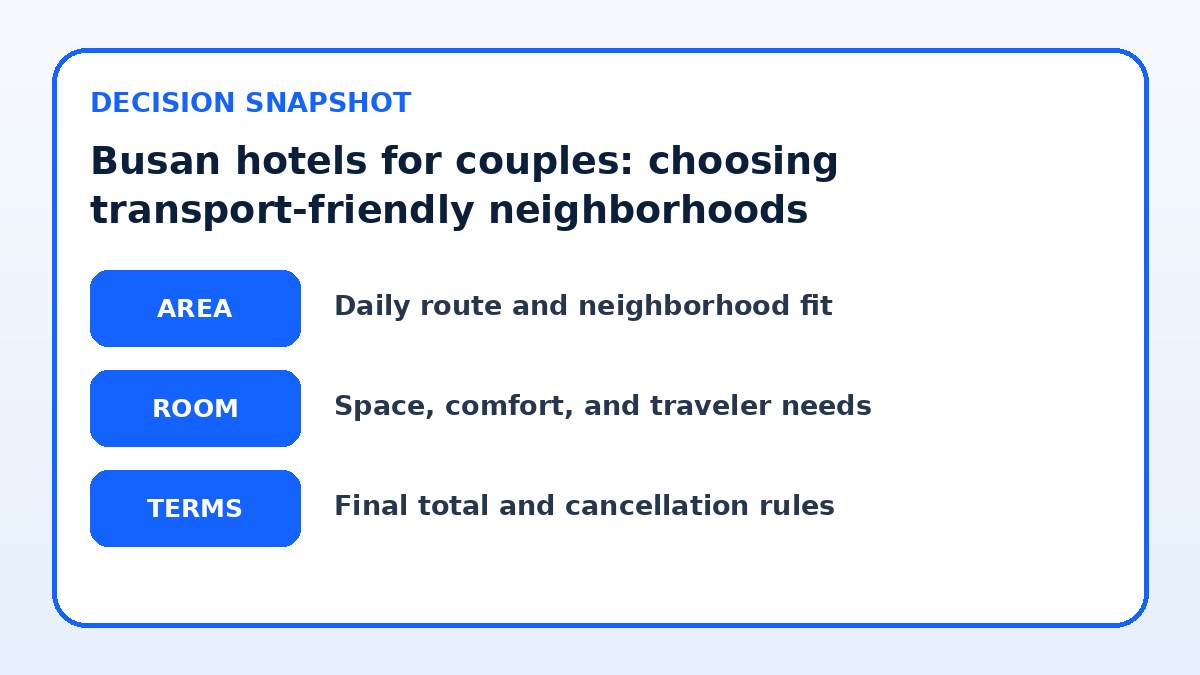
Choose your neighborhood first, then the hotel — that’s the quickest way for couples to reduce daily friction in Busan. For evenings when you want a relaxed stroll, mornings when you’ll commute to sights, or a single luggage drop after arriving, the area you pick affects nearly every hour of your trip. Think about the transport modes you’ll actually use: metro lines for long hops, local buses for coastal sightseeing, or easy access to ferries if you plan a day trip to islands. This guide gives a practical shortlisting method: match neighborhood character to your couple-style (romantic evenings, active sightseeing, beach time, or quiet nights), estimate typical route friction, decide room and party needs, then check final booking terms before confirming. Follow the sections to leave the browsing of live inventory until after you’ve narrowed down a few areas that fit your rhythms and priorities.

Check live stays in the areas that fit
Use your dates and party size to compare current rooms after you narrow the neighborhood fit.
Neighborhood fit: match your couple style to an area
Start by defining what a perfect day looks like for the two of you. If your ideal includes sunrise or sunset beach walks and casual seafood dinners, prioritize Haeundae or Gwangalli-style coastal neighborhoods where walking routes and seaside cafes are central. If you imagine museum mornings and city-market afternoons, a more central, transit-rich neighborhood near Seomyeon or Nampo-dong will shorten connections. Couples who want quiet nights with occasional metro access should pick residential neighborhoods that still sit near a station rather than being inside the busiest tourist strip.
Think about pace, too. Busy nightlife can be energizing for some couples but disruptive for light sleepers; choose a hotel on a quieter side street if noise is a concern. Also consider whether you prefer staying close to nightlife to avoid late-night rides, or slightly farther out to enjoy more space and lower foot traffic. Use simple criteria — walkability, proximity to a metro line, seaside access, and neighborhood vibe — to reduce your shortlist to two or three areas before you search inventory.
Choose an area-selection strategy
| Area approach | Best for | Tradeoff to check |
|---|---|---|
| Prioritize a hotel next to a major metro station | Couples focused on efficient sightseeing with many long hops across the city. | May be noisier and offer smaller rooms; last-mile walkability to restaurants can still vary. |
| Choose a coastal neighborhood near the beach | Couples who want relaxed seaside walks, sunset views, and beachside dining near the hotel. | Transit to inland attractions can take longer and may require transfers or buses. |
| Pick a quieter residential area with good taxi access | Couples who value sleep, space, and local life while accepting slightly longer transit times. | You lose immediate access to nightlife and some tourist services clustered near central stations. |
| Stay in a central tourist hub (markets and nightlife) | Couples who want to step out to restaurants and evening entertainment without long rides. | Can be crowded and less peaceful at night; hotels may be smaller and more expensive for the space. |
Daily-route friction: map two typical days and test connections
Before you open booking sites, sketch two representative days of your trip: one heavy on sightseeing, another with a relaxed or romantic focus. For each day, list the morning and evening endpoints and the major mid-day stops. Then check how many transfers each route needs from candidate neighborhoods and whether those transfers involve stairs, long walks, or night closures. Fewer transfers and shorter last-mile walks mean less friction; for couples carrying shopping or a small backpack, that reduction is valuable.
Also factor in taxi ease and frequency — especially late at night. Some neighborhoods may show similar metro times to your target attractions, but if the walk from the station to the hotel is steep, poorly signed, or dimly lit, the convenience drops. Compare station exits and the presence of elevators or escalators for luggage or tired feet. Keep one neighborhood as a ‘relaxed’ option if you want buffer time between activities instead of squeezing everything into tight transit windows.
Now compare like with like
Keep the same dates, guests, room needs, and cancellation preferences while you compare the final choices.
Room and party needs: choose layout and amenities that matter
Decide the practical room features that will shape your stay: bed configuration, a quiet-facing room, a small kitchenette, or a bathtub for long soaks after walking all day. Couples traveling for anniversaries or longer stays might want a larger room or suite with space to linger, while short-stay couples may prefer compact rooms in a prime location. Make a quick list of must-haves and nice-to-haves so you can eliminate options that don’t match needs before comparing prices.
Remember that the neighborhood influences what you can expect in-room: central areas often prioritize location over space, while residential neighborhoods sometimes offer larger rooms or family-style rentals. If accessibility matters, verify elevator access and any mobility features at the property level. When you find a promising listing, check the provider’s details for bed types, room window orientation, and noise policies — and confirm those specifics on the booking page rather than assuming they’re standard.

Hotel booking check before payment
- List your top three transport modes (metro line numbers, bus routes, or ferry terminals) and prioritize neighborhoods that best serve at least two of them.
- Map two typical days with start and end points and count transfers from each candidate neighborhood to estimate daily route friction.
- For each shortlisted hotel, check walking routes from the station using map and street view, paying attention to stairs, lighting, and signage.
- Confirm room specifics (bed type, quiet-facing room, bathtub) and accessibility features directly on the hotel booking page before committing.
- Verify front desk hours, late-check-in policy, and luggage hold options with the property to avoid inconvenient arrival times.
- Compare cancellation terms and any extra fees listed on the provider’s final booking page, and save screenshots of the confirmed policy.
Final booking terms: what to verify before you confirm
Before finalizing a reservation, verify cancellation policy, deposit requirements, and whether the property charges additional local fees or requires ID at check-in. For transport convenience, confirm how late the front desk is staffed if you expect a late arrival and whether the property can hold luggage for early arrivals or late departures. These operational details affect travel flexibility and should be compared across shortlisted hotels.
When the property description mentions proximity to a station or ferry, check the exact walking route using a map and street view where possible; marketing language can understate uphill walks or missing sidewalks. If a ferry or special transport is part of your plan, verify timetables and boarding procedures on the operator’s page before assuming connections. Trip.com can be used to compare current availability, but always confirm final conditions and any special requests directly on the provider’s booking page.
Hotel Guide questions travelers ask
Is it better for couples to stay by the beach or near a metro station in Busan?
It depends on your priorities. Staying by the beach (for example, neighborhoods known for coastline access) supports restful mornings and romantic strolls, plus easy dinner options along the waterfront. Staying near a metro station shortens travel time to attractions across Busan and is ideal when you have a packed sightseeing agenda. Balance the decision by mapping your planned activities: if most are coastal, prioritize beachside; if you’ll crisscross the city, pick a spot with strong metro links.
How much does last-mile walkability matter when picking a hotel?
Last-mile walkability matters a lot for couples because evenings and late returns magnify small inconveniences. A hotel listed as near a station can still involve a steep, poorly lit or luggage-unfriendly walk. Check the distance in minutes on foot, inspect the route in street view, and note whether the station exit has elevators. If you plan to dine out frequently or return late, prioritize a location where the walk from station to hotel feels safe and easy after long days.
What booking terms should couples never skip verifying?
Always verify cancellation and modification policies, check-in/check-out times, front desk staffing for late arrivals, and whether the hotel charges extra fees (resort fees, city taxes) at check-in. Also confirm bed type and room orientation to avoid surprises for celebrations or anniversaries. When transport is central to your plan, verify any claims about proximity to stations and whether room requests like quiet-facing windows are confirmed on the booking page rather than assumed.
Final decision note
Choosing a hotel in Busan as a couple is a neighborhood decision as much as a property one. Start by aligning neighborhood character with your couple-style: seaside relaxation, efficient transport for sightseeing, peaceful residential comfort, or lively central nights. Next, map two representative days and test how many transfers, walks, or taxis each option requires. Match room layout and amenities to your comfort needs, and verify operational terms on the provider’s booking page before you confirm. With a short, focused shortlist of areas and a clear checklist, you’ll be ready to open live inventory and pick the hotel that supports your daily rhythm rather than complicates it.
Continue planning
Check current options and final conditions
Use the provider page to confirm live availability, the final total, cancellation terms, and every condition that matters to your trip.
This evergreen planning guide was created with AI-assisted drafting and a structured quality review. It does not display live prices, schedules, availability, visa guidance, or provider rankings. Verify current details before booking. Some links are affiliate links; we may earn a commission at no additional cost to you.