Practical answer first: if you’re a solo traveler prioritizing comfort on a Paris to Rome journey, choose a single-airline itinerary with a mid-length connection (90–180 minutes) at a major hub and buy a fare that includes checked baggage and confirmed seat selection. That minimizes baggage risk, gives you lounge or controlled waiting options, and reduces stress if your schedule shifts. Now the tradeoffs: shorter connections save time but increase missed-connection risk and race-through security; long overnight connections can be cheap but add fatigue and a logistics headache; multi-carrier itineraries may lower cost but raise baggage and recheck complexity. This guide walks through routing choices, baggage and connection risk, schedule fit and fare terms so you can prepare exact travel dates, passport details, and any airline club status before checking live options on airline sites or comparison tools like Trip.com.
See live routes for your exact travel day
Compare direct and connecting choices with the same baggage and traveler details.
Routing: direct vs single-connection vs multi-stop
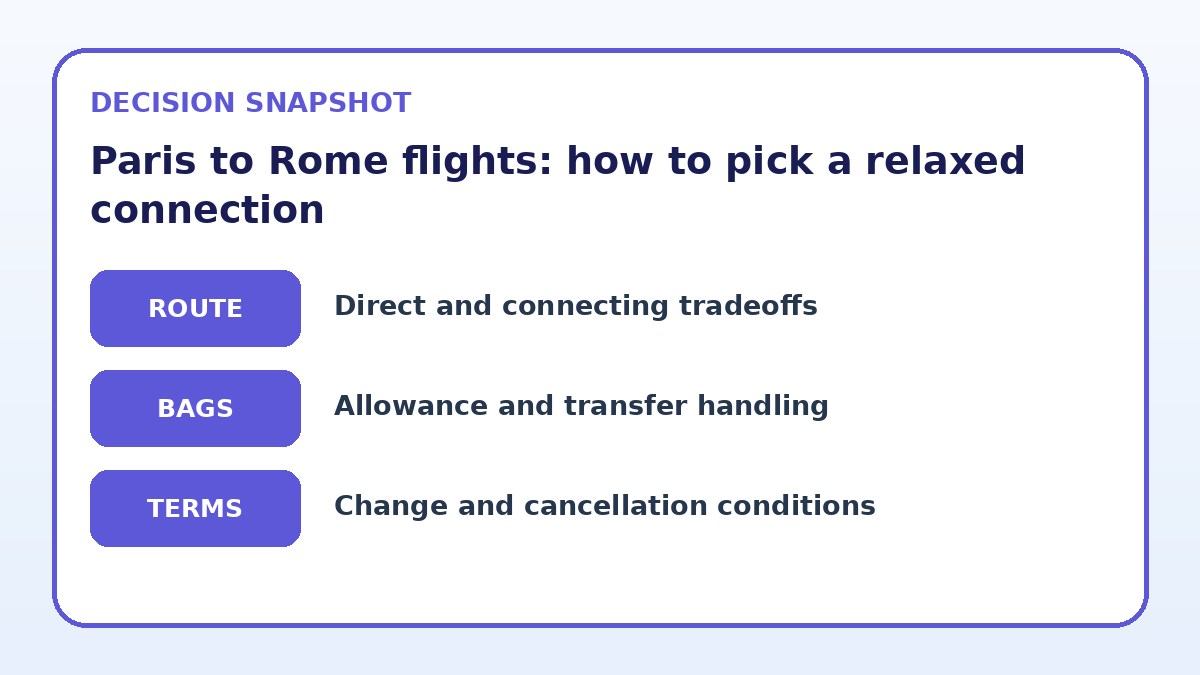
Direct flights between Paris and Rome (when available) are the simplest option: one boarding, one security check, and minimal baggage handling. If direct schedules fit your day and you can secure seat selection, that usually offers the smoothest door-to-door experience for a solo traveler who values simplicity. However, when direct options are limited, a single-connection itinerary via a major hub can balance comfort and price — especially if the connecting airport has decent passenger facilities and predictable transfer processes.
Multi-stop routings that require deplaning and re-checking luggage at a second airport or long overnight layovers increase complexity and stress. These can work if you intentionally want a stopover to break the journey or save money, but they require precise planning: verify whether each segment is on the same ticket, whether baggage is interlined, and how re-entry into a terminal or city might affect timing. Always compare total door-to-door time, not just flight hours, when evaluating these options.
Baggage and connection risk: what to protect against
For solo travelers, lost or delayed baggage is more disruptive than for groups because there’s no companion to share clothing or tech. To reduce risk, book itineraries where checked baggage is tagged through to your final destination. That typically requires a single ticket and carrier or partners within the same alliance. If you pick separate tickets, be prepared to collect and re-check bags, and add cushion time between flights accordingly. Carry essential items—chargers, medication, a change of clothes—in your carry-on.
Connection risk increases with shorter layovers and when transferring between terminals or separate airports. Map the transfer: know whether transfers require exiting security, taking a shuttle, or re-clearing checks. Invest in a slightly longer connection if it buys you a rested wait in a lounge or a comfortable gate area. If you have minimal luggage and are confident about airport layouts, shorter connections might be fine; otherwise err on the side of extra time.
Compare flight-selection strategies
| Flight strategy | Best for | Risk to check |
|---|---|---|
| Single-carrier direct or single-connection booking | Travelers who want lowest connection risk and easier rebooking | Often costs more upfront but simplifies baggage and irregular-operation handling |
| Mixed carriers on one ticket (partner airlines) | Budget-conscious travelers wanting more routing options with some protection | Saves money and offers flexibility but requires checking alliance and interline rules |
| Separate tickets for each leg | Those prioritizing lowest fare and willing to manage transfers independently | Cheapest-per-segment potential but highest baggage and missed-connection risk |
| Long overnight connection as a planned stopover | Travelers combining rest or city time with travel savings | Can reduce ticket cost but adds fatigue and logistical work arranging accommodation |
Recheck the complete itinerary
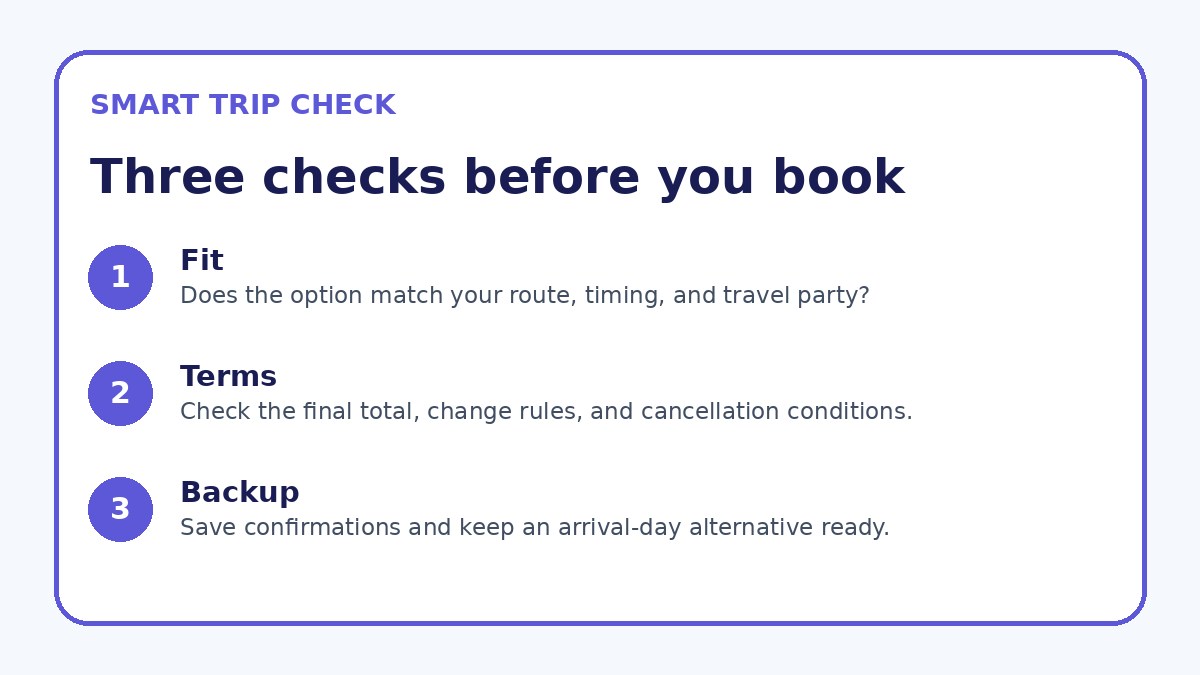
Confirm airports, connection handling, baggage, and change conditions before deciding.
Schedule fit: timing your travel day as a solo traveler
Think beyond flight departure time. Consider when you want to arrive in Rome and whether you want to travel through the night or during daylight. Early-morning departures from Paris can be efficient if you want to arrive in Rome with a full first afternoon, but they require earlier transport to the airport and potentially an early wake-up. Late departures may feel more relaxed for packing but can mean arriving at your destination late, increasing taxi or public-transport complexity upon arrival.
Layover timing also affects fatigue. A 2–3 hour daytime connection at a comfortable airport can be a buffer that reduces stress, lets you eat, and gives time to replаn if delays occur. Overnight layovers require planning for an airport hotel or safe overnight area; if you choose an overnight connection for cost reasons, check terminal hours and nearby accommodation options before you commit. Solo travelers should prioritize predictable schedules that align with personal energy levels and local transport availability at arrival.
Flight details to verify
- Collect exact travel dates, passport name, and traveler age before searching fares to ensure matching booking data.
- Decide how much you value a through-checked bag and filter search results to show fares that include baggage or add the fee to compare real totals.
- Set a minimum connection time you’re comfortable with (suggest 90–180 minutes) and exclude itineraries below that threshold unless direct transfer is confirmed.
- Check the fare rules on the carrier’s final booking page for change fees, refundability, seat assignment policies, and irregular-operation handling.
- Map transfer logistics at the connecting airport: terminal changes, shuttle requirements, security re-entry, and whether lounge access is feasible.
- Pack essentials in your carry-on (chargers, medication, a change of clothes) and bring printed or offline copies of ticket and itinerary details.
Fare conditions: how to read what you’re buying
Fare rules determine your real flexibility. Look for whether the ticket allows free changes, refunds, or only vouchers; whether seat selection is included; and what the baggage allowance is. A slightly higher fare that includes a checked bag and seat assignment can save stress and add a known cost ceiling. When comparing options, open the detailed fare conditions on the airline’s page and note change and cancellation fees, any reissue deadlines, and rules for name or date corrections.
Confirm what happens after irregular operations. Some airlines automatically rebook on the next available flight for same-ticket passengers, while separate-ticket itineraries may leave you stranded. Check whether the fare is sold as a single-connection contract and whether the carrier provides minimum connection times. When provider-specific facts matter, verify them on the airline’s final booking page; if you rely on a third-party search, use it only to find options then confirm conditions with the carrier.
Flight Guide questions travelers ask
Should I always pick the shortest total travel time between Paris and Rome?
Not necessarily. Shortest travel time can mean tight connections that increase the risk of missed flights if delays occur. For solo travelers who value comfort and predictability, a slightly longer itinerary with a reasonable layover (about 90–180 minutes) can reduce stress, allow time for food and bathroom breaks, and make rebooking simpler if a delay happens. Evaluate the total door-to-door time including transfers to and from airports, and balance that against how comfortable you are with very short connection windows.
How can I tell whether my baggage will be checked through to Rome on a connecting itinerary?
The clearest indicator is that both flight segments are on the same ticket and operated by the same carrier or named partner airlines; the booking confirmation and baggage tag should show the final destination. If you’re booking separate tickets, expect to collect and re-check baggage unless the airline explicitly offers interline baggage for separately booked legs. Always verify baggage routing on the carrier’s final booking page and ask the airline agent at check-in to confirm where your bag is tagged and whether you must collect it during the connection.
What should I check in fare rules when I want flexibility for a solo trip?
Look specifically for change fee amounts and conditions, whether the fare is refundable, what penalties apply for date or name changes, and whether seat selection and baggage are included. Also check timelines for when changes are permitted without penalty and whether an airline will rebook you on a new flight at no extra cost during irregular operations. Since policies vary, open the detailed fare conditions on the airline’s booking page or contact customer service to confirm how they handle missed connections and re-accommodation.
Final decision note
For solo travelers between Paris and Rome, the most comfortable long-haul connection combines predictable routing, reasonable layover time, and fare conditions that match your flexibility needs. Prioritize single-ticket itineraries with through-checked baggage and a comfortable connection window — roughly 90–180 minutes — unless a direct flight fits your schedule. Always prepare exact traveler details before searching, read the carrier’s final fare rules, and map the connection logistics at the transfer airport. Use comparison tools to find options but confirm critical facts like baggage routing, seat assignment, and change policies on the airline’s booking page. Thoughtful preparation will turn a connection into an intentional, low-stress part of your journey.
Continue planning
Check current options and final conditions
Use the provider page to confirm live availability, the final total, cancellation terms, and every condition that matters to your trip.
This evergreen planning guide was created with AI-assisted drafting and a structured quality review. It does not display live prices, schedules, availability, visa guidance, or provider rankings. Verify current details before booking. Some links are affiliate links; we may earn a commission at no additional cost to you.