If your flight into Tokyo touches down late and you’re traveling with extra or oversized luggage, your first hour after landing will feel like a series of small decisions: get through immigration and baggage claim, choose a transfer that can handle your bags and party size, find a clear meeting point, and confirm how your accommodation will accept a late-night drop-off. The simplest immediate answer is to prioritize a transfer option that explicitly fits your luggage and arrival time — arrange a vehicle that can carry both people and suitcases, confirm a meeting spot at the terminal, and have at least one backup (train, hotel shuttle, or paid luggage service) if your flight is delayed or the first option can’t wait. Below are the practical tradeoffs for each approach and the checks to make while you still have your flight and hotel details open.
Check options for your arrival details
Use your flight, luggage, party size, and accommodation address to compare current choices.
Plan for luggage and party size
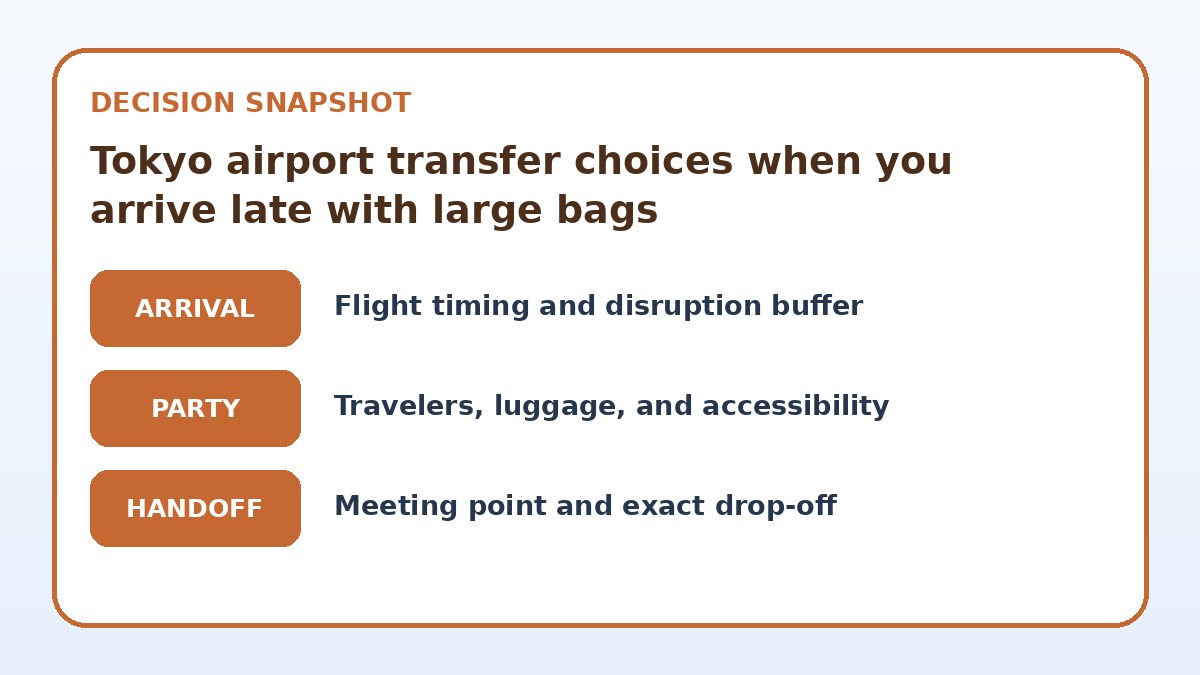
Count bags by size and consider awkward items (skis, strollers, oversized suitcases). One standard taxi often fits two standard suitcases and passengers, but larger groups or many bags need a van, multiple vehicles, or a commercial airport transfer. When booking any private vehicle, state the number and approximate size of bags and the number of passengers. Request confirmation that the chosen vehicle type will be supplied, and ask the provider whether additional luggage fees or multiple trips might apply.
Think about how luggage affects timing and meeting points. Large or heavy bags slow down boarding and curbside movement; you may want a driver who will meet you at the curb or an assisted meet-and-greet service that helps with loading. If using public transport late at night, check whether stations on your route have elevators and consider your ability to move suitcases through crowded platforms. Where available, luggage forwarding or temporary airport storage can simplify late-night transfers but require an extra step and time to retrieve bags.
Arrival details to have ready
- Confirm the number, size, and type of your bags and state these exactly when booking a transfer or taxi.
- Save and print your accommodation address in Japanese and the terminal exit number or baggage belt you expect to use.
- Ask your transfer provider to confirm terminal, exit, landmark meeting point, driver phone number, and a waiting-time policy in writing.
- Prepare at least one backup plan: alternate vehicle type, hotel shuttle number, or the nearest night-time public transit route with elevator access.
- Keep a charged phone with local data or roaming, plus a portable battery and screenshots of your booking and driver contact.
- If you suspect a very late arrival, check if your hotel accepts late check-in or luggage drop-off and request explicit late-arrival instructions.
Handle late or disrupted arrivals
If you’re landing late or your flight might be delayed, prioritize providers with clear late-arrival policies, 24-hour phone support, and flexible pick-up windows. Don’t rely solely on booking confirmation text times; ask how they monitor flights and update drivers. Have a backup plan listed in order: your original booking, an alternate vehicle type, a hotel shuttle, and the nearest public transport option. Save the local emergency numbers for your booking platform and the airport information desk so you can get help if communications fail.
Prepare to be adaptable at the airport. Late arrivals sometimes mean limited staff at counters, closed service desks, or reduced public transport frequency. If your first-choice transfer cannot meet you due to delays, request that the company arrange a replacement vehicle or give you clear instructions for an alternate meeting point. Keep paper copies of your booking reference and the hotel address in Japanese so an on-call driver, airport staff, or taxi can take you without confusion when digital help is limited.
Match the transfer to your arrival
| Arrival approach | Best for | Detail to verify |
|---|---|---|
| Private pre-booked transfer (van or car) | Groups with many or oversized suitcases who want door-to-door service and minimal handling. | Less flexible for unexpected delays unless the provider offers explicit late-arrival terms and possible waiting time. |
| Airport taxi or ride-hailing on arrival | Travelers who prefer flexibility and immediate departures without advance coordination. | May struggle with space for many large bags; you may need two vehicles or multiple trips for larger parties. |
| Night train/airport express plus short taxi | Solo travelers or light packers seeking predictable routes into central Tokyo with frequent late-night service. | Requires moving luggage on and off trains and using station elevators; less convenient for oversized items. |
| Meet-and-greet with luggage assistance | Travelers who need help through the terminal and quick curbside loading, including late-night arrivals. | Typically more expensive and depends on staff availability; verify after-hours operation and exact pick-up protocol. |
Make the meeting plan clear
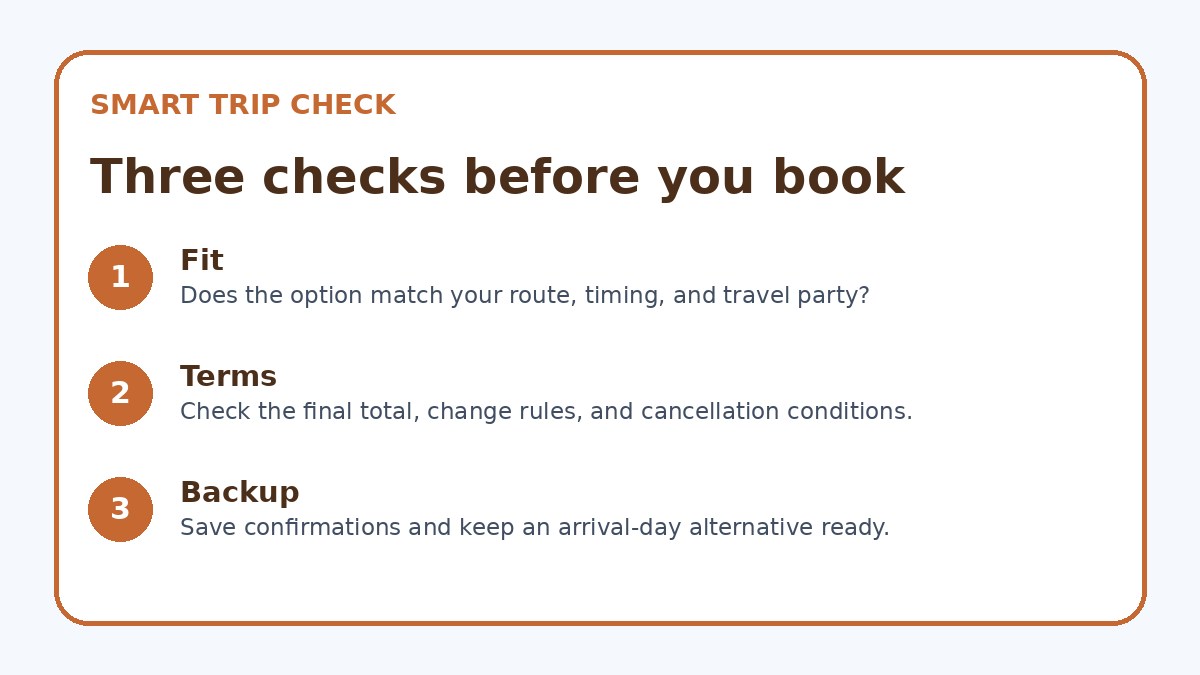
Check the final pickup instructions, waiting conditions, and exact drop-off coverage.
Make meeting points clear
Tokyo’s major airports have multiple exits, terminals, and designated pick-up zones that can be confusing — especially late at night. Require the exact terminal, exit number (or gate) and a fixed landmark for your pick-up confirmation: an official terminal sign, a specific gate area, or a named meeting desk. Confirm whether the driver will wait inside the terminal by baggage claim or curbside outside. If you plan to use a meet-and-greet service, confirm how they will identify you (signboard, app photo, or phone call) and whether they will call on arrival.
Consider language and visibility at night: include your mobile number with international dialing code, a backup local SIM or roaming plan, and a photo of the airport signage near your planned meeting point. If you’re arriving into a terminal with multiple international arrival belts, name the baggage claim belt you expect to use. When possible, send your driver a live update if you clear customs early or are delayed. Clear meeting instructions reduce waiting time and the risk of missed pickups in a dimly lit or quieter late-night terminal.
Fit the transfer to your destination drop-off
Decide whether curbside hotel drop-off is practical for your Tokyo accommodation. Many city hotels in central Tokyo have narrow streets or restricted curb access; larger vehicles may need to stop a short walk away. If your hotel is in a busy neighborhood, check in advance whether they can accept luggage deliveries or offer late check-in instructions. For longer stays or if you want to avoid dragging bags through narrow streets, consider a drop at a nearby station with an elevator and a short taxi ride, or book a smaller car that can navigate tighter roads.
When your end address is outside central Tokyo, factor in highway access and possible toll or pick-up restrictions late at night. A direct door-to-door transfer reduces the need to transfer between vehicles but can be slower if roads are congested or access is limited. If you plan to use public transit for part of the journey, map elevator locations and confirm schedules after midnight. Always confirm whether the driver will assist with luggage to the hotel door, or whether you will be expected to manage oversized items yourself.
Airport Transfer & Local Mobility questions travelers ask
Can I rely on airport taxis after midnight if I have lots of luggage?
Yes, airport taxis generally operate through the night, but space is limited for large groups or oversized items. If your baggage load exceeds what a standard taxi can comfortably carry, plan for a larger vehicle or multiple taxis. Before you arrive, note that drivers may charge extra for excessive luggage or need to make additional trips; ask the taxi operator or driver about trunk capacity and any extra charges when possible. For peace of mind, consider booking a pre-arranged van or private transfer that lists luggage capacity and confirms night-time availability.
How do I make sure a pre-booked transfer will wait if my flight is delayed?
When booking, ask the provider how they monitor flight status and what their waiting window is for late arrivals. Reputable services will track flights and adjust pick-up times automatically up to a stated limit, but you must request that service and get it in writing. If your flight is delayed beyond their waiting policy, confirm whether they offer a rebook or an option to dispatch a replacement vehicle and whether there are additional fees. Save the provider’s after-hours contact so you can arrange alternatives if needed on arrival.
Is it better to use public transport at night with many suitcases?
Public transport can be fast and cost-effective into central Tokyo, but it requires transferring luggage through stations, handling stairs if elevators are limited, and managing busy platforms. If your bags are heavy or oversized, the physical effort and potential crowding make trains less comfortable. For arrivals with manageable luggage and confidence in station layouts, a night train plus a short taxi from the station may be efficient. For larger or fragile items, a direct vehicle to your door reduces handling and the risk of damage.
Final decision note
Arriving late in Tokyo with extra luggage is a solvable logistics problem when you prioritize fit over price: choose the transfer that clearly accommodates your baggage and arrival time, confirm meeting details and driver contact information, and keep a realistic backup plan. Decide whether you value door-to-door convenience, flexibility, or lower cost, and then verify flight-monitoring and waiting policies before you travel. With your phone charged, hotel instructions saved in Japanese, and a printed backup, you’ll reduce stress and be ready to move quickly from the terminal to your Tokyo accommodation even after a late arrival.
Continue planning
Check current options and final conditions
Use the provider page to confirm live availability, the final total, cancellation terms, and every condition that matters to your trip.
This evergreen planning guide was created with AI-assisted drafting and a structured quality review. It does not display live prices, schedules, availability, visa guidance, or provider rankings. Verify current details before booking. Some links are affiliate links; we may earn a commission at no additional cost to you.