If your Manila business trip includes multiple meetings across Makati, BGC and airport runs, renting a car can feel like control until you unpack the fine print on fuel and mileage. The practical answer: rent only if your itinerary needs flexible east–west or late-night travel that taxis, ride-hail, and shuttle services can’t cover reliably; otherwise rely on drivers or ride-hailing. Before you hit reserve, read four things on the rental contract: fuel policy (full-to-full versus prepaid fuel), daily and total mileage caps, exact insurance wording and excess, and how pickup and return logistics add time and cost. This guide helps you weigh route value, insurance gaps, pickup friction and a non-driving fallback so you can decide quickly and book with confidence.

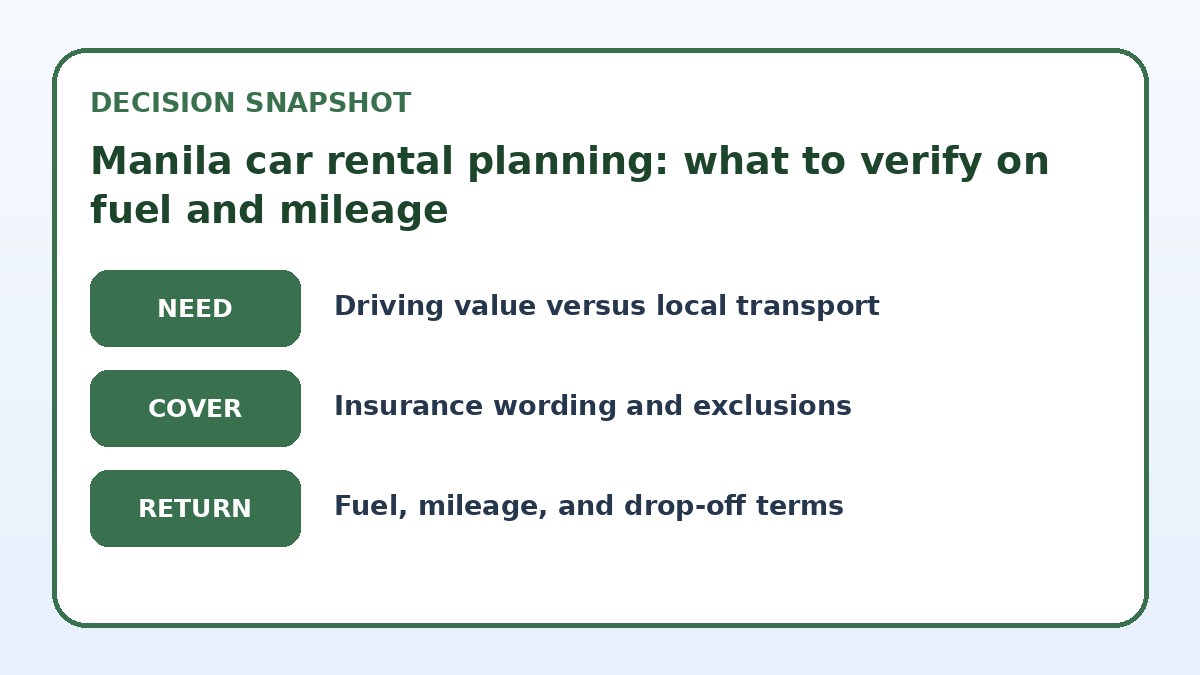
Decide whether driving improves your Manila itinerary
Start by mapping your appointments and arrival/departure logistics. Driving in Manila can save time when you must move between dispersed corporate offices, industrial parks, or client sites outside central business districts. If your schedule clusters meetings in Makati or BGC and you plan short trips to a single venue, traffic, parking limits and security clearances often make a hire-with-driver or ride-hail faster and less stressful. Consider late-night or early-morning work: a rented car gives control but also shifts responsibility for route choice and safety onto you.
Weigh frequency and distance against friction points. If you face multiple same-day, cross-city transfers or need gear moved between venues, a car has clear route value. But if most travel is inside a compact area or you expect traffic delays that consume billable time, the time lost behind the wheel can outweigh convenience. For business travelers on fixed schedules, also factor in parking availability at meeting locations and whether companies will validate or reimburse parking and tolls.
Decide whether driving earns its place
| Mobility strategy | Best for | Cost or friction to check |
|---|---|---|
| Self-drive rental | Travelers needing control for multi-stop or off-hour trips | You bear fuel, mileage overage risk, parking hassles, and must verify insurance excess and pickup procedures |
| Car + driver (local hire) | Delegating navigation and traffic management while keeping schedule flexibility | Higher hourly cost and less personal control; check liability terms and who pays fuel and tolls |
| Ride-hailing apps | Single-point trips inside central business districts or unpredictable schedules | Surge pricing and limited capacity for multi-stop agendas; verify business features and receipt policies |
| Corporate shuttle / airport transfer | Predictable airport-to-hotel or venue transfers with cost control | Less flexibility for ad-hoc meetings or off-route visits; confirm pickup points and cancellation rules |
Check live rental choices only after the route test
Use the exact driver, dates, pickup point, and return plan to compare current conditions.
What to verify in fuel and mileage terms
Fuel policies vary and change rental costs dramatically at return. The two common approaches are full-to-full, where you pick up with a full tank and return full, and prepaid fuel, where you buy a tank upfront and often do not get refunds for unused gasoline. On the final booking page, verify which policy applies, how pump receipts or tank-level photos must be supplied, and the vendor’s charge rate for missing fuel. Also check whether partial tanks at pickup are accepted and whether refueling must use specific stations.
Mileage caps matter for intercity meetings or long suburban transfers. Confirm daily and total mileage allowances, how overage is billed per kilometer, and whether the vendor rounds distances. Ask whether temporary route exceptions exist for business-related long drives, such as trips to Cavite, Laguna or Rizal provinces. If your itinerary includes toll roads or expressways, see whether those kilometers count toward the limit and whether tolls are charged to your card, settled on-site, or added to the final invoice.
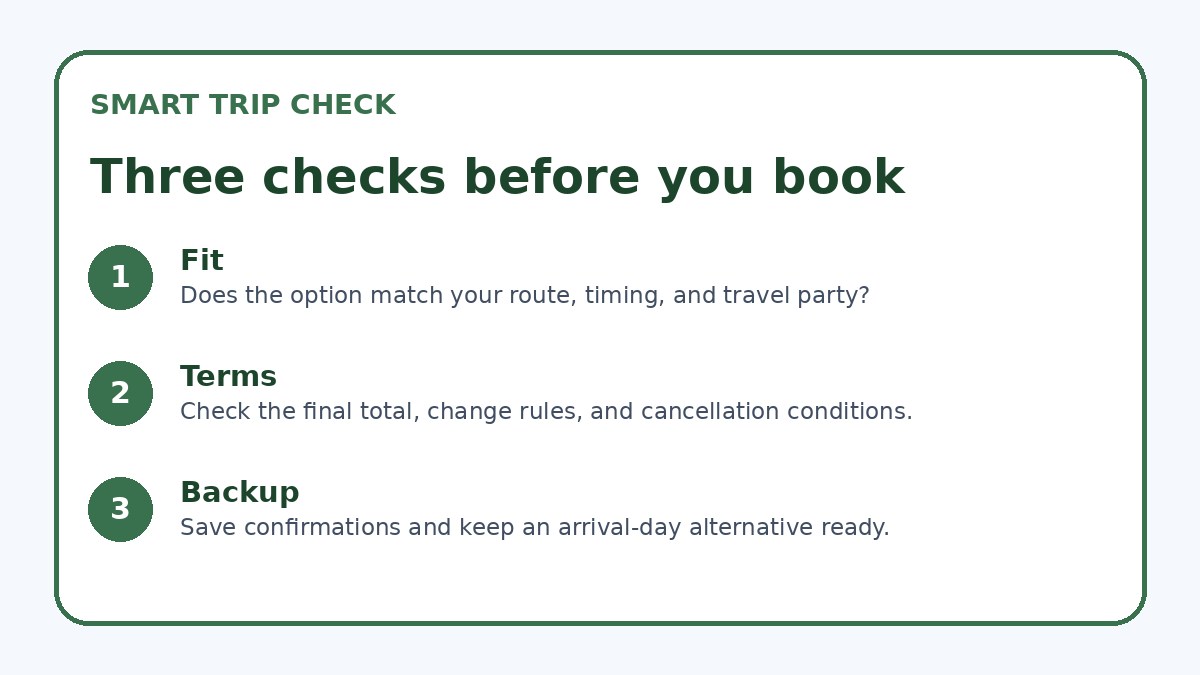
Compare the full rental conditions
Confirm insurance wording, exclusions, deposit, fuel, mileage, and return terms on the final page.
Insurance wording, excess and corporate coverage checks
Insurance descriptions can look similar but leave crucial gaps for business travelers. On the booking page, read the exact terms for Collision Damage Waiver (CDW) or Loss Damage Waiver (LDW), what incidents are excluded (e.g., off-road use, driving under influence), and the monetary excess payable after a claim. Determine if roadside assistance is included and whether there are geographic restrictions. If your company has a corporate rental policy or you plan to use a corporate card, verify whether coverage is primary or secondary and which documents you must present at pickup.
Ask how damage claims are handled and how quickly disputed charges are resolved. Some contracts authorize immediate holds or debits on the card for the full vehicle value until inspection and claim resolution; others cap the hold at the excess. For business travelers, an unclear claims process can interrupt expense reporting and reimbursement. Request written confirmation of covered perils, contact numbers for on-the-road support, and whether you can add a company-approved additional driver without invalidating coverage.
Car rental terms to verify
- On the booking page, confirm the fuel policy (full-to-full or prepaid) and note required proof for tank level at return.
- Check daily and total mileage limits, overage rate per kilometer, and whether business routes may be exempted.
- Read the exact insurance wording for CDW/LDW, exclusions, excess amount, and whether corporate cards reduce or replace the excess.
- Verify pickup and return logistics: airport counter location, after-hours procedures, vehicle inspection protocol and documentation required.
- Ask how tolls and parking fees are charged and whether they will be billed to your company card or invoiced later.
- Save contact numbers for roadside assistance, the rental counter, and your company travel administrator before departure.
Pickup and return friction plus a non-driving fallback
Pickup and return logistics often create hidden time costs. Check whether airport counters are inside the terminal or offsite shuttle-access points, the provider’s after-hours return procedure, and how inspections are recorded — many firms require staff to sign exterior/interior condition records or supply timestamped photos. Confirm if your driver’s license (foreign or domestic), passport, and credit card must match and whether additional documentation is needed for corporate rentals. Also check reported wait times at desks during peak arrivals and whether the company provides express lanes for corporate customers.
Plan a clear non-driving fallback before you commit. Reliable alternatives in Manila for business travelers include ride-hailing apps, pre-arranged chauffeur services, corporate shuttles, and a dedicated local driver hired through a trusted agency. A fallback should match your biggest needs—late-night availability, rapid point-to-point transfers, or luggage handling. If you decide not to drive, still verify appointment windows and pick-up points with your clients and allow buffer time for Manila traffic unpredictability. Having a pre-approved cab or driver contact inside your calendar reduces stress if your rental plan becomes impractical.
Car Rental & Road Trip questions travelers ask
Will a prepaid fuel option save time for short business trips in Manila?
Prepaid fuel can save time at return because you don’t need to refuel before dropping the car off, but it often costs more when you use less than a full tank. For short city-only itineraries where you expect low mileage, full-to-full is usually fairer because you only pay for fuel you actually use. Check the booking page for the provider’s refund policy on unused prepaid fuel and whether they offer a partial refund; if no refund is offered, factor that wasted cost into your rental decision.
How can I avoid disputes over vehicle condition at return?
Document the vehicle thoroughly at pickup and return: take timestamped photos of all sides, interior, and any existing scratches or dents, and request the inspection report be signed by the agent. If the provider allows digital check-in, save the confirmation emails and images. Keep pump receipts for refueling evidence if you follow full-to-full. Before leaving, ask the agent to note any discrepancies and provide a copy of the signed report to prevent later chargebacks during the expense reimbursement process.
Does a corporate credit card usually cover the rental excess or collision damage?
Corporate card coverage varies widely and can be primary, secondary, or limited to certain perils. Don’t assume the card will automatically cover the excess or CDW unless you have a written policy from the card issuer and your company travel office confirming this. On the booking page and at pickup, ask whether the card’s protection applies, what documentation is required, and whether the cardholder must decline on-site insurance to activate card benefits. Keep a copy of the card policy and vendor confirmation for claims.
Final decision note
For business travelers, the right Manila car rental decision starts by matching itinerary needs to fuel, mileage and insurance realities. If your schedule requires flexible, multi-stop travel across the metropolitan area or late-night movement, a self-drive rental may be worth the additional checks—provided you confirm full details about fuel policy, mileage caps, and insurance excess on the provider’s booking page. If most appointments are concentrated in a single district, or you want to avoid pickup friction and inspection disputes, a car with driver or ride-hail alternative will often save time and stress. Whichever path you take, use the checklist to verify the contract terms and keep evidence at pickup and drop-off to protect yourself and your company expenses.
Continue planning
Check current options and final conditions
Use the provider page to confirm live availability, the final total, cancellation terms, and every condition that matters to your trip.
This evergreen planning guide was created with AI-assisted drafting and a structured quality review. It does not display live prices, schedules, availability, visa guidance, or provider rankings. Verify current details before booking. Some links are affiliate links; we may earn a commission at no additional cost to you.