If you're a solo traveler weighing whether to rent a car on Jeju, a quick practical answer: driving usually adds freedom to reach coastal roads, quieter viewpoints, and rural cafes, but only if you confirm the fuel policy, mileage allowance, and pickup/return logistics before you book. Fuel and mileage rules can turn an otherwise easy day into extra cost or stress—prepaid fuel, “same-to-same” return, or per-kilometer limits change both route choices and insurance needs. Read the fine print on liability and roadside assistance; verify what constitutes damage and where to report it. This guide helps you decide whether driving genuinely improves your trip, what contract terms to inspect on the booking page, how pickup and return can add friction, and a realistic non-driving fallback so you still have a smooth solo itinerary.

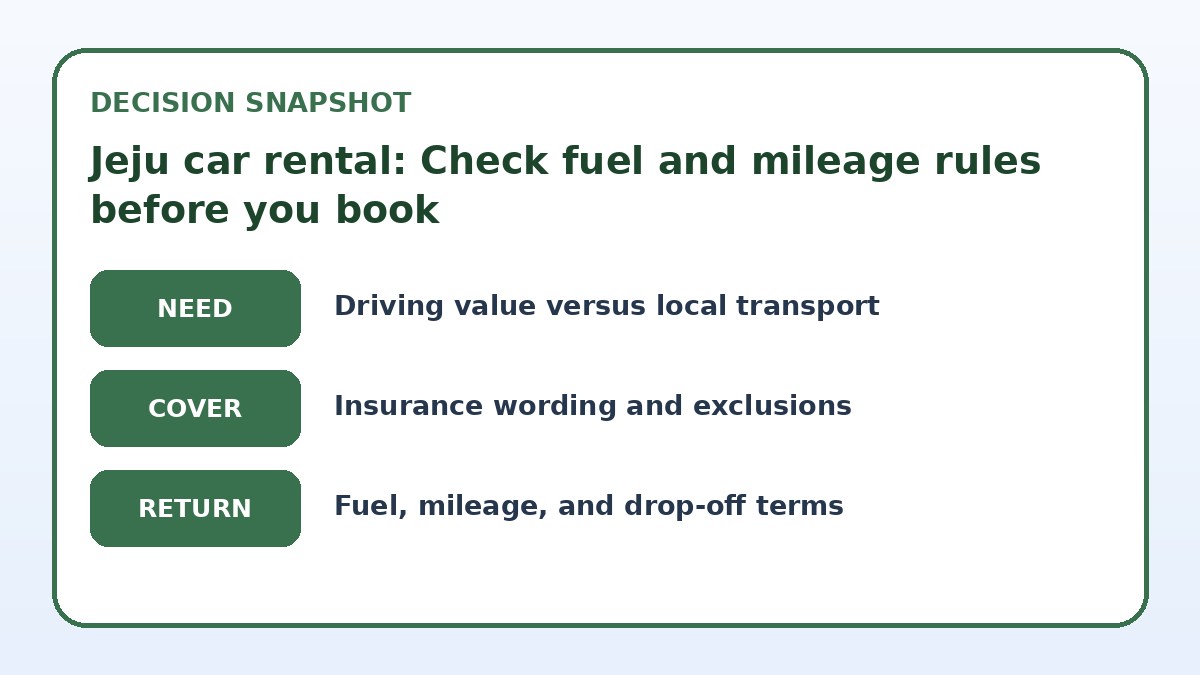
Does driving improve a solo Jeju itinerary?
Driving on Jeju often improves access to dispersed coastal attractions, scenic byways and remote cafes that are hard to reach by public transport. For a solo traveler on a short trip, driving is most valuable if you plan several stops in one day, want flexibility for sunrise or late-evening sessions, or prefer to carry light gear like a tripod or hiking kit. If your plan focuses on concentrated areas—Jeju City, Seogwipo central, or well-served beaches—public buses and local taxis can be enough.
Decide by mapping your intended daily loop distances. If most days are under 40–60 km roundtrip you may not need a car; if you want multiple long coast-to-mountain loops, the convenience of a rental outweighs public-transport scheduling. Remember that fuel and mileage policies directly change this math: a low mileage allowance will limit route value even when a car is otherwise attractive.
Decide whether driving earns its place
| Mobility strategy | Best for | Cost or friction to check |
|---|---|---|
| Rent a car with full-to-full fuel and unlimited mileage | Solo travelers planning long daily loops who prefer freedom to roam without refueling stops. | Typically higher upfront responsibility for fuel logistics and more paperwork at pickup/return. |
| Prepaid fuel rental with limited mileage | Travelers who want quick pickup/return and expect short, local drives under the mileage cap. | You may pay more per liter and face strict distance caps that limit long excursions. |
| No rental — buses, taxis and day tours | Solo travelers preferring no driving stress, avoiding insurance complexity and parking hassles. | Less flexibility for remote or early/late visits; transfers and tour schedules shape the itinerary. |
| Split approach: rent for select days, use public transport otherwise | Those wanting flexibility for one or two long exploration days without full-trip rental costs. | You’ll handle two sets of logistics and may pay more overall if short rentals have higher daily rates. |
Check live rental choices only after the route test
Use the exact driver, dates, pickup point, and return plan to compare current conditions.
What fuel and mileage clauses to check on the final booking page
On the rental contract page look for three distinct fuel terms: full-to-full, prepaid (one-way or return), and refueling charges. Full-to-full means you pick up with a full tank and should return full—keep fuel receipts. Prepaid fuel can remove the refuel hassle but often is sold at a higher rate; if you don’t use the whole tank, you rarely get a refund. Also verify how the company measures fuel level (visual gauge vs. photo record) and whether they expect a specific fuel type (gasoline vs. diesel).
For mileage, read whether the vehicle has unlimited kilometers, a per-day cap, or a total-trip cap and what overage fees apply per extra kilometer. Note also whether mileage is rounded per day or counted precisely at return. These rules affect route planning: limited mileage favors shorter loops and concentrated sightseeing, while unlimited mileage supports island-wide exploration without surprise fees.

Compare the full rental conditions
Confirm insurance wording, exclusions, deposit, fuel, mileage, and return terms on the final page.
Insurance wording and pickup/return friction to anticipate
Insurance pages can be dense: check liability limits, the collision damage waiver (CDW) and the excess (your financial responsibility after a claim). Confirm whether local insurance covers damage to tires, windshield, and undercarriage—these are common exclusions. Also check if third-party liability is included or needs separate purchase and whether roadside assistance is 24/7 or has geographic limits on Jeju island. When in doubt, take photos and timestamp them at pickup and return and get written acknowledgement of pre-existing damage.
Pickup and return can add hidden friction: airport or ferry terminal desks may have limited hours; drop-off outside office hours can incur extra fees. Verify the exact address, after-hours procedures, and whether there’s an onsite attendant to sign mileage/fuel records. Ask how they document vehicle condition—digital checklists or photos are better than anecdotal notes—and whether staff will provide a written handover receipt; if not, create your own photo log.
Car rental terms to verify
- Verify the fuel policy: is it full-to-full, pre-purchase, or charged per missing liter; note fuel type required and how fuel level is documented.
- Confirm mileage allowance and exact overage fee per kilometer on the final booking page before you accept the contract.
- Read insurance specifics: collision damage waiver, excess amount, tire/windshield coverage, third-party liability and roadside assistance details.
- Ask about pickup and return windows, after-hours procedures, required ID and deposit method and make a photographic record of vehicle condition.
- Plan routes against the stated mileage allowance and fuel policy; if you expect long loops, calculate likely fuel and distance costs ahead of time.
- Compare a non-driving plan (bus/taxi/tours) for at least one day so you can switch mid-trip if vehicle issues or stress arise.
A realistic non-driving fallback for solo travelers
If driving’s hassles outweigh benefits, plan a fallback combining buses, taxis, and organized transfers. Jeju has an improving public bus network that connects major towns and tourist loops, and regional taxis are common for last-mile connections where buses are sparse. Design days around transport nodes—base yourself in Jeju City for northern sights and in Seogwipo for southern attractions—so you minimize inter-area transfers and keep single-day travel distances manageable.
For spontaneity without a car, pre-book one or two taxi-based excursions (taxi drivers often accept half-day rates) or join small local tours for specific remote sites. Always check refund/cancellation rules of those bookings and compare times to bus schedules. Trip.com can be used to compare current availability for transfers and tours, but verify pickup details and cancellation policy on the provider’s final booking page before committing.
Car Rental & Road Trip questions travelers ask
How do I decide whether unlimited mileage is worth the extra cost for Jeju?
Decide by estimating your planned daily kilometers. Add likely detours and an allowance for wrong turns. Multiply by the number of days you’d drive and compare that total with the rental’s mileage cap; then calculate the overage fee versus any cost premium for unlimited mileage. Also factor in the type of sightseeing you want: long coastal loops and multiple mountain access points consume distance quickly. If the island-wide plan pushes you near or above a cap, unlimited mileage reduces stress and the risk of surprise fees—verify the exact terms on the booking page.
What should I photograph at pickup and return to avoid disputes?
Take wide-angle photos of all four sides, close-ups of existing scratches, dents, tire and windshield condition, the fuel gauge reading, and the odometer. Time-stamp these photos or use the camera’s metadata. If staff completes a written inspection form, ask for a copy or take a clear photo of it. On return, repeat the same photo sequence and get a signed receipt or email confirmation that shows drop-off time and mileage. These records are your best protection if damage or fuel disputes arise after you leave.
How do insurance excess and local liability affect solo travelers on Jeju?
Excess (the amount you pay before insurance covers the rest) determines your immediate financial exposure after an incident; higher excess means higher out-of-pocket risk. Some policies exclude tires, undercarriage or windscreen, so you might need additional cover if you’ll be driving on rougher roads. Confirm whether roadside assistance includes towing on Jeju island and whether claims require police reports or specific documentation. Read the insurer’s wording on liability limits and claim timelines; when in doubt, ask the rental company to show the exact contract clause on their booking page.
Final decision note
For solo travelers, renting on Jeju is a practical choice when your route needs flexibility and you’ve checked fuel, mileage and insurance limits. The decision hinges less on personal driving confidence and more on contract details: fuel policy determines refueling tasks and potential surcharge, mileage caps dictate how far you can roam, and insurance wording shapes financial risk in case of damage. Before you book, compare a full-to-full unlimited option versus prepaid or limited options and weigh a non-driving fallback based on bus and taxi connectivity. Always verify the final terms on the provider’s booking page and keep photographic evidence at pickup and return to protect yourself from disputes.
Continue planning
Check current options and final conditions
Use the provider page to confirm live availability, the final total, cancellation terms, and every condition that matters to your trip.
This evergreen planning guide was created with AI-assisted drafting and a structured quality review. It does not display live prices, schedules, availability, visa guidance, or provider rankings. Verify current details before booking. Some links are affiliate links; we may earn a commission at no additional cost to you.