The first hour after landing is where the decision that shapes the rest of your day is made: do you accept the first taxi, wait for an app car, use a meet-and-greet service from your hotel, or arrange a pre-booked transfer? For a business traveler in Manila the priorities are predictable: arrive at the terminal on time, keep luggage and devices secure, and stay on schedule for meetings or connections. Start by confirming your departure terminal, the party and luggage size, and the check-in time required by your airline. If your flight is disrupted or delayed, that plan must flex immediately. This guide gives the practical answer up front, then breaks down tradeoffs and the decision criteria you need to choose the right Manila airport transfer for your return trip.
Check options for your arrival details
Use your flight, luggage, party size, and accommodation address to compare current choices.
Luggage and party size: match vehicle to needs
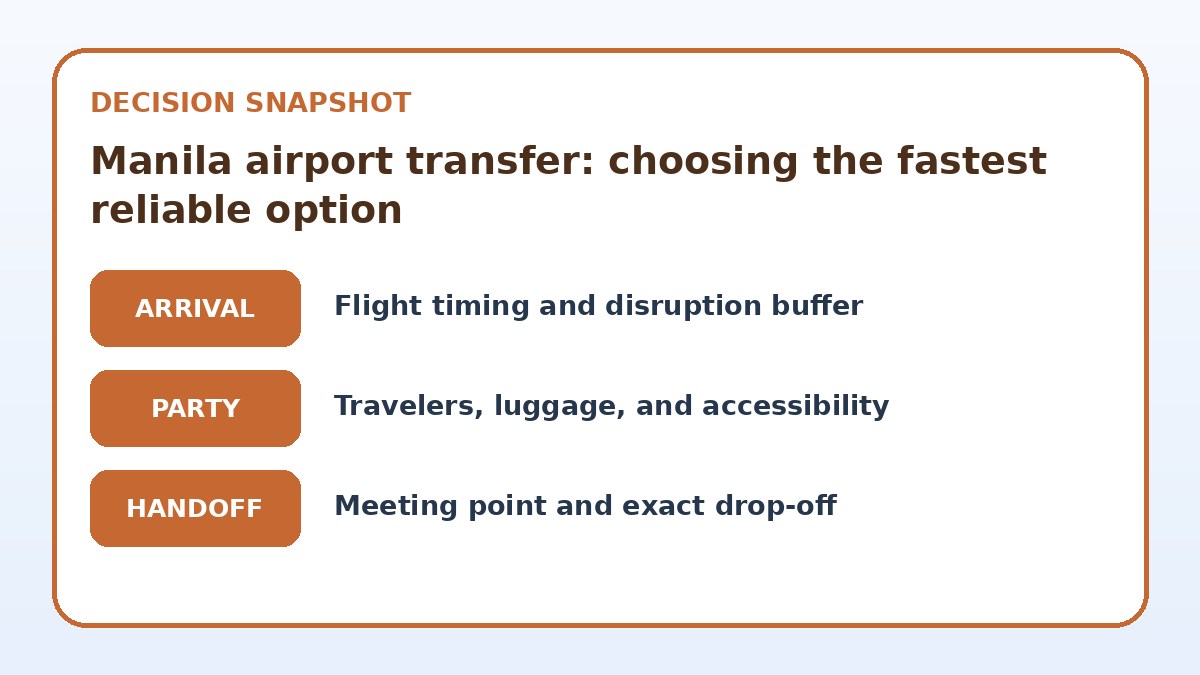
Start by counting passengers, suitcases, and any special equipment such as sample cases or instruments. A single traveler with one carry-on has very different needs than a three-person team with checked luggage and a display case. When comparing options, list total bags and measure larger items if they won’t fit upright in a standard trunk. If your team includes an assistant or driver who will be handling materials, confirm whether they will ride with you or meet you at the hotel to collect baggage later.
Different transfer choices have predictable capacity tradeoffs. App cars often work for one to two people with limited luggage but can become cramped once everyone has large suitcases. Pre-booked vans and reserved hotel transfers explicitly reserve cargo space and staff to help load and unload; that reduces time at pickup but requires confirming vehicle size on the booking page. Make a quick table in your notes to match each option against party size, number of bags, and door-to-door time so the right vehicle is obvious when it’s needed.
Arrival details to have ready
- Confirm your departure terminal and note the arrivals hall and preferred meeting point before you board.
- Count passengers and measure luggage; record the total number of large suitcases to choose the right vehicle.
- Save the transfer provider’s booking reference and a local contact number where you can reach them upon arrival.
- Set a realistic buffer time for Manila road conditions and add it to your hotel or office arrival window.
- If your flight is delayed, contact the provider immediately and have your alternate transfer option ready.
- Share one communication channel and a photo or map of the meeting point with every traveler in your party.
Late or disrupted arrivals: build flexibility into the plan
Flights get delayed, baggage can be slow, and meetings sometimes spill over time. For business travelers, the simplest hedge is a transfer option with clear rebooking or wait-time policies; ask about grace periods and what happens if your flight is diverted. If you rely on an app car, ensure you can update pickup details quickly and that the provider has a local contact number. If your schedule is tight and delay risk is high, consider a service that offers live flight tracking or a point of contact who monitors arrivals.
When a disruption happens, it helps to have a sequence of fallback options: an on-demand ride, a hotel-arranged car, and a list of nearby terminals or lounges where you can regroup. Note that some booked transfers require notification if your arrival moves past a stated window—keeping the supplier’s contact info and your booking reference accessible will save minutes. Also, identify a covered meeting point inside the terminal so you don’t waste time searching crowd or curbside areas when tired from travel.
Match the transfer to your arrival
| Arrival approach | Best for | Detail to verify |
|---|---|---|
| Pre-booked private transfer | Travelers needing guaranteed pickup, luggage handling, and a fixed schedule. | Less flexible on short-notice changes; verify cancellation and delay policies before booking. |
| Hotel-arranged car or shuttle | Those who prefer a local contact and assistance with luggage and check-in coordination. | May require confirmation with the hotel if your flight is delayed; compare pickup instructions carefully. |
| App-based ride (on-demand) | Small teams who prioritize speed and cost control when arrivals are on time. | Curbside rules and trunk space vary; have a backup if driver access to the terminal is restricted. |
| Shared airport shuttle or coach | Groups on a budget or travelers with flexible schedules who can handle stopovers. | Longer door-to-door time and possible multiple stops; confirm luggage limits and route details. |
Make the meeting plan clear
Check the final pickup instructions, waiting conditions, and exact drop-off coverage.
Meeting-point clarity: avoid curbside confusion
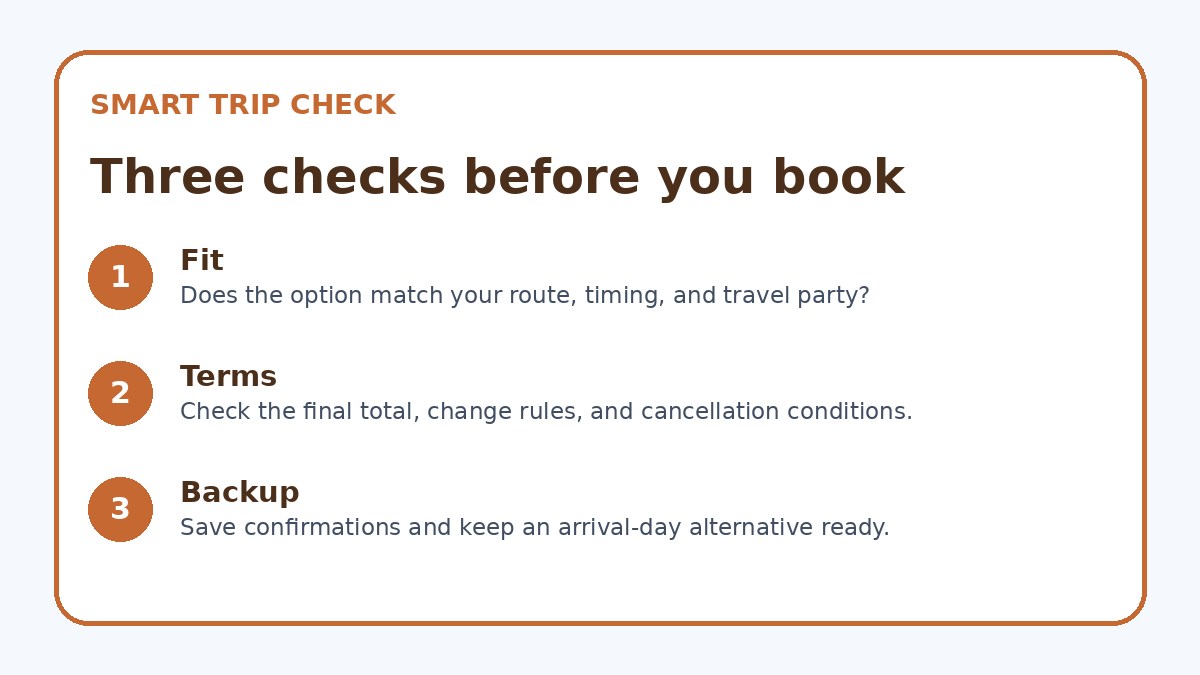
Manila’s airport terminals have busy curbside areas, varying passenger drop-off rules, and multiple levels for departures and arrivals. Before you land, confirm exactly where your driver will meet you—name the terminal, specify the baggage claim carousel if that’s the plan, or pick a clearly marked store, kiosk, or airline desk. If you’re using an app car, choose an official pickup zone on the airport map rather than an ambiguous curb point; if you’re unsure, ask the driver to wait by a landmark you can see from the arrivals hall.
For corporate teams, use a single communication channel—WhatsApp, SMS, or a designated contact number—so everyone knows when to move and where to assemble. Share photos or a short map of the chosen meeting spot in advance. If your group splits between domestic and international connections, confirm which terminal each passenger will use and whether a transfer between terminals is needed; that prevents missed pickups and wasted time when one sub-group lands earlier than others.
Destination-side drop-off: fit the hotel or office arrival
Think of the drop-off as part of your schedule. If you must be at a downtown office at a precise time, add a buffer for Manila traffic and for unloading time at the building entrance. Hotels may have different drop-off points—some allow arrivals inside a porte-cochère, others require curbside unloading followed by a short walk. If you plan to check in quickly and head to a meeting, request help with fast-tracking check-in or a luggage hold at the hotel so you can arrive light and focused.
For office arrivals, ask whether the building requires guest registration, security passes, or specific lanes for ride-share vehicles. If you will be carrying copies, samples, or presentation materials, confirm whether the driver can wait while you sign in, or whether someone from your office should meet you outside. Clear expectations on where the driver will wait, how long they can remain, and whether they are permitted to enter a secure lobby will smooth a tight business schedule.
Airport Transfer & Local Mobility questions travelers ask
How far in advance should I book a Manila airport transfer for a business trip?
For business travel the safest approach is to book at least 24–48 hours in advance when possible, because that secures vehicle type and service confirmation. If your schedule is fixed—tight meeting times, group travel, or large equipment—book earlier and request written pickup details that reference your flight number and terminal. For last-minute changes verify the provider’s rebooking or wait‑time policy and keep a reliable on-demand app installed as a fallback.
What should I verify on the provider’s booking page before confirming?
On the booking page confirm the pickup terminal, allowable wait time, vehicle size and luggage capacity, cancellation or amendment policies, and whether the supplier monitors flight status. Also check whether any meet-and-greet includes assistance through arrivals, whether the price covers tolls and parking, and whether the operator allows returns to the airport at a specific time. If any detail is unclear, contact the provider directly so you don’t rely on assumptions at the curbside.
If my inbound flight is delayed or rerouted, what are the fastest ways to adjust my return transfer?
First, notify the transfer contact and provide your new arrival details and updated meeting point. If you booked an app ride, cancel and request a new pickup once your arrival time is confirmed; allow a small extra window because drivers may be assigned elsewhere. If you used a hotel-arranged or pre-booked service, use the supplier’s emergency contact to re-confirm pickup; they may already monitor flight arrivals. Always keep the alternative option—another app, hotel car, or airport counter—ready to avoid waiting without a solution.
Final decision note
Planning the return trip to Manila airport for business travel is about controlling the controllables: match vehicle capacity to luggage and party size, confirm a specific meeting point in the terminal, and choose a transfer product whose flexibility aligns with your tolerance for delay. Pre-booked private transfers and hotel-arranged cars give predictability and luggage support; app rides offer speed for lighter loads; shared shuttles save cost at the expense of time. Before you go, note terminal details, save provider contacts, and keep a fallback option handy. For current availability and comparisons, you can check providers listed on Trip.com or the operator’s official booking page and verify the exact pickup instructions there.
Continue planning
Check current options and final conditions
Use the provider page to confirm live availability, the final total, cancellation terms, and every condition that matters to your trip.
This evergreen planning guide was created with AI-assisted drafting and a structured quality review. It does not display live prices, schedules, availability, visa guidance, or provider rankings. Verify current details before booking. Some links are affiliate links; we may earn a commission at no additional cost to you.