If you’re flying Dubai to Sydney with extra baggage, the central tradeoff is usually route convenience versus fare and baggage cost. A direct routing, if available, can save transfer risk and extra time in airports for oversized suitcases, but it may carry a stricter checked-bag allowance or higher fare conditions. Conversely, connecting itineraries sometimes allow more flexible baggage rules or cheaper base fares but increase the risk of missed connections, delayed transfers and baggage misrouting.
Before you search, collect exact travel dates, number and weight of bags, passenger ages, and any mobility needs—this lets you compare fares and baggage rules side by side. The guidance below shows which routing choices reduce connection risk, how to organize baggage to meet airline limits, and where to allocate extra airport time so your Dubai to Sydney flights go smoothly.

See live routes for your exact travel day
Compare direct and connecting choices with the same baggage and traveler details.
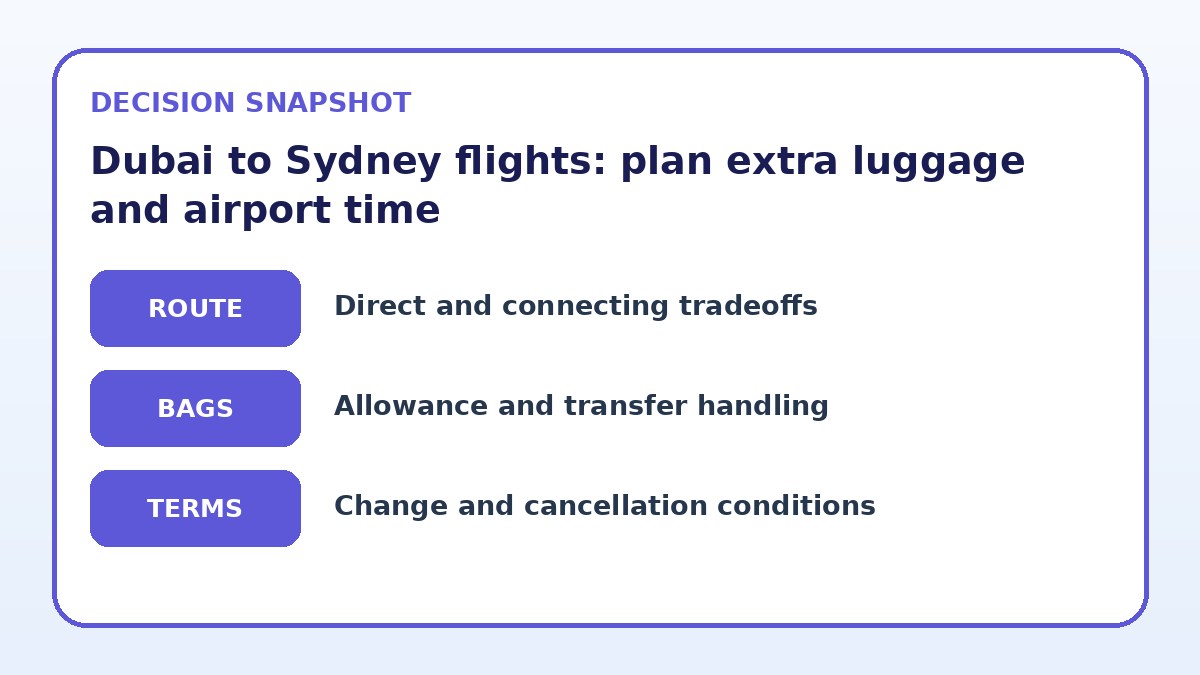
Routing: direct versus connecting and how that affects luggage
Choosing between the most direct routing and a multi-stop itinerary is the first practical decision for travellers carrying extra luggage. A more direct itinerary typically reduces the number of times bags are transferred between aircraft and the number of times you must re-check or monitor them, which lowers the chance of damage or delay. However, direct routings can impose stricter piece or weight limits depending on aircraft and fare class. If a direct option exists, compare its baggage terms against a connecting itinerary that might offer a more generous allowance or a cheaper checked-bag fee structure.
When evaluating connecting options, look at each carrier’s baggage rules for the booking class you would purchase. If the connection involves two different carriers operating separate tickets, you may need to collect and re-check bags between flights; that requires sufficient transfer time and adds complexity. If the itinerary is sold on a single ticket (interline or codeshare), many airlines will transfer bags, but carriers still differ on how they count pieces and weight. Make a checklist of per-carrier allowances and any oversize/odd-item procedures before committing to an itinerary.
Baggage and connection risk: prevent lost bags and delays
Extra luggage increases the risk profile for your trip: more pieces mean more tags, more handling and proportionally higher chances of misrouting. To reduce connection risk, prioritize itineraries with fewer connections or longer minimum connection times when you have heavy or unconventional items. Always verify whether the airline will check your bags through to the final destination; if not, add time to re-check and clear security. Consider packing valuables and essentials in carry-on or a single, easily manageable case that you keep with you during transfers.
Label every bag inside and out with your name, phone number, and a copy of your itinerary; include a copy of your passport or contact details inside a sealed document pouch. If you have fragile or high-value items, use a hard-shell case, secure internal padding and consider transit insurance that specifically covers checked baggage. Photograph each bag and its contents before checking it in; these photos help with claims if damage or loss occurs. Finally, when you land, move promptly to the baggage belt and report any irregularities immediately to the airline’s baggage office.
Compare flight-selection strategies
| Flight strategy | Best for | Risk to check |
|---|---|---|
| Direct or single-connection itinerary | Travelers prioritizing minimal transfers and reduced baggage handling | May have higher fare or stricter baggage limits; fewer options if you need flexible dates |
| Cheapest multi-connection routing | Passengers willing to trade time for lower base fares | Higher risk of missed connections and baggage misrouting; adds airport time for re-checking |
| Mixed-carrier itinerary with separate tickets | Those who value lower segment prices or specific carrier schedules | Often requires collecting and re-checking bags; needs generous connection buffers |
| Higher-fare bundle with extra baggage included | Travelers who prefer pre-paid certainty for multiple checked items | Higher upfront cost but reduces uncertainty; verify if bundle applies across all carriers |
Recheck the complete itinerary
Confirm airports, connection handling, baggage, and change conditions before deciding.
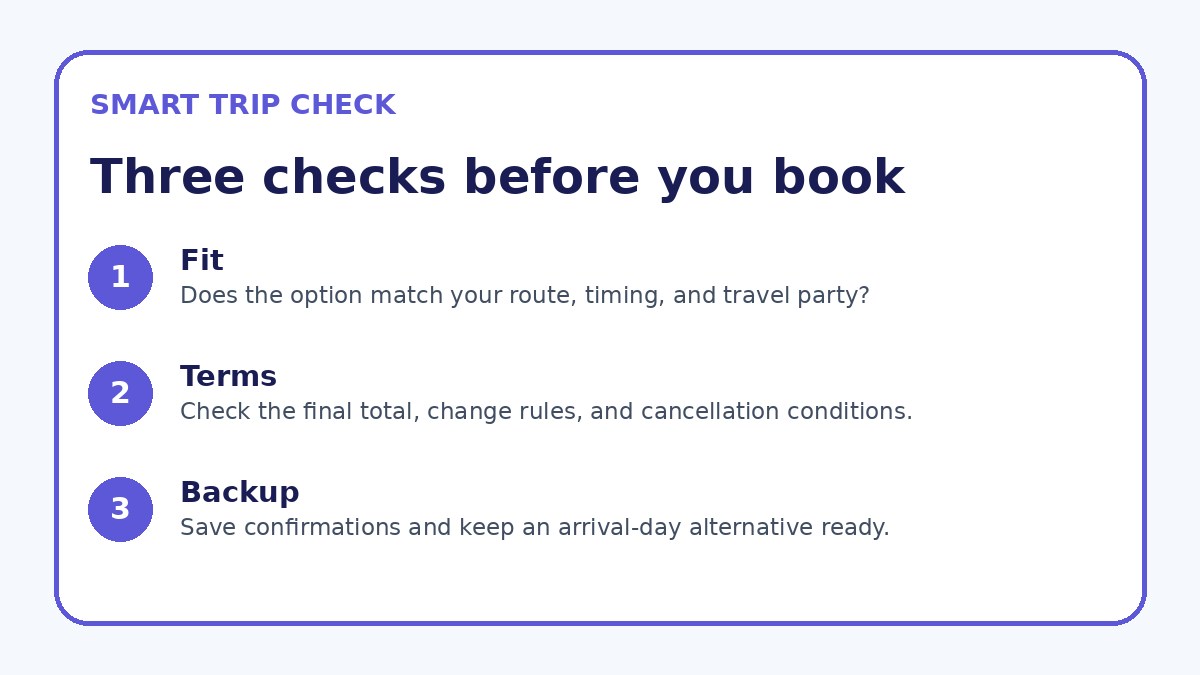
Schedule fit: how much airport time to add at Dubai and connecting airports
For planning airport time, start with the airline’s recommended arrival windows: many carriers suggest arriving earlier for international flights when checking bags. If you’re departing from Dubai with oversized or numerous pieces, add extra time for check-in counters that process special baggage and for potential weight/size checks. For connections, factor in immigration and security times at transit points, especially if a connection requires switching terminals or airlines. When possible, choose connection windows that give you a buffer beyond minimum connection times for luggage handling and unexpected delays.
Allow more time for arrival processes in Sydney as well: Immigration lines, customs procedures and baggage reclaim can add unpredictable delays. If you carry restricted or dutiable goods, factor the additional time required for declarations. For peace of mind, plan at least an extra 60–90 minutes over the airline minimums for any segment where you must re-check bags or clear passport control. Use airport maps and terminal transfer guides to plan your walk times and consider paid fast-track services only after verifying what they cover for baggage and immigration.
Flight details to verify
- Gather exact travel dates, passenger names as on passport, cabin class, and total number, weight and dimensions of checked bags before searching fares.
- On the airline’s booking page, confirm whether allowance is piece-based or weight-based, and note oversize and overweight fee thresholds.
- If connecting, write down terminal transfer requirements and minimum connection times; add at least 60–90 minutes as a buffer for baggage handling.
- Pack valuables, travel documents and an outfit in carry-on luggage so delays or lost bags won’t derail essential plans.
- Label each bag inside and outside with contact details and a copy of the itinerary; photograph contents and exterior before check-in.
- Check refund/change conditions and baggage rules after selecting a fare; take screenshots of the carrier’s baggage policy page and your booking summary.
Fare conditions: what to check on the booking page before paying
Before you click buy, inspect the fare conditions for baggage allowances, change and cancellation rules, and the carrier responsibilities for interline baggage. Check whether the fare includes a checked baggage allowance by piece or by weight, and whether oversized, overweight and extra-piece fees apply. If your itinerary uses multiple carriers, confirm whose rules apply to checked baggage on each segment. On the airline or booking page, find the precise dimensions, weight limits, and fees listed for your specific booking class and aircraft type.
Verify who is responsible for lost or delayed baggage on your route and what timeframe triggers compensation or emergency purchases. If you plan to change dates, confirm the reissue or change fee structure and how baggage allowances move with a changed fare. If the provider allows add-on bundles for extra pieces or priority handling, confirm whether those add-ons apply to all carriers on your ticket or only to the operating carrier. As a last step, cross-check your planned itinerary and baggage needs on the provider’s final booking page; Trip.com can be used as a comparison shopping tool but always verify the policy language on the airline’s official page.
Flight Guide questions travelers ask
How much extra airport time should I allow in Dubai when checking several large bags?
Plan more time than the airline’s minimum recommendation when you have multiple or oversized items. Allow an extra 45–90 minutes at departure for queueing, special-baggage handling and possible weight checks, particularly during peak hours. If you require cargo handling or special equipment (for sports gear, mobility devices, or fragile items), contact the airline in advance and ask for check-in desk arrival windows. Also factor in travel time to the airport and any lane closures that could affect your commute.
If my Dubai to Sydney itinerary uses two different carriers, will my bags be checked through to the final destination?
That depends on whether carriers have an interline agreement or if the itinerary is sold on a single ticket. If the booking is on one ticket, many airlines will transfer bags, but policies on piece limits and oversize items may still follow the operating carrier. If you booked separate tickets, you will likely need to collect and re-check bags between flights. Always verify baggage routing and responsibilities on the booking page and ask the airline staff at check-in to confirm whether bags will be tagged to Sydney.
What is the best way to handle oversized or fragile items on this route?
Reserve specific oversized-baggage services or cargo handling ahead of departure and declare items at check-in so staff can assign the correct handling. Use rigid cases, internal padding and tamper-evident seals; include an inventory list and clear contact information inside the case. Ask the airline about special handling labels and manual transfer procedures during connections. Consider buying transit insurance that covers checked equipment and keep proof of condition before departure with photos. Verify service availability at both the Dubai departure and Sydney arrival airports when booking.
Final decision note
When planning Dubai to Sydney flights with extra baggage, the fastest path to a stress-free trip is to choose the routing that matches your tolerance for connection risk and extra time at airports. Gather exact travel dates and full luggage details before comparing fares, and read the fare conditions on the carrier’s booking page so you know whether baggage is piece- or weight-based and how oversize fees apply. Prioritize fewer transfers if avoiding baggage handling is critical, or opt for a fare bundle that pre-pays multiple pieces if that saves time and worry. Finally, label and photograph every bag, allow generous connection buffers, and verify all policies on the airline’s final booking screen; you can use Trip.com to compare options, but confirm the carrier’s terms directly.
Continue planning
Check current options and final conditions
Use the provider page to confirm live availability, the final total, cancellation terms, and every condition that matters to your trip.
This evergreen planning guide was created with AI-assisted drafting and a structured quality review. It does not display live prices, schedules, availability, visa guidance, or provider rankings. Verify current details before booking. Some links are affiliate links; we may earn a commission at no additional cost to you.