Practical answer first: before you open a booking site, pick exact travel dates, confirm the total trip time you can accept, and gather traveler documents and baggage needs. With those in hand, compare direct versus connecting options, check connection minimums and baggage-through policies, and read the fare conditions on the carrier’s final booking page. This route-versus-fare tradeoff shapes almost every sensible decision: a cheaper ticket with a long connection can mean more risk and tighter baggage rules, while a direct or single-carrier itinerary usually costs more but reduces connection hassle. Use the checklist below to avoid surprises, then bring your prepared dates and traveler details to a comparison site—Trip.com can be used as one of several tools—to confirm live availability and the exact fare conditions offered at checkout.
See live routes for your exact travel day
Compare direct and connecting choices with the same baggage and traveler details.
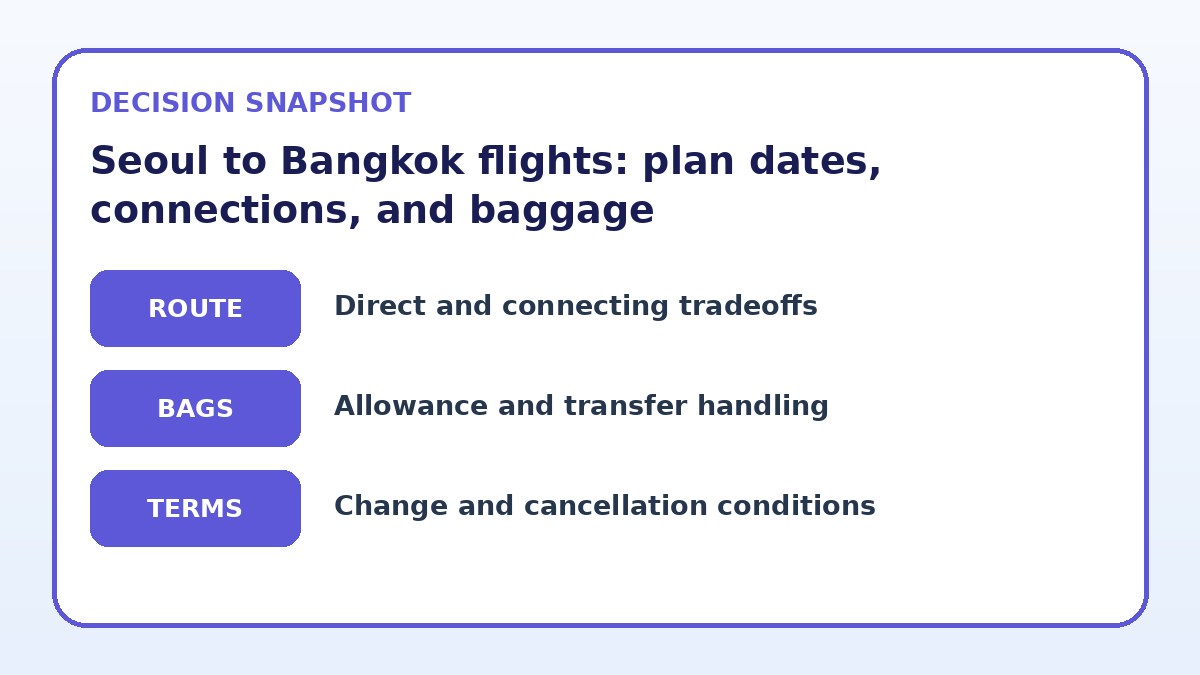
Routing: direct versus connecting and how to compare them
Start by deciding whether you want the simplicity of a direct flight or the lower price that connecting itineraries often offer. Direct flights reduce the number of variables—no intermediate security lines, fewer transfer steps, and usually less potential for missed connections. However, many routes between Seoul and Bangkok also have one-stop options that save money or open up better departure times. When comparing routes, always check total door-to-door travel time, number and length of connections, and whether the same ticket covers both flight legs or you must recheck luggage between carriers.
If direct and connecting options are both available, compare the real tradeoffs: marginal time savings versus fare difference, risk of delays at transfer airports in either direction, and whether a single airline alliance can protect you on a missed connection. Use the departure and arrival airports in Seoul and Bangkok as variables—confirm which airport pairs are involved—and when an itinerary uses different carriers for each leg, read the fare conditions carefully to learn how baggage and rebooking are handled.
Baggage and connection risk: what to verify before you click
Before booking, list every traveler’s baggage: carry-on only, one checked bag, or multiple checked bags. Different itineraries and fare classes include different baggage allowances, and connecting itineraries with separate tickets can force you to reclaim and recheck luggage. Verify on the provider’s final booking page whether checked bags are through-checked to your final destination. If it’s not explicit, assume you’ll need to collect and recheck luggage during a self-transfer and build extra time into your itinerary.
Assess connection risk by examining minimum connecting times and typical transfer procedures at the transit airport. If your itinerary includes separate tickets or a long layover, plan for immigration, security re-screening, and ground transfers between terminals. Choose longer layovers for complex transfers or when carriers do not provide protective connections. If you need to save money but want lower risk, look for single-carrier connecting options where the airline will normally accommodate missed connections on the same ticket.
Compare flight-selection strategies
| Flight strategy | Best for | Risk to check |
|---|---|---|
| Book a direct nonstop flight | Travelers valuing minimal transfer hassle and faster door-to-door time | Usually higher fare and fewer schedule choices compared with multi-stop options |
| Choose a single-carrier connecting itinerary | Those who want lower fares while keeping carrier protection for missed connections | Longer travel time than direct flights; limited flexibility if carrier changes schedule |
| Mix-and-match separate tickets to save money | Budget-focused travelers comfortable with self-transfers and longer connections | Higher risk: no through-checked baggage or guaranteed rebooking if flights are delayed |
| Buy a flexible/refundable fare | Travelers who expect changes or require flexible timing for work or uncertain plans | Higher upfront cost but reduced financial risk when altering or cancelling plans |
Recheck the complete itinerary
Confirm airports, connection handling, baggage, and change conditions before deciding.
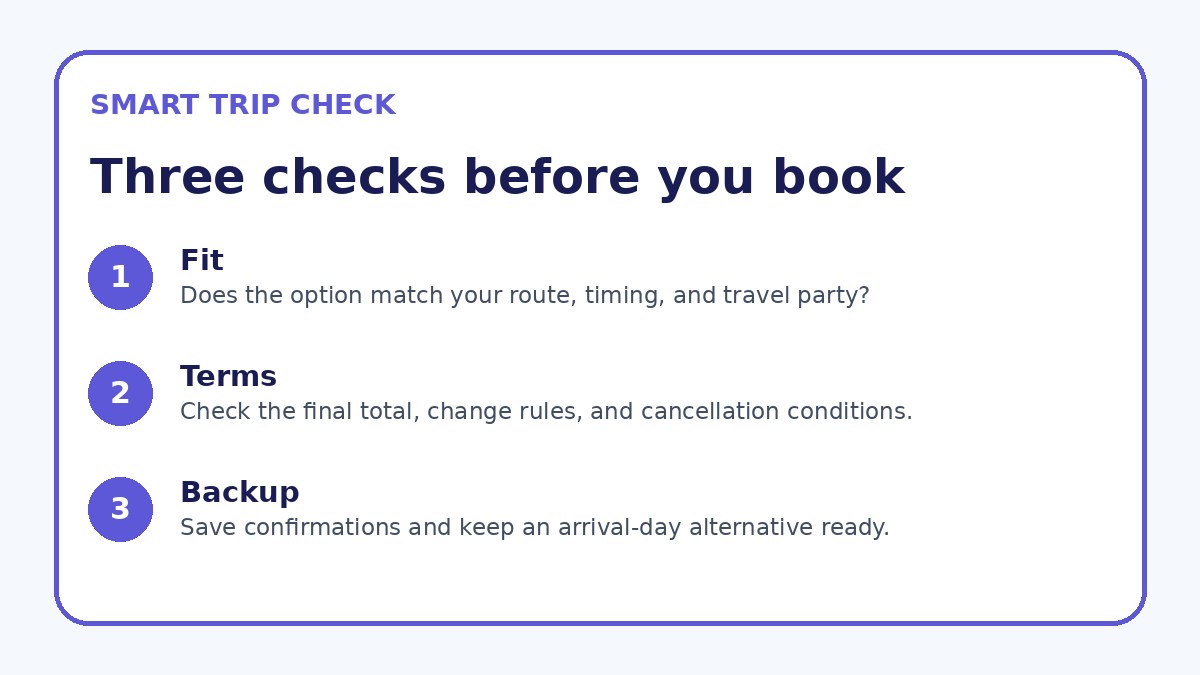
Schedule fit: matching departure and arrival times to your trip
Decide what arrival time in Bangkok works best for your onward plans—daylight arrival for easy ground transport, late arrival if you have a flexible first night, or specific timing for meetings or events. Compare itineraries by not just flight duration but also by arrival window; a slightly longer itinerary that lands at a convenient hour may be better than a shorter one that arrives in the small hours. Check local daylight and peak traffic windows if you have ground travel to a hotel, and use the schedule to plan arrival transfer bookings or first-day activities.
Also consider outbound timing from Seoul: early departures may require an extra night near the airport, while late flights can let you work a full day but may be more tiring upon arrival. If you have connecting flights, ensure the layover sits within acceptable wait times—too short risks missed connections, too long eats into vacation time. When comparing schedules, mark the times that work for your personal rhythm, then prioritize itineraries that match those windows when booking.
Flight details to verify
- Choose and lock your exact travel dates and return dates; write them down before you start searching live fares.
- Gather passport details for each traveler: full name as shown, passport number, country of issue and expiry date.
- Decide baggage needs per person and check each fare’s included allowance on the booking page before payment.
- Note acceptable maximum total travel time and minimum layover length so you can filter itineraries efficiently.
- Confirm whether you want a single-ticket itinerary or are willing to self-transfer; verify transfer procedures if self-transferring.
- Open the final booking page for your chosen itinerary and read the fare conditions, change/cancel policies, and exact fees before paying.
Fare conditions: cancellations, changes and what to confirm at checkout
Fare conditions determine how flexible your booking will be. Before completing a purchase, read the carrier or booking site’s final breakdown for change fees, cancellation rules, and whether taxes or third-party fees are refundable. Look for terms about name corrections, date changes, or involuntary reroutes. If you might need to change dates, a slightly higher refundable or changeable fare can be cheaper overall than a low-cost nonrefundable ticket with steep penalties.
When the itinerary involves multiple carriers, confirm which segment’s rules apply in different scenarios. On separate tickets, each carrier enforces its own conditions and you may have no recourse if a delay on the first causes you to miss the second. On a single ticket with transfer protection, the operating carrier usually manages rebooking. Always verify baggage allowance, seat assignment rules, and whether ancillary services—meals, preferred seats, priority boarding—are included or will cost extra at checkout.
Flight Guide questions travelers ask
Should I prioritize a direct flight from Seoul to Bangkok or save money with a connection?
Prioritize based on how you value time versus price. If minimizing travel stress, potential missed connections, and luggage transfers matters most, direct flights reduce those risks. If you have flexible time and a strict budget, a single-carrier connecting option can offer savings while retaining protection for missed connections. Only choose separate tickets to save money if you accept the extra effort and risk of rechecking luggage and dealing with independent carrier rules.
How long should my layover be when connecting through another airport?
Allow enough time for immigration, security re-screening, and any terminal transfers at the connecting airport. For a single-ticket transfer with no immigration, shorter layovers can work; for transfers requiring immigration clearance or separate tickets, build a longer layover to avoid stress. Consider the minimum connection times advertised by carriers as a floor, then add buffer for delays and ground transit between terminals where applicable.
What exactly do I need to check on the carrier’s final booking page?
On the final booking page, verify fare conditions for cancellations and changes, the exact baggage allowance and fees, seat selection rules, and whether the itinerary is on one ticket or multiple tickets. Confirm taxes and total payable, as well as any restrictions on name changes or refunds. If the itinerary uses partner carriers, check which carrier’s contract of carriage applies and whether connections are protected.
Final decision note
Making a smart booking decision for Seoul to Bangkok flights starts with preparation. Lock your travel dates, collect passport and traveler details, and decide how much time versus money matters to you. Use the checklist to compare direct and connecting options, confirm baggage and transfer procedures, and read the fare conditions on the final booking page before paying. If you need a quick comparator, Trip.com is an optional place to check live availability, but always treat the carrier’s final checkout page as the authoritative source for rules and fees. With those steps completed, you’ll reduce surprises and choose an itinerary that matches your priorities.
Continue planning
Check current options and final conditions
Use the provider page to confirm live availability, the final total, cancellation terms, and every condition that matters to your trip.
This evergreen planning guide was created with AI-assisted drafting and a structured quality review. It does not display live prices, schedules, availability, visa guidance, or provider rankings. Verify current details before booking. Some links are affiliate links; we may earn a commission at no additional cost to you.