
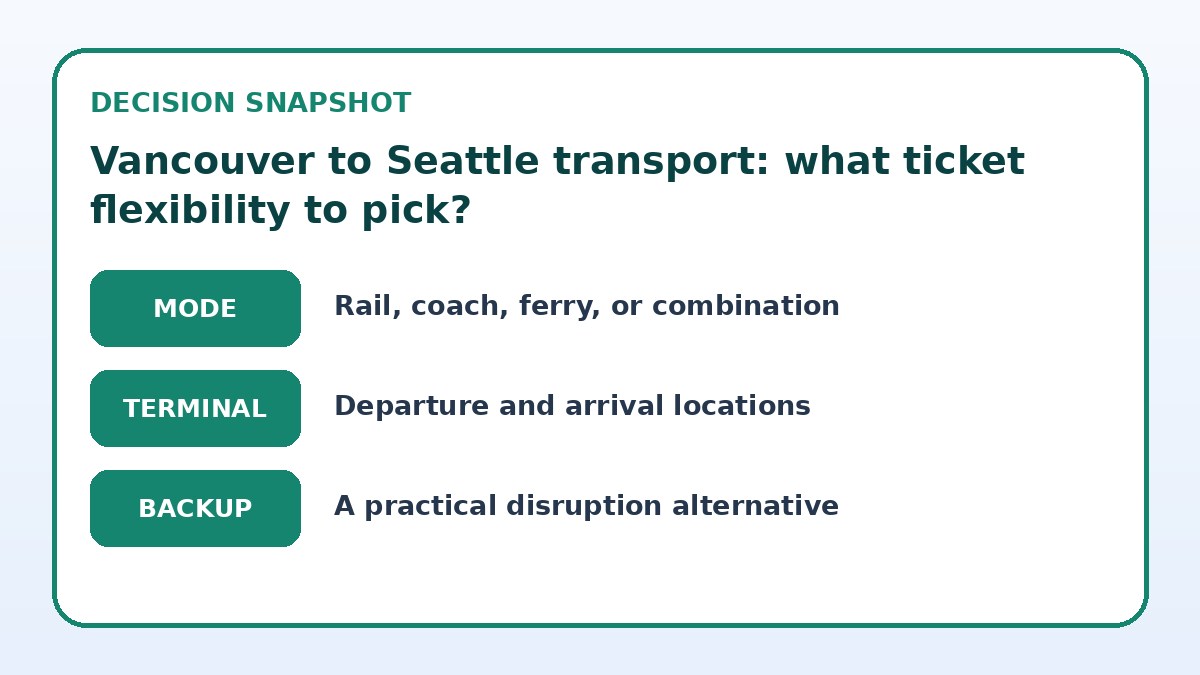
Practical answer first: if you value the ability to change plans at short notice, pick the most flexible ticket you can afford; if your schedule is fixed and you want to save money, choose a restrictive fare but verify refund and change terms. Solo travelers often juggle work plans, border waits, and transit connections—so ticket flexibility matters more here than in a two-person trip where costs can be shared. This article explains the tradeoffs you’ll face on the Vancouver to Seattle corridor, how to compare direct versus connecting options, and exactly what to verify on the provider’s final booking page. It focuses on decisions—refunds, change fees, travel-credit policies, and how flexibility interacts with luggage and entry requirements—so you can pick the right ticket for your risk tolerance and itinerary.
What ticket flexibility means and why it matters
Ticket flexibility describes how easily you can change or cancel a booking and what financial exposure you face when doing so. It includes the ability to change travel dates or times, receive a refund to your original payment method, or obtain travel credit for future trips. Different carriers and ticket types apply distinct rules: some allow free changes up to a set window, others charge fixed fees, and a few offer refundable fares at a premium. For a solo traveler, small inconveniences become significant because there’s no travel partner to share costs or cover last-minute gaps.
On the Vancouver to Seattle route, flexibility interacts with other uncertainties: border wait times, appointment schedules, or sudden need to return home. If you rely on a single morning service to make a meeting, a restrictive nonrefundable ticket could leave you paying for a new full fare if you miss your connection. Conversely, a fully refundable ticket reduces financial risk but transfers that cost into a higher up-front fare. Understanding precisely what changes and cancellations cost—rather than assuming a ticket is flexible—lets you choose the appropriate level of protection.
How to compare flexible and non-flexible options
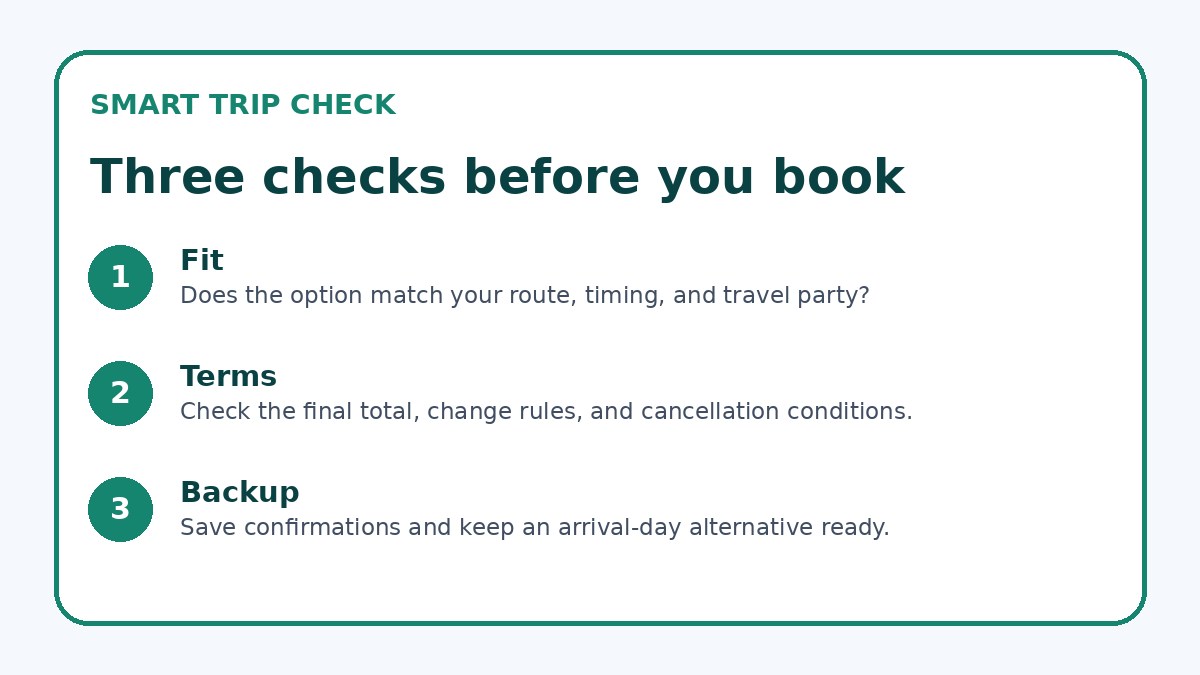
When comparing fares, first identify the change and cancellation rules on the final booking screen. Look for: whether changes are allowed, whether they incur a fixed fee or only a fare difference, whether refunds are permitted and if they'll be issued to your card or as travel credit, and any time limits for free changes. Don’t rely solely on fare class names like “flex” or “economy”; those labels vary by provider. If the provider publishes a tariff or fare rules PDF, scan it for phrases such as “non-refundable,” “change fee,” or “credit valid for X months.”
Next, calculate the real cost of flexibility by combining the fare difference with likely scenarios. For example, a refundable fare might cost significantly more, but if you expect a 20–40% chance of needing to rebook, that premium could be worthwhile. If you’re willing to accept travel credit rather than a refund, note how long that credit lasts and any blackout dates. Also check baggage and seat assignments—some flexible fares include perks that reduce other out-of-pocket expenses, which changes the value proposition.
| Approach | Best for | Tradeoff to check |
|---|---|---|
| Fully refundable fare | Solo travelers with unpredictable plans or fixed commitments | Higher upfront cost but straightforward refunds to the original payment method |
| Changeable fare with fees | Those who want a middle ground: cheaper than refundable, but allows date changes | Lower base fare than refundable, but change fees and fare differences can add up |
| Non-refundable fare with travel credit | Flexible travelers who can reuse credit and accept restrictions | Cheapest up front but refunds are not to cash and credits may expire |
| Separate-leg bookings | Budget-focused travelers comfortable managing connection risk | Lowest fares possible but high exposure to missed connections and no through-protection |
Direct vs. connecting options and how flexibility differs
Direct services are simpler to manage when plans shift: usually a single ticket change covers the entire trip, and missed connections are less likely. Connecting itineraries can be cheaper but introduce complexity: you may need to change multiple legs separately unless the carrier sells a through-ticket with protected connections. If you book separate tickets for each leg, the flexibility of one leg doesn’t protect the other, so check whether the operator offers protected connections or whether separate tickets leave you fully exposed to missed segments.
When evaluating flexibility for connecting trips, verify whether the provider allows reissue of the whole itinerary under one transaction and what happens to unused portions. Some carriers will rebook the remainder of a journey if a delay on the first leg causes a missed connection; others treat legs independently. For solo travelers, the risk of being stranded between legs is higher without someone to manage baggage or logistics, so weigh the convenience of a through-ticket or a later connection buffer against any potential fare savings from fragmented bookings.
Before you book
- On the provider’s final booking page, read and save the exact change and cancellation policy before you pay.
- Check whether refunds go to your original payment method or are issued as travel credit and note any expiry date.
- If your itinerary crosses the border, allow extra buffer time and confirm how late arrivals affect change policies.
- Compare total cost of flexibility by adding potential change fees and fare differences to the base price.
- Decide whether to buy trip protection from your card issuer or a third party to cover interruptions not handled by the carrier.
- If booking a connecting trip, verify whether the ticket is sold through as one protected itinerary or as separate legs.
Decision checklist: choosing the right level of flexibility
Decide based on your personal tolerance for disruption and your schedule rigidity. If your travel date is tied to a non-moveable obligation (a fixed meeting time, medical visit, or training), prioritize refundable or change-permitted fares with low reissue fees. If your plans are tentative—laying groundwork for a later trip, uncertain return date, or reliant on flexible remote work—choose fares that offer free changes or credits that can be applied easily. Always include buffer time for border crossing and local transport when planning connections.
Also consider how much you value extras bundled with flexible fares, such as priority boarding, included seat selection, or increased baggage allowance. These can offset the higher fare and save time at the station or terminal. Finally, before you book, locate the exact change, cancellation, and refund terms on the seller’s final booking page, note any travel-credit expiry, and decide whether to buy with a card that offers trip protections or use a third-party travel insurance policy to cover unexpected disruptions.
Frequently asked questions
Can I rely on a travel credit instead of a cash refund for a flexible ticket?
Travel credit can be useful if you plan to travel again with the same carrier within the credit validity period, but it’s not equivalent to a cash refund. Check the exact expiry, transferability, and blackout restrictions on the final booking page: some credits are non-transferable, require account use, or must be used within a short window. If you might not travel again soon or would prefer your money back, choose a refundable fare or verify whether your payment card offers purchase protection that can be used instead of accepting credit.
How do change fees and fare differences interact when I rebook a new date?
Most carriers charge both a change fee and any difference between the original fare and the new fare, but policies vary. The total cost equals the published change fee plus any price gap; sometimes flexible fare classes waive change fees and only apply the fare difference. To understand the real cost, simulate a date change on the provider’s booking page (without completing payment) or read the fare rules PDF; that reveals whether changes are allowed and how fees apply. Remember to confirm whether taxes or service charges are refundable as well.
If I book separate tickets for each leg, how can I reduce the risk of being stranded?
If you take separate tickets to save money, build large time buffers between connections so delays on the first leg are less likely to derail the second. Avoid tight transfers, and consider booking later alternatives on the second leg to allow a missed connection. Keep contact details for local ticket offices and verify baggage transfer policies—if the carriers aren’t partners you may need to collect and recheck luggage. Finally, determine rebooking fees for each leg in advance so you can quickly evaluate whether to pay for a change or buy a new ticket.
Final planning note
Choosing ticket flexibility for Vancouver to Seattle transport means balancing the financial cost of flexible fares against the personal cost of being stranded or forced to buy a new ticket. Solo travelers should honestly assess schedule certainty, border crossing risk, and their willingness to accept travel credit rather than refunds. Use the provider’s final booking page to confirm exact change and cancellation rules, credit expiry, and whether any perks reduce other expenses like baggage fees. If uncertainty is high, favor refundable or low-fee changeable fares; if your plans are firm, restrictive tickets can be economical—but only after you’ve documented the refund and change terms.
Continue planning
Check current options and final conditions
Use the provider page to confirm live availability, the final total, cancellation terms, and every condition that matters to your trip.
This evergreen planning guide was created with AI-assisted drafting and a structured quality review. It does not display live prices, schedules, availability, visa guidance, or provider rankings. Verify current details before booking. Some links are affiliate links; we may earn a commission at no additional cost to you.