Practical answer first: pick a direct high-speed train if you want the simplest door-to-door experience with minimal transfers; choose coach if you need the lowest-fuss, often cheaper end-to-end option; consider a combination of rail plus local transit if your departure or arrival points are away from central stations. The rest of this article explains how to decide between rail, coach, or mixed options based on terminal fit, luggage friction, timing flexibility, and disruption plans.
You’re planning a travel day, so think end-to-end: how you get to the station or coach terminal in Paris, how you handle luggage between platforms or services, and how you’ll arrive and reach your Amsterdam accommodation. I’ll walk you through practical tradeoffs, what to check before booking, how to budget time, and the simplest disruption backups so you can actually reach your next door without surprises.
Choosing between train, coach, or a mixed plan
Start by mapping door-to-door time, not just the on-board duration. A direct high-speed train connecting central Paris stations to central Amsterdam locations often wins on simplicity because it reduces the number of pickups and drop-offs and frequently places you nearer city transit on arrival. Conversely, a coach can be attractive for a traveler prioritizing cost and who is comfortable with longer on-road time and potential stops. A mixed plan — for example, a short regional train to a long-distance coach terminal or vice versa — can make sense when schedules or station locations match your lodgings, but it adds transfer steps and more coordination.
To decide, list where you’ll be staying in Paris and where in Amsterdam you need to end up. Measure the transfer time and complexity from your Paris address to each departure terminal, then from arrival points in Amsterdam to your accommodation. Factor in luggage handling: more transfers usually mean more hauling. If you prefer fewer decisions on the travel day, lean toward options with fewer transfers even if they cost slightly more.
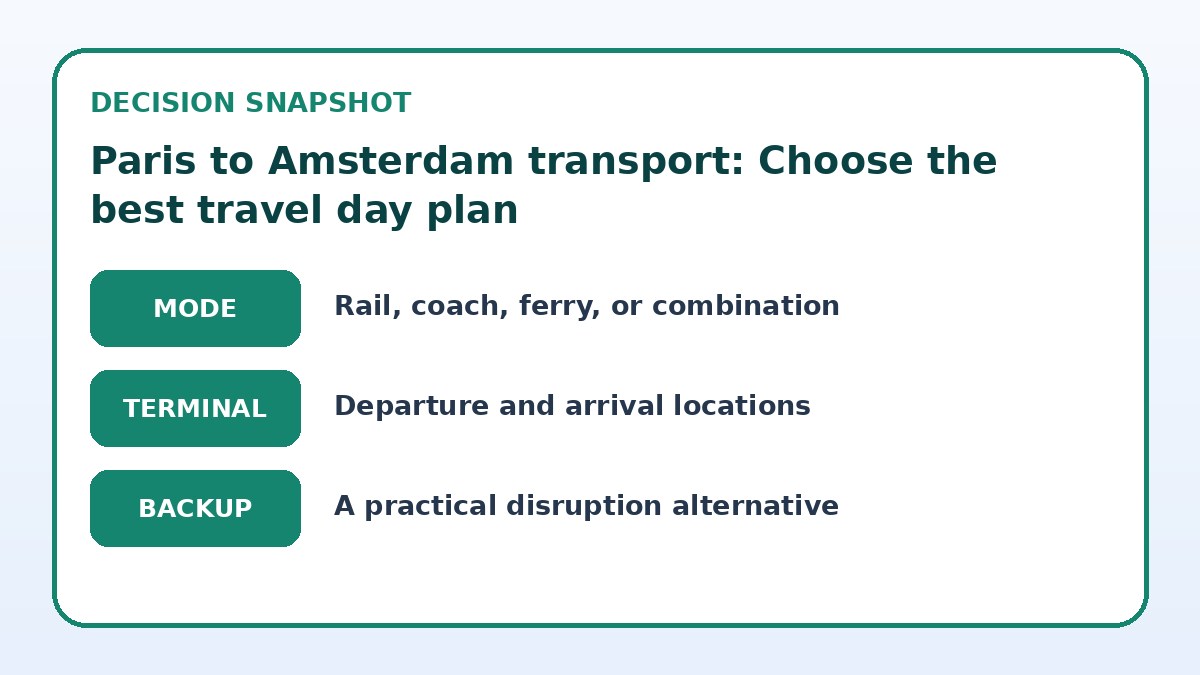
Choose the end-to-end journey plan
| Journey approach | Best for | Friction to check |
|---|---|---|
| Direct high-speed train | Travelers prioritizing fewer transfers and central arrival locations | May be more expensive and less flexible on schedule changes |
| Intercity coach | Budget-conscious travelers comfortable with longer door-to-door times | Often stops outside central hubs, adding local connections and transfer friction |
| Mixed rail and coach connections | Those optimizing schedules when direct options don't match departure or arrival locations | Adds coordination and luggage handling between different operators |
| Private transfer or taxi segments combined with public travel | Travelers valuing door-to-door convenience and fixed pickup points | Higher cost and potential traffic delays on road-heavy legs |
Check live intercity options
Look beyond the ride itself and compare terminals, transfers, luggage, and arrival fit.
Terminal fit: stations, coach terminals, and local connections
Terminal fit matters more than many travelers expect. Central Paris train stations and central Amsterdam stations tend to connect directly to local metro or tram networks that simplify the final leg to your hotel. Coach terminals are sometimes outside the primary transit hubs and can add a tram, metro, or taxi leg. Before you book, check walking distances, availability of luggage storage or elevators for heavy bags, and whether your arrival terminal has straightforward onward transport for your schedule — early morning or late-night arrivals change what’s convenient.
Think about accessibility and baggage movement: an apparently short walk between platforms can become challenging with large suitcases or during peak hours. If you have mobility needs, verify station accessibility features and elevator availability on the provider’s booking page or the station’s official site. Also confirm how close short-term taxi ranks, rideshare pickup points, or reliable local transit stops are to each terminal so you can plan the full door-to-door itinerary rather than just the ride itself.
Luggage, transfer friction, and packing strategies
Packing and luggage rules shape which mode is most convenient. Some operators let you store larger suitcases in dedicated compartments; others limit carry-on size or require you to stow bags overhead. More transfers increase the chance you’ll need to carry a heavy case up or down stairs, through ticket barriers, or across platforms. For a first-time traveler on a single travel day, a single wheeled suitcase plus a small daypack usually eases movement and reduces boarding stress. Consider collapsible carry options that can be stowed beneath seats when space is limited.
If you are deciding between modes, factor in how luggage is handled at each step: will you need to collect and re-check bags, or do you keep them with you? Longer transfer windows can give peace of mind but extend door-to-door time. Pack a small emergency kit (charger, snacks, water, and a compact rain layer) in your daypack, so you don’t have to open your main luggage during tight transfers or unexpected waits.
Compare the practical alternatives
Use the final page to confirm what is actually offered on your dates and save a workable fallback.
Intercity travel checklist
- Compare door-to-door times including walks, local transit, and taxi legs before booking any single segment.
- Verify luggage allowances, onboard storage space, and transfer baggage rules on each operator’s final booking page.
- Reserve a seat or boarding pass when available to reduce last-minute boarding uncertainty and platform stress.
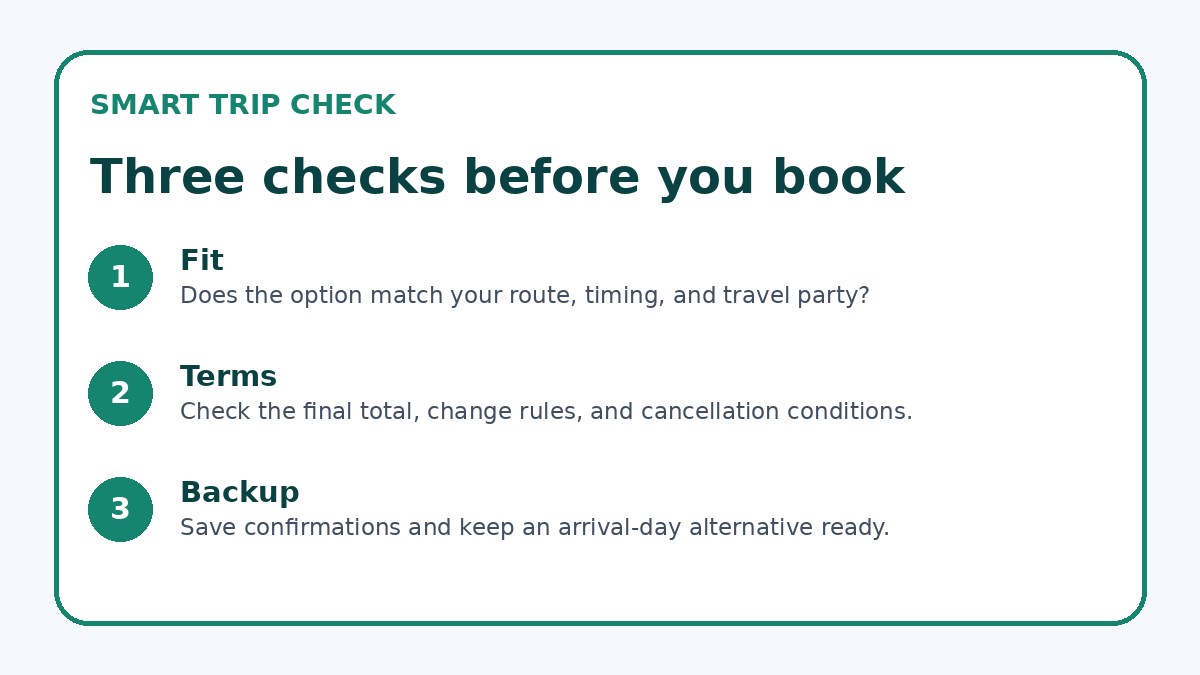
- Plan at least a 60–90 minute buffer for major transfers and a longer buffer if you must change stations in Paris.
- Save offline maps, operator contact numbers, and your accommodation address in multiple forms (phone and paper).
- Identify two alternate services or routes and know how to rebook or contact support if your original service is disrupted.
Timing flexibility and disruption backup plans
Build buffer time into the travel day. Aim to arrive at your departure terminal with comfortable time for ticketing, security, or platform access, and add extra margin if you need to exchange currency or pick up travel essentials. If your schedule is tight around hotel check-out or a tour reservation, consider booking a slightly earlier local connection the night before to reduce morning stress. Flexibility on departure times also gives you options if an earlier service is delayed and you need another available seat.
Always prepare a clear backup plan for disruptions. Identify at least two alternate services (later trains or coach operators) and an alternative route that avoids the expected transfer point. Know how to find live information on the provider’s official pages and where to confirm booking changes; Trip.com can be used as a comparison tool but always verify changes on the operator’s final booking page. Keep contact details for your accommodation and a simple map of alternate routes on your phone or printed copy so you can adapt quickly.
Rail & Intercity Transport questions travelers ask
Should I book a direct train from Paris to Amsterdam or look for cheaper coach options?
If simplicity and fewer transfers are your priority, a direct train typically reduces the number of steps between doorways and places you nearer central transit at both ends. Coaches can be cheaper and provide a single-seat option for long-distance travel, but they sometimes arrive at terminals further from city-center accommodations, requiring additional onward travel. Balance how much you value door-to-door convenience against budget and the acceptable total journey time, and check the operator pages for luggage rules and boarding procedures before buying.
How much transfer time should I allow when changing from a Paris station to an international departure?
Allow extra time for ticketing, security checks, and moving luggage between platforms or terminals, especially if you must switch stations in Paris. A practical buffer for major transfers is 60–90 minutes, longer if you need to change stations or use metro/tram connections. If you’re traveling during peak hours or with bulky luggage, increase the margin. Always confirm station layouts and step-free access on official station or operator pages to avoid surprises when you arrive.
What is a reliable disruption backup for the Paris to Amsterdam travel day?
A good disruption backup includes knowing two later services on the same route, at least one alternative route that avoids a single transfer point, and simple accommodation fallback options near major stations if delays push your arrival late. Keep operator contact info, the ability to rebook or exchange tickets, and local transport options (taxi, rideshare pickup points) ready. Use comparison tools like Trip.com to view alternatives but always confirm availability and change policies on the provider’s official booking page before relying on a plan.
Final decision note
For first-time visitors, planning the Paris to Amsterdam travel day is about minimizing friction and ensuring predictable door-to-door movement. Choose the mode that matches your tolerance for transfers and luggage handling: trains for simplicity, coaches for cost-conscious flexibility, and mixed or private combinations when station locations or schedules demand it. Verify luggage rules, station access, and local onward transport on each provider’s booking page, and keep clear backups and buffer time. With those steps, you’ll reduce stress on the travel day and arrive in Amsterdam ready to start exploring.
Continue planning
Check current options and final conditions
Use the provider page to confirm live availability, the final total, cancellation terms, and every condition that matters to your trip.
This evergreen planning guide was created with AI-assisted drafting and a structured quality review. It does not display live prices, schedules, availability, visa guidance, or provider rankings. Verify current details before booking. Some links are affiliate links; we may earn a commission at no additional cost to you.