Practical answer first: if you’re traveling Seoul to Bangkok with extra luggage, pick the flight option that minimizes connections and maximizes checked-bag allowance or flexible fare rules — then add buffer time at both departure and arrival airports for check-in, security, and any oversized-bag handling. Before you search, collect exact travel dates, number and weight of bags, who’s traveling, and whether any pieces are oversized or require special handling. With that in hand you can compare direct versus connecting flights, confirmed baggage allowances across fare types, and the time required for rechecking or transfer. This article walks through route-versus-fare tradeoffs, baggage and connection risks, schedule-fit strategies, and what fare conditions you must verify on the airline’s final booking page.

See live routes for your exact travel day
Compare direct and connecting choices with the same baggage and traveler details.
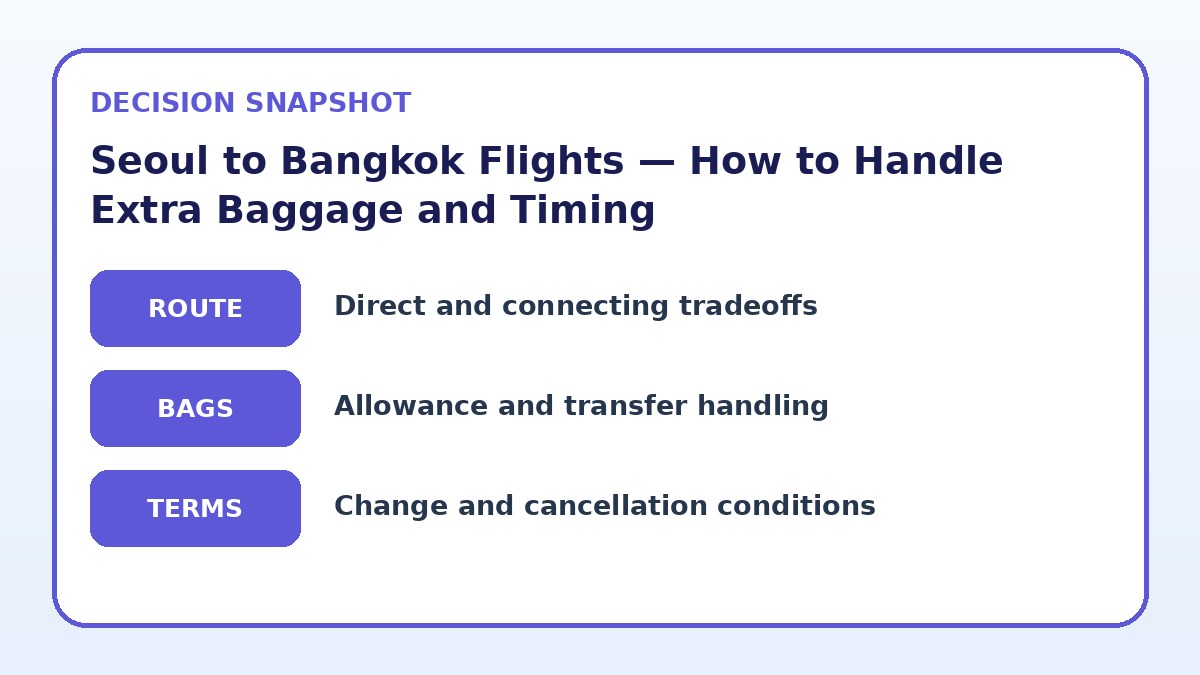
Routing: direct versus connecting flights
The simplest routing decision for travelers with extra luggage is often to prioritize direct flights because they reduce the number of times baggage must be handled and the risk of missed connections. A nonstop route from Seoul to Bangkok means you check your bags once at departure and collect them only at arrival, minimizing the chance of damage or misrouting. But direct flights may offer fewer fare tiers that include generous baggage allowances. If a direct option doesn’t include the baggage you need, you’ll compare the cost of an upgraded fare or paying excess fees against a connecting itinerary that offers better baseline allowances.
Connecting flights can be attractive when they provide a lower fare that includes more checked baggage, or when travel dates force a connection. However, connections add complexity: you must confirm whether bags will be through-checked to Bangkok or whether you’ll need to collect and recheck them during a layover. Also check minimum connection times at the transfer airport and the practical time needed to transfer oversized pieces between terminals. When comparing routes, map out each leg’s baggage rules and the total door-to-door time so you can weigh convenience against price.
Baggage and connection risk: what to verify
Before booking, gather exact baggage details: number of pieces, individual weights, and dimensions for each item, plus whether anything is sporting equipment, a musical instrument, or fragile. On the airline’s booking page verify the included allowance for your chosen fare, the per-kilogram or per-piece excess fees, and any size limits. If you have connecting flights on different carriers, call or check both carriers’ policies to confirm whether they will interline luggage; do not assume through-checking. If bags must be rechecked, build extra time into the layover and check whether customs procedures require you to clear immigration with your bags.
For special items, such as large suitcases, surfboards, or bicycles, confirm handling requirements and whether advance notice or reservations are needed. Some carriers require online prepayment for oversized items; others limit how many can be accepted on each flight. Note any maximum dimensions that would classify an item as cargo rather than checked baggage. If your plans involve collecting bags and checking them with another carrier, plan for potential storage or trolley issues at each airport and verify whether airport staff will accept large items without additional paperwork.
Compare flight-selection strategies
| Flight strategy | Best for | Risk to check |
|---|---|---|
| Pick a nonstop direct flight with standard checked baggage included | Travelers who want minimal handling and faster arrival with predictable baggage flow | May offer less generous included allowance or a smaller range of fare choices to avoid fees |
| Choose a connecting itinerary with higher included baggage allowance | Those who need more free kilograms or pieces and who accept an extra transfer | Raises the risk of rechecking, delays, or missing a tight connection with heavy luggage |
| Book a lower-fare ticket and purchase extra baggage online in advance | Budget-focused travelers who can plan sizes/weights ahead and save compared with airport rates | You must prepay and confirm availability for oversized items; changes can become expensive |
| Split-ticket approach: separate carriers to mix low fare and large allowance | Experienced travelers seeking optimal fare versus allowance tradeoffs across carriers | Higher complexity: no through-check guarantees, and you must allow extra time to recheck bags |
Recheck the complete itinerary
Confirm airports, connection handling, baggage, and change conditions before deciding.
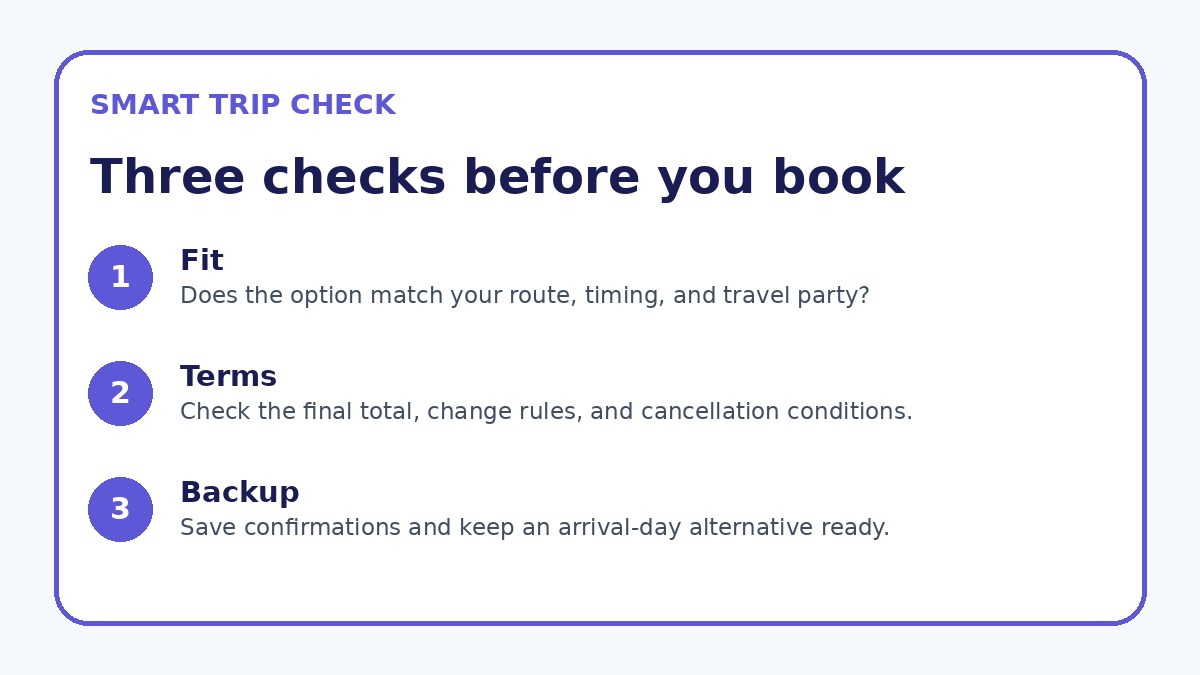
Schedule fit: building realistic airport time
At departure, factor more time than the airline’s minimum recommended check-in window when you have extra luggage. Allow a baseline of two to three hours at Seoul’s airports for international departures if you’re handling oversized or multiple pieces: this covers check-in, oversized bag drop, security screening, and any last-minute repacking. Rush-hour traffic and longer lines at peak travel times can add unpredictable delays, so if you have an early morning or late-night flight, double-check transport options to the airport that match your baggage needs — for example a shuttle with trunk space or an airport limousine service.
For connections, your required buffer increases. If the itinerary does not guarantee through-checked bags, allow enough time to clear immigration, retrieve and recheck luggage, pass export security, and move between terminals if needed. Even when bags are through-checked, allow time for potential delays, aircraft late arrivals, and the need to switch terminals. At the arrival airport in Bangkok, account for longer baggage-claim times for oversized items and any necessary customs inspections. Planning with concrete minute estimates for each step keeps your total connection buffer realistic.
Flight details to verify
- Before price-checking, write down travel dates, number of passengers, and exact weight/dimensions of every checked item.
- On the airline booking page, confirm baggage allowance per passenger and any per-piece or per-kilogram excess fees for your fare.
- If your itinerary has a connection, call both carriers to confirm whether luggage will be through-checked and request confirmation in writing.
- Reserve or prepay for oversized or special items on the airline’s site if required, and save the confirmation or receipt.
- Plan door-to-door timing: add extra transfer minutes for oversized luggage, immigration, customs, and potential terminal transfers.
- At check-in, arrive early, present any special-handling confirmations, and get a baggage receipt or tag number for each checked item.
Fare conditions and what to confirm before booking
Ticketing rules greatly affect how flexible you can be about baggage and time. Before you pay, confirm what the fare includes and how it behaves if you need to change flights: check change and cancellation fees, baggage allowance entitlements per fare class, and whether upgrades or extra bags can be purchased online after booking. If you plan to add paid baggage later, verify the maximum charge you might face and whether the booking page shows capacity limits for oversized items. If you need to reserve space for special baggage, look for an option to reserve or note it in passenger remarks and confirm acceptance by the carrier.
Also verify final details that commonly change: accepted payment types, whether a boarding pass will be issued electronically for all segments, and any airport check-in cutoffs for oversized items. If your itinerary uses more than one carrier, check the contract of carriage for each and confirm interline baggage agreements on the booking page or by phone. When in doubt, contact the airline’s baggage desk and the airport’s ground-handling office and save screenshots or confirmation numbers for any special baggage arrangements you book. Trip.com may be useful to compare live availability and fare conditions, but always validate the final rules on the airline’s official page before confirming.
Flight Guide questions travelers ask
How much extra time should I allow at Seoul airports when I have several oversized bags?
Allow at least two to three hours for international departures when handling oversized or multiple checked items to cover check-in, oversized-bag processing, payment of any extra fees, and security screening. If you need ground handling assistance or are traveling during peak hours, add an extra 30–60 minutes. For itineraries involving a connecting carrier where bags must be rechecked, add additional time for immigration, baggage retrieval, and re-drop — often one to two hours depending on the airport layout and terminal transfer distances. Check the airline’s published check-in cutoff for oversized items and plan earlier than that cutoff.
Can I rely on through-checking for luggage on a connecting ticket from Seoul to Bangkok?
Do not assume through-checking unless the booking confirmation explicitly states it and all flights are on the same ticket or covered by an interline agreement. When bookings involve different carriers or separate tickets, you will frequently need to collect and recheck luggage during layovers and possibly clear customs. Always verify with both carriers before you book, and ask for written confirmation if the airline agrees to through-check. If through-checking is critical, favor itineraries sold on a single ticket or with airlines that explicitly advertise interline handling on your specific routing.
What should I check about fare rules to avoid surprises with heavy luggage on my Seoul-Bangkok trip?
Review the fare conditions for included baggage entitlement, change and cancellation fees, and whether the carrier allows online purchase of additional baggage at a discounted rate. Check whether excess-baggage costs are per kilogram or per piece and whether dimension limits apply. Look for any special handling requirements that require prior notification or reservation. Finally, confirm how refunds or changes are handled if you later reduce or increase bags, and save screenshots of the booking page or email confirmations that document the baggage terms you relied on when booking.
Final decision note
For travelers flying Seoul to Bangkok with extra luggage, prioritize a route and fare that minimize handling and clearly match your baggage needs. Start by documenting exact bag counts, weights, and dimensions, then compare direct and connecting itineraries against included allowances and the practical time needed at each airport. Always verify interline baggage agreements and fare conditions on the carrier’s final booking page, prepay or reserve special-item handling when required, and build generous time buffers for check-in and transfers. With those checks in place you’ll reduce the chance of costly surprises and make the trip more predictable and comfortable.
Continue planning
Check current options and final conditions
Use the provider page to confirm live availability, the final total, cancellation terms, and every condition that matters to your trip.
This evergreen planning guide was created with AI-assisted drafting and a structured quality review. It does not display live prices, schedules, availability, visa guidance, or provider rankings. Verify current details before booking. Some links are affiliate links; we may earn a commission at no additional cost to you.