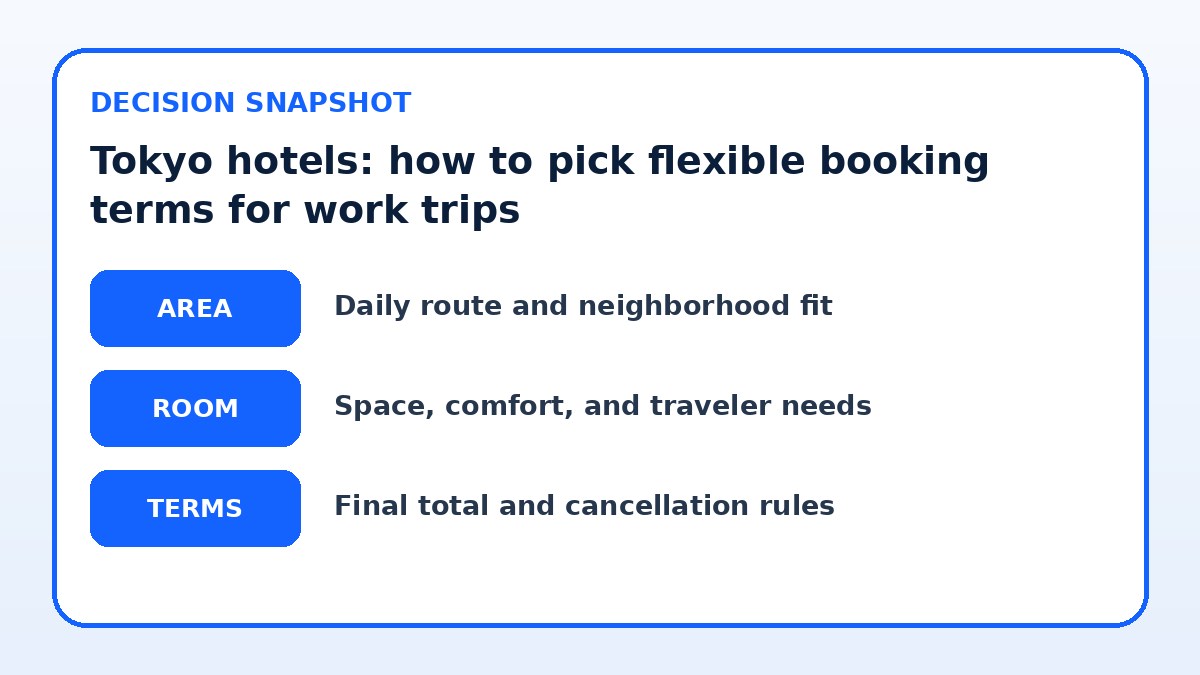
Choose the stay area first: it determines daily commute time, meeting access, and which flexible booking terms matter most. For a short Tokyo business trip, “flexible” can mean refundable rates, free date changes, or transferable bookings — each matters differently depending on your schedule and team. If you have back-to-back meetings in different parts of the city, prioritize hotels near transport hubs with lenient same-day cancellation and easy rebooking options. If your itinerary is uncertain, prioritize full refunds within a reasonable window or no-penalty modifications. This article helps business travelers compare four area-selection approaches, balance daily-route friction against booking flexibility, match rooms to party and gear needs, and confirm the exact cancellation and change conditions to verify on a hotel's booking page before committing.

Check live stays in the areas that fit
Use your dates and party size to compare current rooms after you narrow the neighborhood fit.
Neighborhood fit: pick an area that aligns with your meeting map
Begin by mapping your most important meetings and transport nodes in Tokyo. Business travelers often prioritize areas that reduce transfers: Marunouchi and Nihonbashi cluster around Tokyo Station for Shinkansen and airport limousine access; Shinagawa and Tamachi are convenient for southside business districts and Haneda; Shinjuku and Shibuya give quick access across many lines but can add walking time to specific offices. Choose the area that minimizes your single longest journey each day rather than average travel time, because a single late-night or early-morning trip is the one most likely to be disrupted and have ripple effects on your schedule.
Once you’ve shortlisted neighborhoods, look at the type of hotels common there: large international chains tend to offer clearer corporate flexible policies, while boutique properties may have stricter rules but localized benefits like later checkouts or concierge help. Consider whether you need immediate access to a station lobby or prefer a quieter business hotel set back from nightlife. Neighborhood fit should guide which flexible terms you prioritize — if you expect to move between neighborhoods during the trip, prioritize flexible change policies; if you will be based in one area, prioritize refundable rates and straightforward cancellation windows.
Choose an area-selection strategy
| Area approach | Best for | Tradeoff to check |
|---|---|---|
| Base-neighborhood approach (choose nearest station to meetings) | Travelers with tightly clustered meetings and fixed locations | May pay more for prime-location hotels with stricter rates but saves commuting time and reduces rescheduling needs |
| Hub-based approach (stay by a major transfer/airport hub) | Travelers juggling inbound/outbound legs or multi-district meetings | Offers transport flexibility but can increase walking or taxi time to specific offices |
| Cost-flexibility balance (choose neighborhoods with many hotel options) | Travelers willing to trade a moderate commute for easier last-minute rebookings | Neighborhoods with many options may offer looser change terms but could add transit complexity |
| Quiet-base approach (choose calmer business districts outside nightlife) | Travelers needing rest, late-night work, or reliable sleep before meetings | Lower noise and better rest may mean fewer properties with flexible corporate policies nearby |
Daily-route friction: how transit and walks change the value of flexibility
Evaluate friction factors: number of transfer changes, walking at each end, and platform-to-exit distance inside large stations. A hotel five minutes’ walk from a small station entrance might save more time than a hotel advertised as nearer to a major hub but requiring long underground walks. For Tokyo business trips where meetings may run late, a hotel close to your last appointment or with easy late-night transit options reduces the downside of having to rebook on short notice. If your itinerary includes airport runs, weigh proximity to train or limousine bus stops; that can make a nonrefundable but cheap rate less risky compared with staying farther away.
Flexible booking value rises with friction: the more transfers and late-night walking involved, the more worthwhile a no-penalty same-day cancellation or free rebooking option becomes. Conversely, if you are in a hotel cluster by one key station and all meetings are within walking distance, you may accept stricter change policies in exchange for a lower rate or better room category. When comparing hotels in an area, add transit buffer time to meeting schedules and treat potential delays as a cost — then choose booking terms that economically cover that cost.
Now compare like with like
Keep the same dates, guests, room needs, and cancellation preferences while you compare the final choices.
Room and party needs: what flexibility should cover beyond cancellation
Think beyond simple refunds. Business travelers often need adjustable room types, late checkout, meeting-room access, and reliable Wi‑Fi. If you may need to add a colleague or swap from single to twin occupancy, verify whether the flexible rate allows same-day room-type changes without rebooking or penalty. Check whether breakfasts, lounge access, or business-center services included under a flexible rate remain honored if dates shift. For equipment-heavy visits, confirm porter service or dedicated storage options and whether those services are affected by rate class or booking channel.
Also confirm the hotel’s policy for corporate or third-party modifications: some flexible rates allow the traveler to modify online, while others require contacting the booking provider or the hotel directly, which can delay changes and incur fees. If multiple people are traveling on the same corporate itinerary, check whether transfers of reservations or splitting bills are permitted. These operational details matter as much as cancellation windows when you need to rearrange rooms, add a night, or move colleagues between nearby properties.

Hotel booking check before payment
- Map key meeting addresses and pick the Tokyo neighborhood that minimizes your single longest daily commute.
- On the booking page, read the full cancellation and modification policy, noting exact cut-off times and refund method.
- Confirm whether the flexible rate allows online modifications or requires phone support and save contact details.
- Verify room-type change rules, extra-bed policies, and whether included services (breakfast, lounge) stay intact after modifications.
- If traveling with colleagues or on corporate billing, confirm transferability of reservations and invoicing options.
- Screenshot and save the booking confirmation and policy language so you can present it at check-in or in disputes.
Final booking terms: what to verify on the provider’s booking page
Never assume terms listed in a summary match the full policy. On the provider’s final booking page, verify the exact refund window (for example, whether refunds apply up to 24 or 48 hours before check-in), the cost of any late-cancellation penalty, and whether refunds are processed to the original payment method or as credits. Confirm whether modifications can be made online, which cut-off times apply, and whether a third-party booking site or the hotel itself handles changes — these details determine speed and friction when plans shift.
Also check what conditions invalidate the flexible terms: some rates exclude group bookings, long stays, or promotional inclusions; others require identification matching at check-in. If you plan to use corporate billing or a purchase order, verify whether the flexible rate supports invoicing or whether prepayment is mandatory. When in doubt, screenshot or save the booking terms and confirmation page so you can present them quickly to hotel staff or your travel manager if a dispute arises.
Hotel Guide questions travelers ask
How do I decide between refundable and changeable-but-nonrefundable rates for a Tokyo business trip?
Refundable rates return money if you cancel within the stated window, which suits trips at high risk of cancellation. Changeable-but-nonrefundable rates let you alter dates or names without cash refunds but may offer credits or free rebooking within policy limits. Choose refundable when cancellation likelihood is higher than the chance you’ll need only a date shift; choose changeable when you’re confident you’ll travel but schedule timing is uncertain. Always verify the provider’s process for applying credits and any blackout or holding periods before booking.
What specific booking terms should a traveling team lead check when reserving multiple rooms in Tokyo?
Team leads should confirm group booking rules, whether multiple rooms under one reservation can be modified individually, and if cancellations incur per-room penalties. Check how the hotel handles rooming list changes, linking rooms, corporate invoicing, and whether loyalty benefits apply to group bookings. Also verify whether the flexible rate covers early check-in or late checkout requests for the whole group, and whether any deposit or prepayment requirements differ for multiple rooms.
If my meeting runs late, which flexible hotel terms reduce risk of costly disruptions?
Prioritize hotels with lenient same-day cancellation windows, free late check-in, and easy late checkout options. A property that allows free date changes or adds nights without heavy penalties reduces the need for emergency rebooking. Also check the speed of customer service for the booking channel you use; online self-service modifications are faster than phone-only processes. For late-night travel to/from airports, confirm if the hotel offers shuttle options or straightforward taxi procedures to avoid missed departures.
Final decision note
For Tokyo business travel, start by choosing the neighborhood that minimizes your single longest daily journey; that decision shapes which flexible terms save the most time and stress. Compare refundable and changeable rates against your itinerary risk: refundable for cancellation risk, changeable for shifting schedules. Verify the provider’s detailed policy on the booking page — exact cut-off times, who processes modifications, refund methods, and any exclusions for group or corporate bookings. With a neighborhood and a clear list of required flexible services, you can confidently shortlist properties and then confirm live availability and final terms on a booking site or the hotel page.
Continue planning
Check current options and final conditions
Use the provider page to confirm live availability, the final total, cancellation terms, and every condition that matters to your trip.
This evergreen planning guide was created with AI-assisted drafting and a structured quality review. It does not display live prices, schedules, availability, visa guidance, or provider rankings. Verify current details before booking. Some links are affiliate links; we may earn a commission at no additional cost to you.