For business travelers moving between Osaka and Kyoto, the practical question is not just speed but how ticket flexibility affects carry-on plans, meeting schedules and contingency options. Start by deciding whether you need a fully changeable ticket, a fixed-reservation fast train, or a private transfer that lets you depart on demand. Each choice changes the front-door to meeting-door time, luggage handling, and how late cancellations or delays are managed. This article compares four planning approaches — reserve-ahead high-speed rail, flexible local/regional rail, coach or shared shuttle, and private car/hire — with attention to terminal fit, transfer friction, timing flexibility and a concrete disruption backup. Read this to pick the approach that keeps your schedule reliable without overpaying for flexibility you won’t use.
Terminal fit and door-to-door practicality
Start by mapping the full journey from your origin address in Osaka to the meeting address in Kyoto. Stations and coach terminals are rarely next to office buildings, so factor in taxi or subway time, pedestrian transfers, and potential elevator or escalator bottlenecks when carrying a briefcase and rollaboard. Fast-rail services often use major stations with direct taxi ranks and subway links, which can be efficient for tight schedules if you can reserve a seat and stick to the departure time.
If your start or end point is a hotel, conference center, or a suburban office, a private car or shuttle may beat rail for door-to-door simplicity despite longer on-paper travel time. For mixed-mode trips (rail plus taxi or local train), identify which station exits and transfer corridors save steps. Also check whether your train or coach terminal has luggage storage or porter options if you need to split travel segments during the day.
Choose the end-to-end journey plan
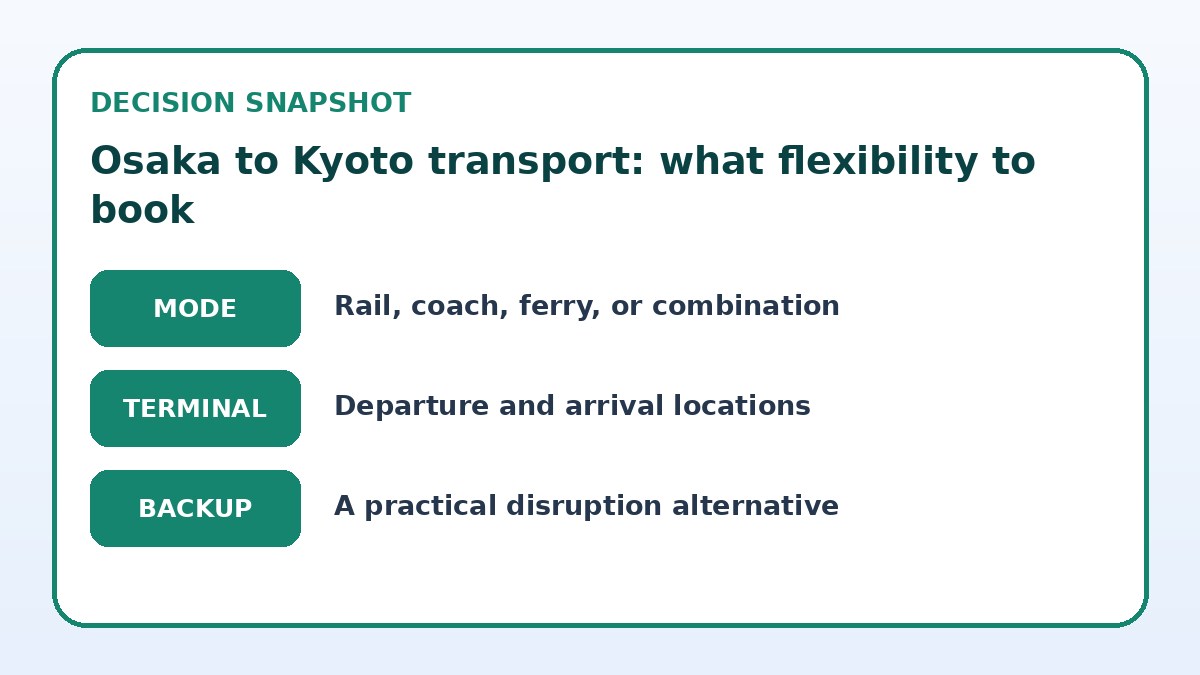
| Journey approach | Best for | Friction to check |
|---|---|---|
| Reserved high-speed rail | Travelers with fixed departure times who need predictable journey time and station connections. | Less same-day flexibility; check seat-change and refund rules before booking. |
| Flexible local/regional rail (walk-up) | Travelers who expect last-minute changes and value departure frequency over speed. | Potentially slower and more crowded; luggage and transfer friction can be higher. |
| Coach or shared shuttle | Travelers with larger luggage or simple door-to-terminal needs who accept fixed pickup times. | Lower transfer hassle for bags but fewer departure options and boarding-location walk time. |
| Private car or on-demand hire | Priority on absolute timing control, minimal transfers, and direct door-to-door service. | Higher cost and exposure to road traffic; verify cancellation and contingency policies. |
Check live intercity options
Look beyond the ride itself and compare terminals, transfers, luggage, and arrival fit.
Luggage and transfer friction
Assess luggage constraints realistically: how many bags, their size, and how much walking you will do between modes. Reserved high-speed trains typically have overhead space and limited designated luggage areas; large suitcases may need to be stored vertically at carriage ends. Local trains can be crowded at rush times, increasing friction when boarding with bulky items — compare carriage layouts and platform accessibility when you plan tight connections.
Coaches and private cars generally provide the least transfer friction for checked luggage, with door-to-door loading and no stairs in most cases. But confirm pick-up and drop-off points: some coach services use central bus terminals that require a short taxi ride to your meeting. If you anticipate making same-day returns or stopovers, check whether providers allow leaving luggage with the operator or if you’ll need a separate locker or hotel hold.
Timing flexibility and ticket change policies
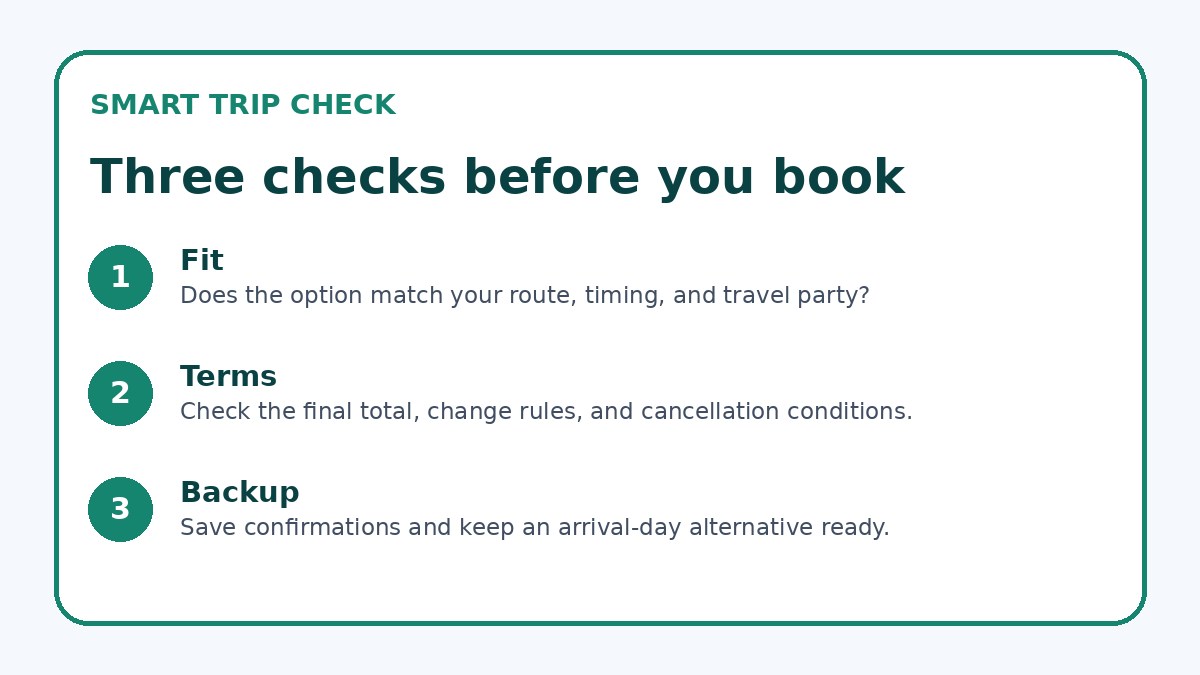
Ticket flexibility ranges from fully changeable open fares to locked-in reservations. For tight business schedules, prioritize options that allow same-day changes or transferable tickets. Before booking, read the fine print on change fees, the time window for free modifications, and whether seat reassignments are guaranteed on replacement services. For reserved trains, check the process for swapping to an earlier or later service on the day of travel and whether there’s an online or station agent option to confirm the change quickly.
If you need absolute flexibility, a walk-up regional service or a private hire offers the most freedom but can mean variable travel times. When choosing a flexible ticket type, balance the cost against the likelihood you will change plans. Always verify on the booking page whether modifications are permitted online, whether documentation is required, and how refunds are handled in case of cancellation.
Compare the practical alternatives
Use the final page to confirm what is actually offered on your dates and save a workable fallback.
Intercity travel checklist
- Map door-to-door time including walk, elevator use, and taxi transfer before choosing a ticket type.
- Confirm luggage allowances, carriage layout, and whether oversized bags need dedicated storage.
- Read the provider’s change and refund conditions on the final booking page before completing payment.
- Identify two realistic alternative departures or modes to use if your first option is delayed.
- Save screenshots of booking confirmations and policy pages for on-the-spot clarification at stations.
- If using a private hire, confirm the pickup point, driver contact, and a traffic contingency plan.
Disruption backup and realistic alternatives
Plan a disruption backup that reflects your meeting tolerance for delay. For rail passengers, identify the next few departures you could reasonably reach and whether the ticket allows rebooking on a later service. If you rely on a single reserved departure, know the station agent procedures and local taxi availability in case trains are delayed or canceled. Keep emergency contacts for your company and local transport operators, and have an offline map showing alternate routes.
For a higher certainty of arrival, pre-book a private transfer or arrange a paid taxi contingency that can be called if rail services are disrupted. If you prefer public modes, check coach and local-train schedules as fallback options and verify their boarding points. Consider purchasing a flexible ticket that permits same-day changes, and save screenshots of cancellation and change policies from the provider’s final booking page to avoid confusion when timelines are tight.
Rail & Intercity Transport questions travelers ask
Should I always pick a reserved high-speed train for Osaka to Kyoto transport when on business?
Not always. Reserved high-speed trains reduce variability in travel time and often connect directly to major stations with good onward links, which is valuable for strict schedules. But if your meetings can shift or you prefer to depart at different times, a walk-up regional service or private transfer may be better. Choose reserved services when predictable journey time outweighs the need to change plans; verify the reservation change window and any fees on the provider’s booking page before finalizing.
How do I decide between a coach and a private car for door-to-door convenience?
Choose a coach or shuttle when you want lower transfer friction for luggage at a lower per-trip cost and can meet fixed pickup times and locations. Opt for a private car when door-to-door timing precision matters and you need to avoid all intermediate transfers. For either option, confirm the boarding or pickup location relative to your start and end addresses, review cancellation terms, and ensure the operator or driver provides contact details so you can manage last-minute changes.
What should I check about tickets if my return timing is uncertain?
If return timing is uncertain, favor tickets that explicitly allow same-day changes or flexible open fares. Verify whether the ticket can be reissued, the deadline for free changes, and whether seat reservations must be rebooked separately. Some providers restrict rebooking to ticket offices or require online modification within a specific window. Always confirm these details on the provider’s final booking page before purchase and consider carrying a flexible backup such as a refundable private hire or a walk-up regional option.
Final decision note
For business travel between Osaka and Kyoto, flexibility is about matching ticket terms to the real constraints of your day: meeting time windows, luggage needs and tolerance for transfers. Reserved trains give predictable journey times but require a commitment to departure slots and an understanding of change penalties. Walk-up regional services and coaches trade speed for frequency and luggage ease, while private hires offer door-to-door control at higher cost and vulnerability to traffic. Before booking, map the full door-to-door route, verify change and refund policies on the final provider page, and prepare at least one realistic alternative. If you want a quick place to compare current availability, Trip.com can list options, but always verify provider rules on their booking pages.
Continue planning
Check current options and final conditions
Use the provider page to confirm live availability, the final total, cancellation terms, and every condition that matters to your trip.
This evergreen planning guide was created with AI-assisted drafting and a structured quality review. It does not display live prices, schedules, availability, visa guidance, or provider rankings. Verify current details before booking. Some links are affiliate links; we may earn a commission at no additional cost to you.