Practical answer first: for most families traveling Seoul to Jeonju, pick the mode that minimizes transfers between big stations or terminals and matches your luggage and timing needs — typically a direct intercity train if you value simple station-to-station transfers, or a direct coach if you prefer terminal-to-terminal convenience with fewer stairs and easier luggage handling. If your itinerary includes last-mile child-friendly concerns (strollers, family restrooms), rank options by how many times you must change platforms, station type (underground vs. surface), and whether transfers require a long walk or a separate shuttle.
This article explains how to compare rail and coach choices, what to check at each terminal, how to calculate luggage and transfer friction, and what backup plan to prepare for disruptions or missed connections. It focuses on end-to-end practicality: door-to-door timing, family comfort, and the transfer steps you’ll actually make with kids and bags in tow.
Choosing rail or coach: terminal fit and family priorities
Start by listing what matters most for your family: minimal platform changes, stroller access, luggage volume, and where you start and end in Seoul and Jeonju. Trains arrive and depart from major railway stations, which usually offer clean waiting areas, platform elevators, and frequent taxi ranks. Coach terminals are often at dedicated bus stations with ground-level boarding, wide luggage bays, and row seating that can be easier for parents managing children and bags.
Consider where you will be before departure and after arrival. If your Seoul accommodation is closest to a subway line that connects smoothly to a main train station, a rail option may be faster overall despite similar in-vehicle durations. Conversely, if your arrival point in Jeonju is a neighborhood served directly by buses from the coach terminal, that door-to-door convenience might outweigh a slightly faster rail ride. Map the first and last 30 minutes of your journey rather than the ride alone.
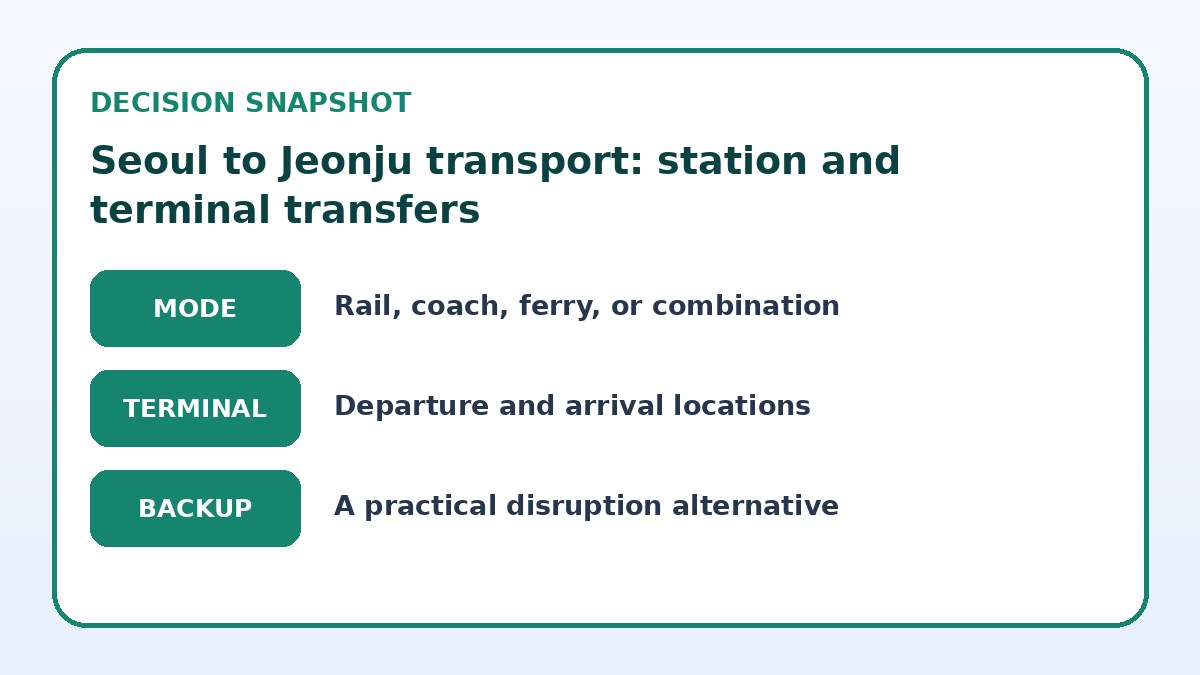
Choose the end-to-end journey plan
| Journey approach | Best for | Friction to check |
|---|---|---|
| Direct intercity train | Families who want fewer transfers and straightforward station-to-station planning | May require longer walks inside large stations; check elevator access for strollers and luggage |
| Direct intercity coach | Families prioritizing ground-level boarding and simpler luggage handling | Coach terminals can be away from city center hotels, requiring an extra taxi or local bus |
| Subway + intercity train/coach combination | Families starting in a neighborhood far from main stations who value flexible first-mile options | More transfers and vertical movement; plan for stroller folds and extra transfer time |
| Door-to-door taxi or ride-hail (longer distance) | Families needing maximum convenience, direct pickup, and no handling of luggage between modes | Higher cost and potential variability in travel time due to traffic; verify vehicle size for large groups |
Check live intercity options
Look beyond the ride itself and compare terminals, transfers, luggage, and arrival fit.
Luggage and transfer friction: what to expect at stations and terminals
Assess physical transfer steps: elevator availability, distance from platform to taxi rank, and whether you must carry luggage up stairs or along long corridors. Major train stations tend to have elevators and escalators but can be spread out; some platforms may require a long walk to exit gates. Coach terminals usually store large bags on curbside bays, so loading and unloading are often closer to street-level. For families with strollers or a toddler on your hip, fewer level changes are preferable.
Plan how you will move bags between transport modes. If you expect to transfer from a train to a local bus or taxi, choose seating and ticket types that let you keep luggage with you or use station luggage services where available. If moving between terminals and hotels, check whether shuttle services, taxis, or ride-hail options park near terminal exits. When in doubt, select the option that keeps luggage handling to a minimum — each lift, stair, or long corridor adds fatigue and time.
Timing flexibility and family-friendly schedules
Kids and family routines make timing flexibility more valuable than shaving minutes off the ride. Look at how often trains or coaches run during the day and how departure intervals affect your ability to shift plans. Fewer departures mean you must schedule precisely; frequent service gives you flexibility if a child needs an extra restroom stop or you’re delayed checking out of your accommodation. Also factor in platform arrival recommendations and how long before departure you must be at the station for ticketing or boarding.
Choose departures that align with your child’s nap, meal, and activity rhythms. Early morning or late evening trips may be quieter but less friendly if station services like family restrooms or food outlets are limited. Midday departures sometimes offer fuller station services and easier on-the-spot problem solving. If you rely on timed connections (for example, subway to intercity train), choose longer layovers to keep stress low — families are better off with extra minutes than missed connections.
Compare the practical alternatives
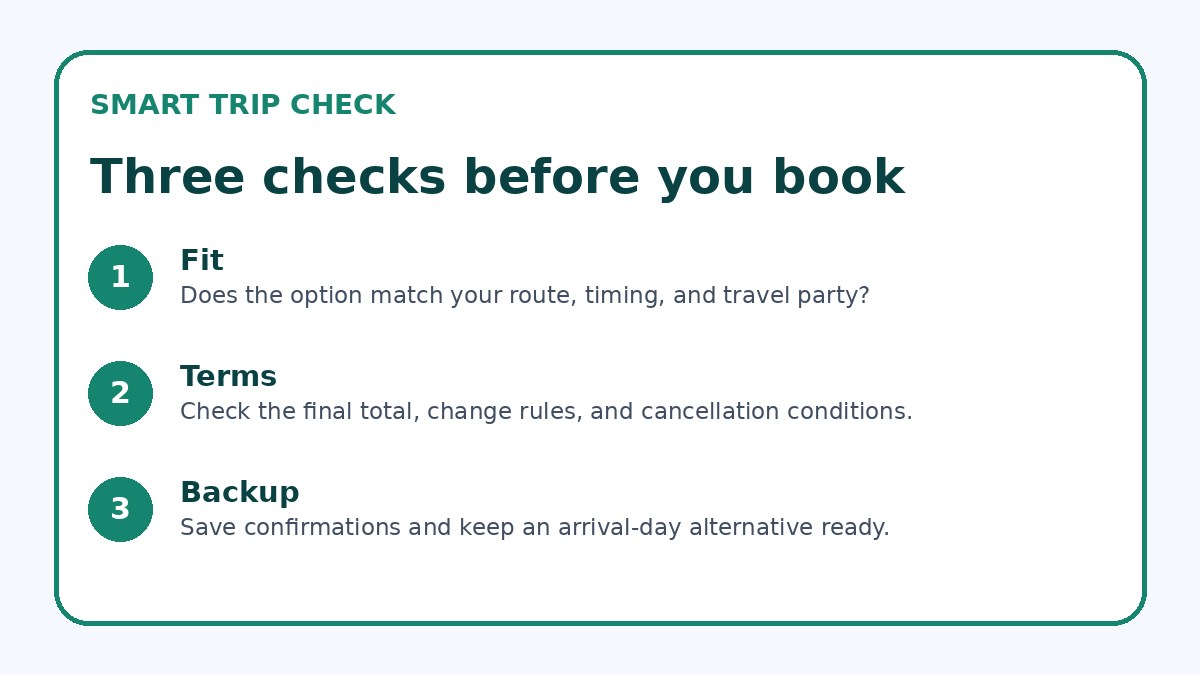
Use the final page to confirm what is actually offered on your dates and save a workable fallback.
Intercity travel checklist
- Map the exact walking route and elevator/escalator locations between your accommodation and the chosen station or terminal.
- Measure or count your main bags and confirm available luggage space on your chosen transport option.
- Book seats or tickets that let you board together and keep children seated nearby; save confirmations on your phone and as screenshots.
- Plan at least a 30–60 minute buffer for transfers, with extra time for rush hours, ticket lines, and restroom breaks.
- Pack an easily accessible family emergency kit with snacks, wet wipes, spare clothes, basic meds, and a portable charger.
- Note alternative departure points and how to rebook or contact providers; verify refund/exchange rules on the provider’s final booking page.
Disruption backup: simple contingency plans for families
Prepare a short, realistic backup plan that your family can execute calmly. Identify the nearest alternative departure points in Seoul and Jeonju, such as a different train station or a coach terminal, and save their public contact numbers or apps. Keep a small emergency kit with snacks, a change of clothes for children, medication, and portable charger so short delays are tolerable. If weather or service alerts are possible, subscribe to provider updates and set a communication plan so everyone knows where to meet if separated.
Decide on a clear rebooking approach ahead of time: whether you will wait for the next available service, take a taxi for an immediate door-to-door option, or split responsibilities so one adult manages tickets while another handles kids and luggage. If you need to buy replacement tickets, verify refund and exchange rules on the provider’s booking page before you travel. Trip.com can be used to compare current availability but confirm provider policies on the final booking page to avoid surprises.
Rail & Intercity Transport questions travelers ask
How do I choose between arriving at Jeonju train station or the bus terminal with kids?
Decide based on your final destination in Jeonju and the physical transfer ease. Train stations usually sit near urban centers with clear taxi ranks and often more frequent local buses; terminals may be slightly outside the central area but offer ground-level boarding and larger luggage bays. Check the walk or transfer from each arrival point to your accommodation, look for elevators and stroller-friendly routes, and consider whether you prefer fewer platform changes or easier luggage loading. Verify station maps and local transit connections before you book.
What luggage and stroller tips make transfers easier for families?
Minimize the number of separate bags and keep essentials in a daypack for quick access. Use a compact, foldable stroller that fits in elevators and narrower passageways; practice folding and unfolding before travel. At stations, choose carriages closest to exits when possible to shorten walks. If you have heavy suitcases, pack a small rolling bag for immediate needs and check larger items if the coach or train allows checked luggage. Confirm elevator locations on station maps to avoid stairs during transfers.
If my train or coach is delayed or canceled, what should families do first?
Stay together and find a staff help point or information desk to get official options for rebooking or refunds. Prioritize children’s immediate needs — food, shelter, restroom — while one adult handles tickets and phone calls. Ask staff about the next departures and alternative routes, and consider a short taxi if it restores a manageable door-to-door plan. Before traveling, know the provider’s rebooking rules on their booking page and have necessary contact numbers saved so you can act quickly without searching through emails or apps.
Final decision note
For families traveling Seoul to Jeonju, the practical choice balances how many transfers you’ll make, where each station or terminal sits relative to your origin and destination, and how much luggage and stroller handling you’re willing to manage. Prioritize options that reduce vertical movement and long corridor walks, book seats that keep your group together, and schedule extra transfer time to absorb the inevitable pauses that come with children. Keep a simple backup plan and emergency kit so small disruptions stay manageable. Finally, confirm rebooking and luggage policies on the provider’s final booking page; Trip.com is a useful place to compare availability, but always verify details where you buy the ticket.
Continue planning
Check current options and final conditions
Use the provider page to confirm live availability, the final total, cancellation terms, and every condition that matters to your trip.
This evergreen planning guide was created with AI-assisted drafting and a structured quality review. It does not display live prices, schedules, availability, visa guidance, or provider rankings. Verify current details before booking. Some links are affiliate links; we may earn a commission at no additional cost to you.