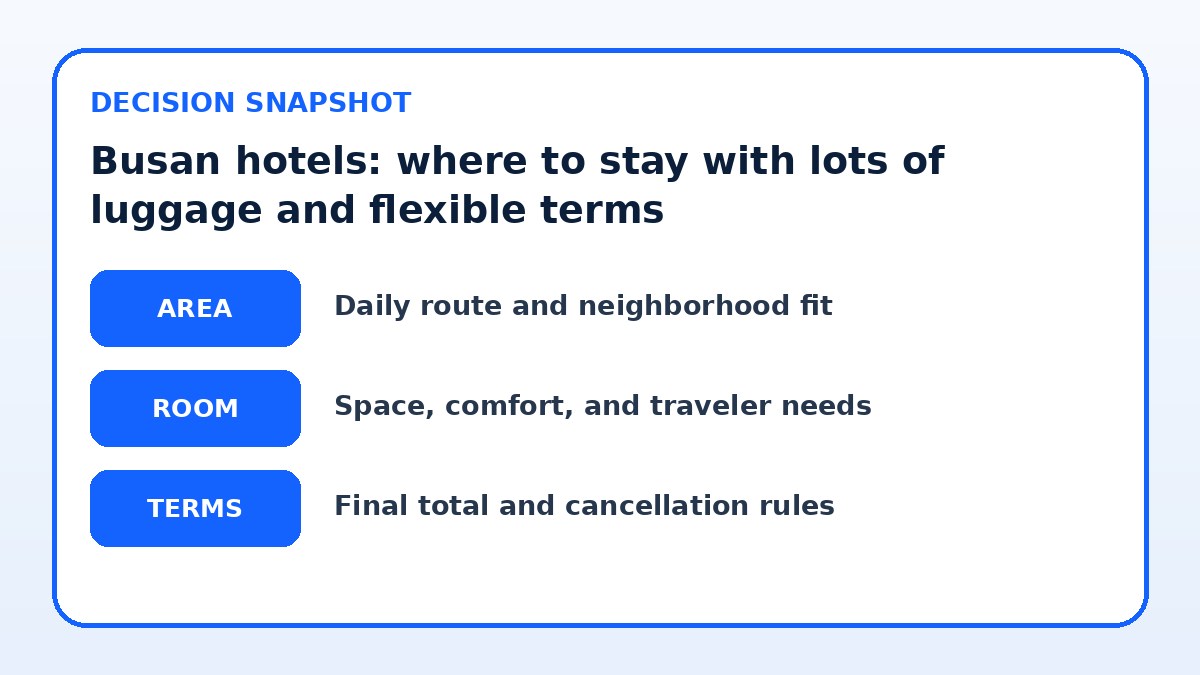
Practical answer first: if you arrive in Busan with extra bags, pick a neighborhood that minimizes transfers between arrival points and your hotel, choose a room type with generous storage or an extra bed option, and book a rate that allows free cancellation or easy date changes plus clear luggage policies. Those three knobs—neighborhood, room layout, and booking flexibility—cut the most friction. This article helps you shortlist an area before you open live inventory: evaluate how you’ll move luggage from the port, train station, or airport; how often you’ll retrace your route each day; whether a hostel, business hotel, or serviced apartment better fits your space needs; and what exact terms to verify on the provider’s booking page before paying.

Check live stays in the areas that fit
Use your dates and party size to compare current rooms after you narrow the neighborhood fit.
Pick the right Busan neighborhood for luggage logistics
Start by matching your arrival mode—KTX train, local train, express bus, or ferry—to neighborhoods with the least handling. Nampo-dong and Busan Station areas are unbeatable if you expect heavy luggage arriving by long-distance train because you’ll likely avoid multiple escalator or stair transfers. Haeundae and Gwangalli make sense for seaside stays but expect either a transfer on local metros or a longer taxi ride from the main long-distance connections. Think in terms of “how many times I’ll lift my bag” and choose areas that reduce those lifts.
Also consider elevator access in the area: older buildings and guesthouses may have narrow stair-only access that becomes a day-long burden if you’re moving bags in and out frequently. Serviced apartments and modern business hotels often advertise ground-floor or elevator-served lobbies and luggage trolleys—verify those features on the hotel’s page or by emailing the property. If your itinerary includes port transfers or early departures, prioritize neighborhoods with easy late-night taxi access or 24-hour reception.
Choose an area-selection strategy
| Area approach | Best for | Tradeoff to check |
|---|---|---|
| Stay near Busan Station (train-focused) | Travelers arriving on long-distance trains who want minimal transfers to their hotel | You may be farther from beachfront attractions and evening sea views. |
| Base in Haeundae (beach-focused) | Guests prioritizing beach access and a range of larger modern hotels with luggage facilities | Expect longer transfers from major rail terminals or the airport unless you use taxis. |
| Choose Nampo-dong or Jung-gu (central shopping & port) | Those who need port access and a compact, walkable base with many transit connections | Streets can be crowded and older buildings may have limited elevator access. |
| Pick a serviced apartment or business hotel near a metro line | Travelers staying several nights who want storage space and self-service facilities | Often slightly removed from tourist hotspots and may require one transfer for arrivals. |
Daily-route friction: how neighborhood choice shapes your days
Walking distance to sights matters differently when you’re carrying extra weight. A five-minute flat walk is far more manageable than the same distance with steep steps or crowded sidewalks. Factor in Seoul-like crowds at popular times: narrow streets around shopping districts in Busan can slow you down and multiply luggage handling. If you plan multiple day trips, pick a base with straightforward transit lines to those destinations so you don’t need to haul bags through transfers.
Also map common micro-frictions: is the hotel on a busy road where taxis can’t pull up? Is the nearest metro station accessible via long underground passages with escalators? These are the small daily taxes that add up. When you shortlist areas, mentally rehearse a few typical days—arrival, a museum or beach day, and departure—to catch non-obvious obstacles before you book.
Now compare like with like
Keep the same dates, guests, room needs, and cancellation preferences while you compare the final choices.
Room and party needs: choose layouts that absorb extra baggage
Decide whether you need one large space or multiple beds spread across rooms. A family or group may prefer a larger suite or an apartment with open floor area to store suitcases out of the way, while solo travelers might prioritize a compact room with a wardrobe and under-bed space. Look for room types described as ‘family’, ‘suite’, or ‘apartment’ when inventorying options; these usually provide more horizontal surface and storage. Don’t assume pictures tell the whole story—request floor plans or ask reception about storage options if you need to stow bulky gear.
If you plan to ask the hotel to hold bags before check-in or after check-out, confirm both the policy and practicalities: where stored, during what hours, and whether large items require advance notice. Some hotels store luggage free at the desk, others may request a small handling fee or space registration for oversized items. Verify these specifics on the booking page or by contacting the property directly to avoid surprises on arrival.
Hotel booking check before payment
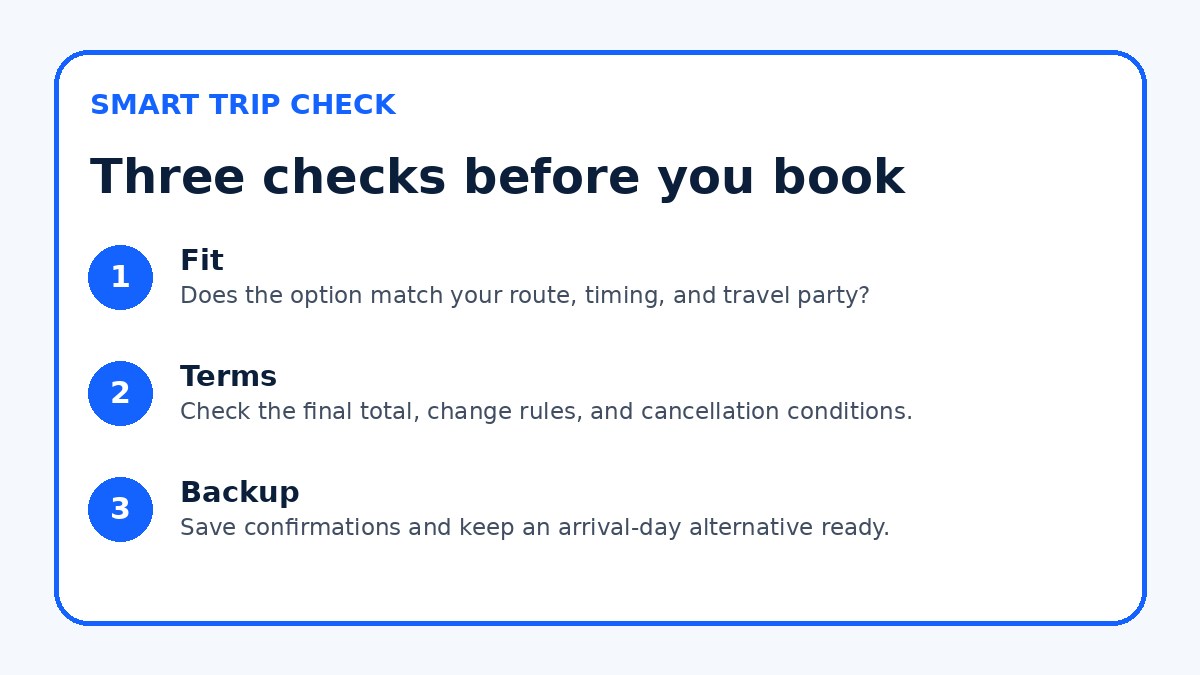
- Map your arrival point to shortlisted neighborhoods and write down the likely taxi or transit route with the fewest transfers.
- On the hotel booking page, confirm elevator access, luggage storage availability, and any size or handling limits for stored items.
- Choose a room type with explicit storage features (wardrobe, sofa bed, extra floor space) and request photos or a floor plan if unclear.
- Compare cancellation and date-change language line-by-line on the provider’s final booking page before paying.
- Ask the hotel to confirm in writing any early check-in, late check-out, or baggage-hold agreements you need, and keep that message.
- Plan the first and last 24 hours of your trip in detail—how you’ll move luggage from arrival to hotel and from hotel to the next transport node.
Final booking terms: what to verify before you commit
When comparing rates, look specifically for cancellation windows, change policies, check-in/check-out flexibility, and any explicit references to luggage handling. A flexible rate that allows free cancellation up to 24 or 48 hours before arrival lowers the risk if your flight changes, but the exact cut-off varies by provider—always read the cancellation clause on the hotel’s final booking page before payment. Also confirm whether the rate includes extra beds or charges for additional luggage to avoid later adjustments.
Third-party booking sites and direct hotel pages sometimes list different terms. If you need a written guarantee—free early check-in, luggage storage, or elevator access—ask the hotel to confirm by message and save that reply. Trip.com can be a place to compare availability and terms, but treat any third-party listing as an initial check and verify all luggage-related policies and change/cancellation terms on the provider’s final booking page before you finish the transaction.
Hotel Guide questions travelers ask
Should I book directly with a hotel or use a third-party site when traveling with oversized luggage?
Direct booking lets you communicate luggage needs to the property and keep a single point of contact; hotels can note oversized items on your reservation. Third-party sites can be useful for comparing flexible rate options across many properties quickly, but their messaging to the hotel may be slower or limited. Whichever route you choose, verify luggage-related policies and cancellation/change terms on the hotel’s final booking page and request written confirmation for special requests such as oversized storage or guaranteed carts.
How can I confirm a hotel actually has elevators or luggage carts before I arrive?
The most reliable method is to check the hotel’s official description and facility list on its own website, then contact the property by phone or email asking for confirmation and specifics—location of elevator, dimensions if relevant, and whether luggage carts are available. If the hotel responds by message, save that reply. Also review recent guest photos and timestamped reviews for mentions of elevator access, but treat those as anecdotal and rely on direct confirmation for critical needs.
What booking terms should I prioritize if I expect itinerary changes because of my heavy baggage?
Prioritize explicit free cancellation or flexible-date-change windows and make sure those clauses are visible on the booking page you will use to pay. Look for mentions of no-fee amendments, the exact cut-off time for free cancellation, and any penalties for moving dates. If you must ensure an early check-in or storage, get written confirmation from the hotel; these operational assurances are not always protected by standard cancellation language and may require direct acknowledgment by the property.
Final decision note
If extra luggage is your main planning constraint in Busan, start with neighborhood fit: reduce transfers by choosing areas aligned with your arrival point, then select a room layout that offers genuine storage or open floor space. Layer on booking flexibility—clear cancellation and change terms plus written confirmation of luggage handling—and rehearse your first and last day logistics so you avoid surprises. Compare options in the short list using the neighborhood decision grid above, verify elevator and luggage policies on the provider’s final booking page, and retain any written confirmations from the hotel. With those steps you can shortlist and book confidently, opening live inventory only to confirm the specific room and terms that match your baggage plan.
Continue planning
Check current options and final conditions
Use the provider page to confirm live availability, the final total, cancellation terms, and every condition that matters to your trip.
This evergreen planning guide was created with AI-assisted drafting and a structured quality review. It does not display live prices, schedules, availability, visa guidance, or provider rankings. Verify current details before booking. Some links are affiliate links; we may earn a commission at no additional cost to you.