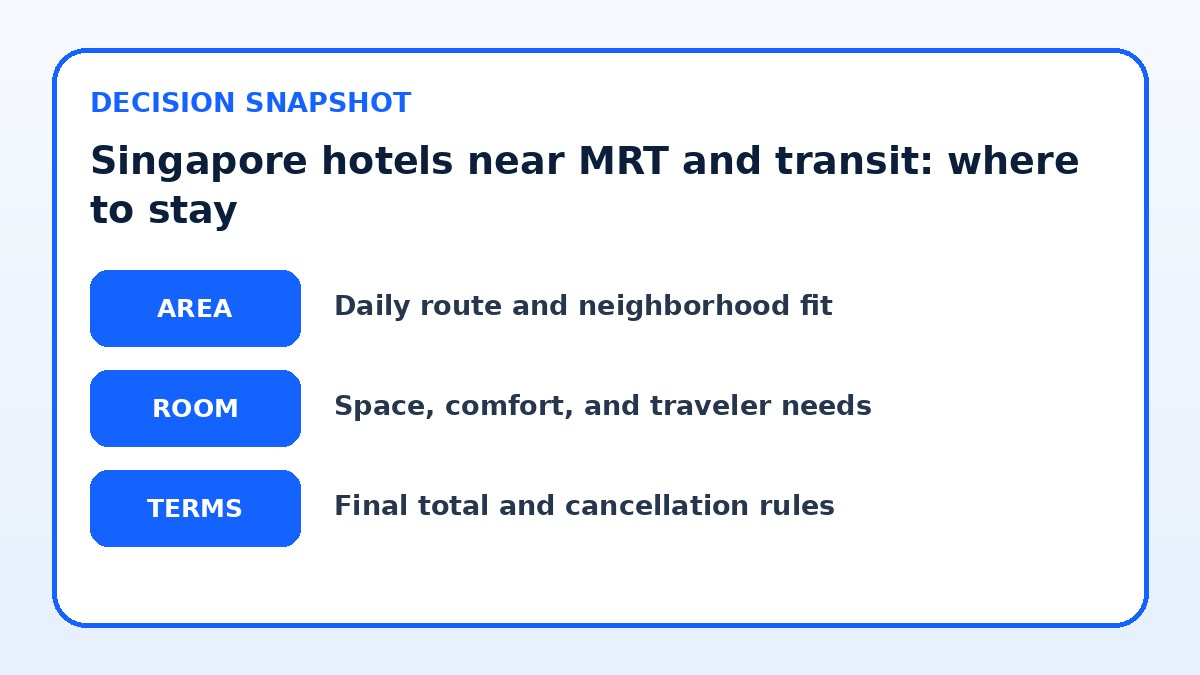
Start by choosing the area, not a single property. For a first-time visit to Singapore, your top priority should be how quickly you can reach the places you plan to visit each day—have a clear daily route in mind, then pick a neighborhood that minimizes transfers. If your itinerary leans museum and Marina Bay activities, prioritize Downtown Core or Bayfront MRT access; if you expect lots of dining and nightlife, look at Clarke Quay, Tiong Bahru or Orchard for fewer late-night transfers; for budget-conscious long stays, consider areas served by frequent MRT lines rather than isolated bus routes. This article gives actionable criteria—neighborhood fit, daily-route friction, room/party needs, and booking terms—so you can shortlist one or two areas before checking live hotel inventory (verify fares, cancellation rules, and exact transit directions on the hotel or booking page).
Check live stays in the areas that fit
Use your dates and party size to compare current rooms after you narrow the neighborhood fit.
Neighborhood fit: match area character to your itinerary
First, define how you’ll spend most days: cultural sites, shopping, business meetings, or nightlife. Neighborhoods in Singapore are compact but varied—some cluster attractions within short walking distance, others are convenient primarily because of a nearby MRT interchange. Pick an area where the majority of your planned stops are on the same line or within one transfer. That reduces daily navigation decisions and gives you more time on activities. Use a simple map tool to drop pins for your top five stops and see which MRT stations appear most often within a 10–20 minute walk radius.
Also consider the local feel you want after hours. Areas like Orchard and Marina Bay have polished commercial streets and straightforward nighttime transit options, while neighborhoods such as Chinatown and Bugis provide denser street-level food and shopping culture with shorter evening strolls from many hotels. If you value quieter streets and lower room rates, look a little farther from the central nodes but ensure those areas still have an efficient link back via frequent MRT or direct bus services.
Choose an area-selection strategy
| Area approach | Best for | Tradeoff to check |
|---|---|---|
| Pick a hotel by nearest MRT line stop | Travelers prioritizing simple, reliable routes with minimal transfers | May require longer walks to specific attractions that sit off the line |
| Choose an interchange station area | Visitors planning multiple, widely spaced destinations across the city | Areas can be busier and more expensive with fewer quiet street options |
| Stay near your single target area (Marina, Orchard, etc.) | Travelers who want to spend most time in one neighborhood | Less convenient for day trips to other parts of the island without transfers |
| Opt for budget hotels outside central nodes with direct bus links | Long-stay or budget travelers willing to trade time for lower nightly rates | Longer transit times and potential dependence on punctual bus schedules |
Daily-route friction: reduce transfers and walking time
Calculate friction by counting transfers, estimating walking time to and from stations, and noting whether you’ll cross busy roads or use covered walkways. Transfers increase both time and cognitive load—especially during peak hours when trains and platforms are crowded. When you shortlist hotels, check the walking route from the hotel entrance to the nearest station: a 5–10 minute sheltered walk with lifts and escalators is far easier than a 15–20 minute uphill trek with luggage. If your plans include mornings and late nights, prefer stations with multiple exits so you can pick the easiest path for different destinations.
Also think about return journeys after late dinners or shows. Areas served by multiple lines or by an interchange give you more options if one line is delayed or if you want to take a taxi without backtracking. For long layovers or arrival/departure days, prioritize hotels with straightforward public transit routes to Changi Airport or major coach terminals. Always verify on the hotel’s page or transit authority information whether the listed walking times account for lifts, escalators, or step-free routes if accessibility is a concern.
Now compare like with like
Keep the same dates, guests, room needs, and cancellation preferences while you compare the final choices.
Room and party needs: choose a room that matches your group
Match room layout and hotel services to your party makeup. Solo travelers and couples often benefit from smaller rooms in central areas because you’ll spend most time outside; families or groups carrying more luggage should seek larger rooms or connecting options near stations with elevators. If you’re traveling with young children or older adults, confirm whether the hotel has step-free access from street to reception and whether the nearest station provides elevators or ramps. Don’t assume every nearby station has full accessibility—check station details and the property’s description before you book.
Think about facilities that reduce friction on transit days: early breakfast options, luggage storage for late departures, and a concierge who can arrange taxi pickups or recommend the best exit from a nearby station. If you’ll be working remotely, prioritize steady Wi-Fi and a comfortable workspace in-room rather than proximity alone. Always inspect the hotel’s room photos and amenity lists on its official page and the booking platform—verify bed configurations and whether breakfast or transfers are included on the confirmation page, since such information can affect which transport-adjacent area you select.

Hotel booking check before payment
- Map your top five destinations and identify the one or two MRT stations that serve most of them.
- Walk the route on a map from each shortlisted hotel to the nearest station and note walking times and shelter coverage.
- Confirm lift/elevator availability at the station exits you will use, if anyone in your party needs step-free access.
- Compare cancellation and amendment terms across shortlisted properties on their official booking pages.
- Check whether the hotel offers luggage storage or early check-in options for arrival and departure logistics.
- Save the hotel’s exact address and the recommended station exit name or number in both digital and printed form.
Booking terms and verification: what to check before you commit
Before finalizing a reservation, compare cancellation policies, breakfast inclusion, and check-in/out flexibility across properties in your chosen area. These terms vary and may change after you initially check rates, so rely on the hotel’s booking page or the booking platform’s confirmation for current conditions. If your travel dates might change, a more flexible cancellation policy could outweigh a slightly better location—particularly for high-demand travel periods. If you plan to use public transit heavily, look for hotels that explicitly mention transport connections or provide printed directions from the hotel to the nearest station.
Also verify transfer details for arrival and departure days: whether the hotel offers an airport shuttle, how the taxi ranks operate near its entrance, and whether luggage assistance is available. When using third-party platforms to compare availability, including Trip.com as one option, confirm all transport-related claims on the hotel’s official page and the provider’s final booking terms. Finally, keep a digital and printed copy of the hotel address and directions to the nearest station, including the exit name or number, so you can present clear instructions to drivers or follow the quickest public transit route on arrival.
Hotel Guide questions travelers ask
How close should a hotel be to an MRT station in Singapore for first-time visitors?
Aim for a hotel within a 5–15 minute walk to an MRT station for a good balance between convenience and cost. A shorter walk reduces the friction of daily commuting, especially with luggage or in wet weather. If your itinerary includes many destinations on different lines, prioritize stations that function as interchanges. For travelers with mobility concerns or heavy bags, focus on hotels adjacent to stations with elevators and sheltered pedestrian links; verify those accessibility features on the station and hotel information pages before you book.
Is staying near the airport a good idea for short trips to Singapore?
Staying near Changi Airport can be practical for very short trips or early departures, but for most first-time visitors who plan to explore the city, it adds commuting time to central attractions. If you choose an airport-proximate hotel for convenience, check the transit options to central MRT lines or bus services and whether the hotel provides shuttle information. Compare total door-to-door travel time rather than distance alone and confirm transfer details on the hotel’s official booking page or transport authority site.
Should I pick an interchange area even if it costs more?
Interchange areas offer flexibility and shorter transfer times, which can save time and reduce stress if your itinerary is broad. That convenience is often worth the extra cost for travelers who plan many day trips across the island or who want redundancy if service disruptions occur. If budget is tight, assess how many transfers your days would require from a cheaper neighborhood; sometimes a slightly longer walk to an interchange station offers the best of both worlds. Always weigh the price difference against the time savings and verify rates and amenities on booking confirmations.
Final decision note
For first-time visitors to Singapore, make the area choice your first decision: map your main activities, count transfers, and then shortlist areas that minimize daily friction. Factor in your party’s mobility and luggage needs when comparing room types and look beyond proximity to stations—check sheltered walks, elevator access, and local exit numbers. Before booking, review cancellation policies, check-in rules, and whether breakfast or luggage services are included on the property’s final booking page. With a clear area selected, you’ll be positioned to open live hotel listings confidently, compare offers (including on Trip.com if you wish), and choose a specific property that matches both your itinerary and practical travel needs.
Continue planning
Check current options and final conditions
Use the provider page to confirm live availability, the final total, cancellation terms, and every condition that matters to your trip.
This evergreen planning guide was created with AI-assisted drafting and a structured quality review. It does not display live prices, schedules, availability, visa guidance, or provider rankings. Verify current details before booking. Some links are affiliate links; we may earn a commission at no additional cost to you.