If you need to travel from Los Angeles to Honolulu for work, the core decision is usually a tradeoff: pay more for a convenient, predictable itinerary or accept less flexibility to save time and money. For a business traveler, that tradeoff narrows to four practical questions: can you absorb the risk of a tight connection, do you require real-time schedule changes, how important is minimizing airport time, and what baggage rules are acceptable for your meeting needs? Start by locking in exact travel dates, morning or evening meeting times, who’s checked versus carry-on baggage, and whether you need a same-day return. With those details in hand you can quickly compare direct versus connecting options, fare-change conditions, and the real cost of convenience — including time in transit, missed-connection exposure, and whether your ticket allows easy rebooking. The rest of this guide breaks those tradeoffs down and gives concrete comparison strategies to help you book with confidence.

See live routes for your exact travel day
Compare direct and connecting choices with the same baggage and traveler details.
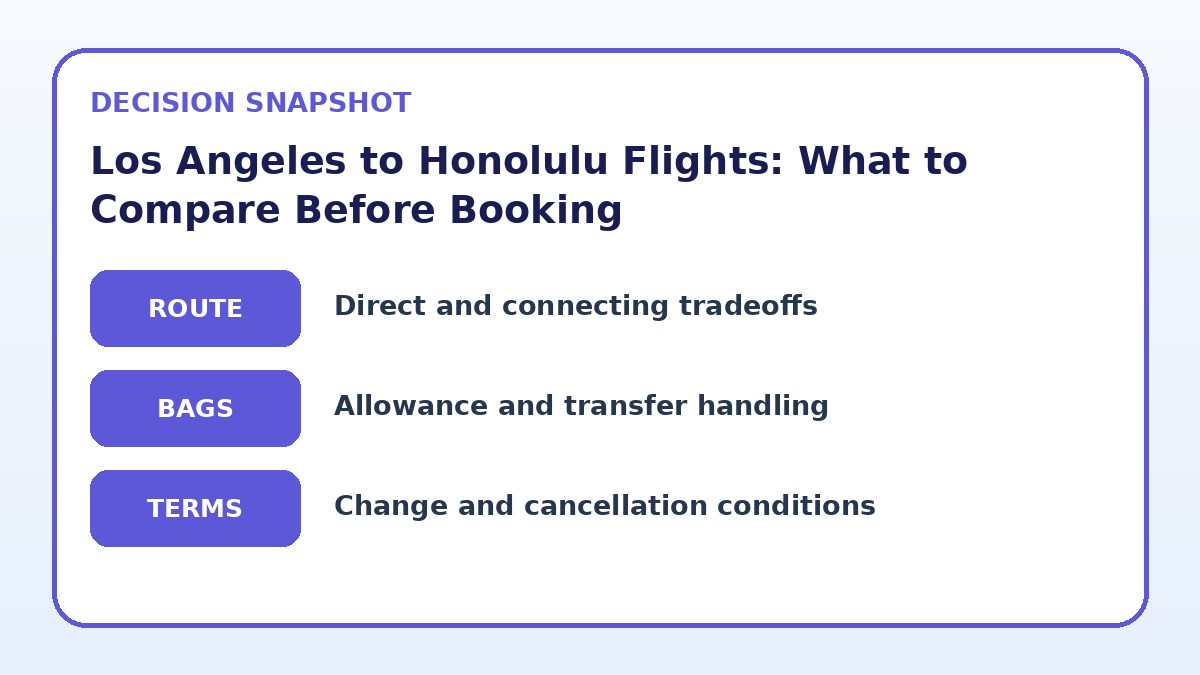
Routing: direct versus connecting choices
On the Los Angeles to Honolulu route, the simplest distinction is between nonstop and connecting itineraries. Nonstop flights minimize airport time and the chance of missed connections, which often matters most to business travelers who value on-time arrival and a short travel day. Connecting itineraries may appear on search pages as cheaper or better timed for certain schedules, but each added segment introduces transfer points where delays, misrouted luggage, or terminal changes can ripple into missed meetings. When comparing options, look beyond total elapsed time to the number of network partners involved: single-carrier connections generally offer smoother rebooking than multi-carrier chains.
To compare direct and connecting services fairly, line up the same travel-day departure windows and note the practical door-to-door time including ground transport and security. If an itinerary lists a connection, check the minimum connection time at the transfer airport and whether your bags are checked through to the final destination. Also consider the risk tolerance of your employer or client schedule—if your meeting can’t shift, prefer the itinerary with the fewest moving parts. Use your exact travel date and arrival window to test how often nonstops exist and whether the timing justifies a premium for convenience.
Baggage and connection risk for business needs
Baggage rules can change the economics of a ticket dramatically for business travelers. A low-fare option that looks attractive on price alone may exclude checked bags, require long layovers to transfer luggage on separate tickets, or place you on carriers with strict carry-on limits. If you must bring suits or sample materials, think through how you’ll store them onboard and on arrival. Also verify when the booking page displays baggage allowance, where fees apply, and whether your loyalty status or corporate program covers the cost — don’t rely on a fare class name alone.
Connections increase the chance of delayed or misrouted baggage and also reduce your buffer to deal with delays. If you’re booking a connecting itinerary, prefer single-ticket routings where the carrier is responsible for rebooking and transferring bags. When using separate tickets to save money, build generous layover time and understand that the second carrier may not accept responsibility for missed connections. Before finalizing any booking, check the carrier’s final booking page for exact baggage allowances, carry-on dimensions, and the handling policy for missed connections or delayed luggage.
Compare flight-selection strategies
| Flight strategy | Best for | Risk to check |
|---|---|---|
| Nonstop flexible fare | Travelers who prioritize minimal airport time and easy rebooking for schedule changes. | Higher base fare for convenience and fewer routing options on preferred times. |
| Nonstop lowest-restriction fare | Travelers with fixed dates and no expected changes who want the shortest travel day. | Limited or no rebooking options; baggage may cost extra and refunds may be restricted. |
| Connecting single-carrier fare | Those balancing cost savings with some protection, provided the ticket is on one airline. | Longer travel time and more exposure to delays, but carrier responsibility simplifies rebooking. |
| Separate-ticket/lowest-price strategy | Cost-focused travelers willing to build in large connection buffers and accept rebooking risk. | Higher chance of missed connections and no guaranteed baggage transfer or carrier assistance. |
Recheck the complete itinerary
Confirm airports, connection handling, baggage, and change conditions before deciding.
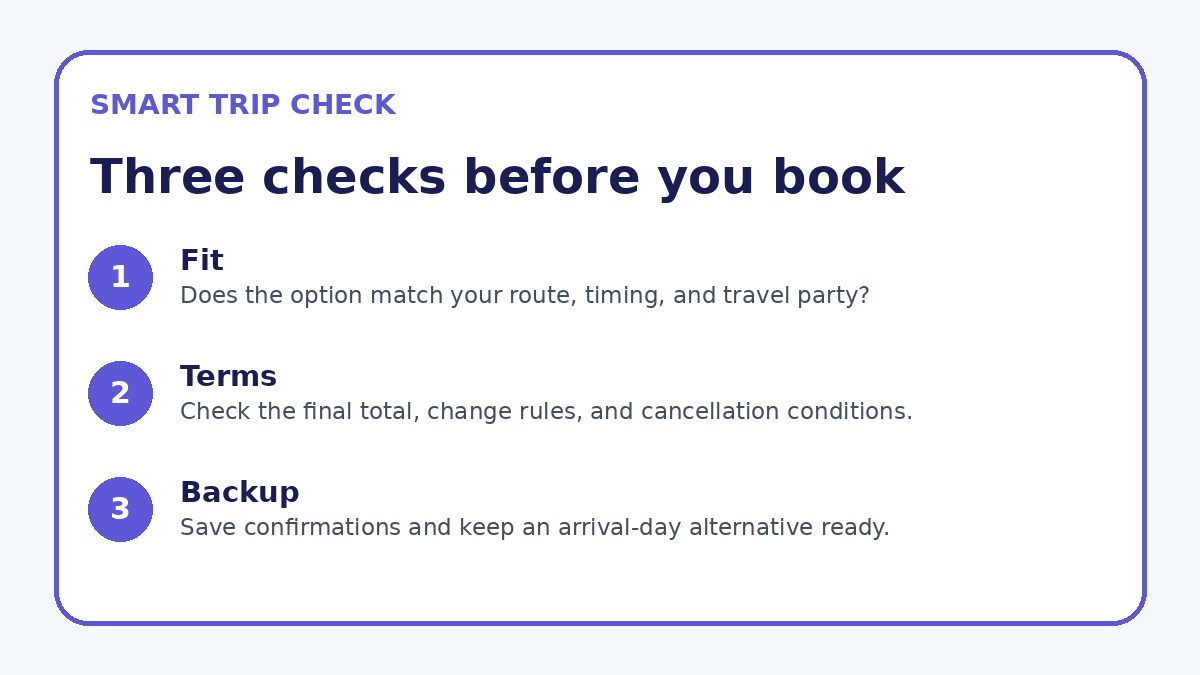
Schedule fit: aligning flight times with meeting commitments
Matching flight times to your business commitments is the practical heart of the decision. For early meetings in Honolulu, consider overnight flights that maximize sleep and keep you fresh, but balance that against the risk and stress of red-eye travel. For late flights home, look at arrival times in Los Angeles and how they align with ground transport and your next-day schedule. Pay attention to how much buffer you realistically need between landing and an important meeting: leaving an extra hour for customs and transit in Honolulu might save you from last-minute scrambling.
When assessing schedule fit, create a short list of acceptable arrival and departure windows before you search so you can quickly reject options that don’t match your meeting constraints. Factor in local traffic patterns and the locations of your meetings relative to the airport. If your plans have any built-in flexibility, note how much time or which days you can shift — that information directly affects whether you should buy a more flexible fare or accept a restricted option and save money. Always verify exact flight times on the carrier’s booking page before purchase.
Flight details to verify
- Confirm exact travel dates, preferred airport times, and whether you need a same-day return before searching fares.
- List passenger full names, loyalty numbers, and any corporate account codes to populate the booking fields accurately.
- Decide carry-on versus checked-bag needs and verify the baggage allowance on the carrier’s final booking page.
- Compare nonstop and connecting itineraries for your exact dates, including total door-to-door time and number of carriers.
- Review the fare’s change, cancellation, and refund conditions on the airline’s final booking page before purchase.
- If using separate tickets, add at least a generous buffer between connections and confirm ground transfer logistics.
Fare conditions: rebooking, refunds, and corporate policy
Fare rules determine how painful schedule changes become. Flexible fares let you change flights with minimal penalties and often include refunds or travel credits, which is crucial if client meetings or approvals can move at short notice. Restricted fares typically come with change fees, limited rebooking options, or non-refundable status; they can be acceptable if your itinerary is locked down. For corporate travelers, check whether your company policy requires refundable or flexible fares and whether the cost difference can be allocated to the department or project.
On any booking page, verify the exact change and cancellation conditions before paying—look for the change fee, whether fare differences apply, how far in advance changes must be made to avoid penalties, and whether credits expire. Confirm that the ticket’s fare class allows upgrades or same-day standby if that’s a potential need. If you use travel management tools or a corporate travel agent, coordinate with them to confirm whether the fare qualifies for special corporate rates or consolidated rebooking assistance. Trip.com can be used to compare current availability and conditions, but always verify final rules on the carrier’s own booking page.
Flight Guide questions travelers ask
Should I always choose a nonstop flight from Los Angeles to Honolulu for business travel?
Not always. Nonstops reduce airport time and connection risk, which is valuable for tight schedules. However, if your meeting windows are constrained and nonstop schedules don’t match your needs, a connecting itinerary on a single carrier might offer better timing at a lower cost. Evaluate the tradeoff between extra transit time and schedule fit: if you can’t tolerate any delay or need a short door-to-door trip, nonstops are usually preferable. If cost or timing drives you to connections, build buffer time and confirm baggage handling and rebooking protections.
How much layover time should I allow if I book a connecting itinerary?
Allow more buffer than the published minimum, because business travel leaves little room for error. A practical approach is to add time for deplaning, possible terminal transfers, re-clearance where required, and baggage transfer. If your connecting flight is on a separate ticket or changes carriers, increase the buffer significantly to protect against missed connections. Consider also the arrival airport’s layout and typical delay patterns. Before you finalize, check the carrier’s recommended connection times and verify whether the booking is on a single ticket with protected connections.
What should I verify on the airline booking page before finalizing a business ticket?
Check the fare’s exact change and cancellation rules, baggage allowances and fees, whether the itinerary is ticketed on a single carrier, and any corporate or loyalty benefits applied. Confirm flight times, terminal information, and whether seats and upgrades are available for purchase. Look for the carrier’s policy on missed connections and how rebooking is handled, and verify that traveler names and loyalty numbers are correct. If any special requests (meal, accessibility, or equipment transport) are needed, ensure the booking page documents them or that you can add them before payment.
Final decision note
For business travel between Los Angeles and Honolulu, the right ticket balances schedule certainty against cost and convenience. Start by fixing your meeting times and baggage needs, then compare nonstop versus connecting itineraries and read the fare conditions on the carrier’s booking page. If schedule changes are likely, favor flexible fares or single-carrier tickets that simplify rebooking; if your dates are firm, a restricted nonstop might save time and money. Prepare traveler details and alternative dates before searching live availability; that makes apples-to-apples comparisons faster and helps you choose the option that protects your meeting time with the least friction.
Continue planning
Check current options and final conditions
Use the provider page to confirm live availability, the final total, cancellation terms, and every condition that matters to your trip.
This evergreen planning guide was created with AI-assisted drafting and a structured quality review. It does not display live prices, schedules, availability, visa guidance, or provider rankings. Verify current details before booking. Some links are affiliate links; we may earn a commission at no additional cost to you.