If you need to get from Tokyo to Osaka as a solo traveler, start by matching priorities: speed, comfort, budget, or low hassle. For most people the decision comes down to three categories — high-speed rail (including shinkansen services), intercity coaches, and overnight ferries — with combinations possible if you want to split comfort and cost. Think of the trip end-to-end: from where you sleep in Tokyo to where you need to arrive in Osaka, how much luggage you have, and whether you value a flexible schedule or a single guaranteed seat. This article compares terminal fit, luggage and transfer friction, timing flexibility, and contingency planning to help you choose the mode or mix that fits your solo trip and to list practical checks before you book.
Terminal fit and door-to-door practicality
Pick the option that places you closest to your start and end points. A train terminal in central Tokyo or Osaka will usually reduce taxi or local-transit time compared with a coach station or ferry terminal that sits farther from neighborhoods or hotels. Consider the walking distance with your luggage, ease of transferring between subway lines, and whether you’ll need a taxi late at night. For solo travelers, a terminal with clear signage, staffed ticket counters, and frequent onward services reduces stress; if you have mobility needs, confirm elevator access and step-free routes before you go.
If your schedule begins or ends at unusual hours, check the terminal’s late-night access and whether onward services operate when you arrive. Some coach or ferry terminals may have limited late-night public transport, making a short taxi necessary. Also factor where baggage storage or coin lockers are available in case you want to explore the city before check-in. Ultimately the fastest scheduled transit may not be the quickest door-to-door if transfers and local connections add time or complexity, so map the full journey from your accommodation in Tokyo to your final drop-off in Osaka.
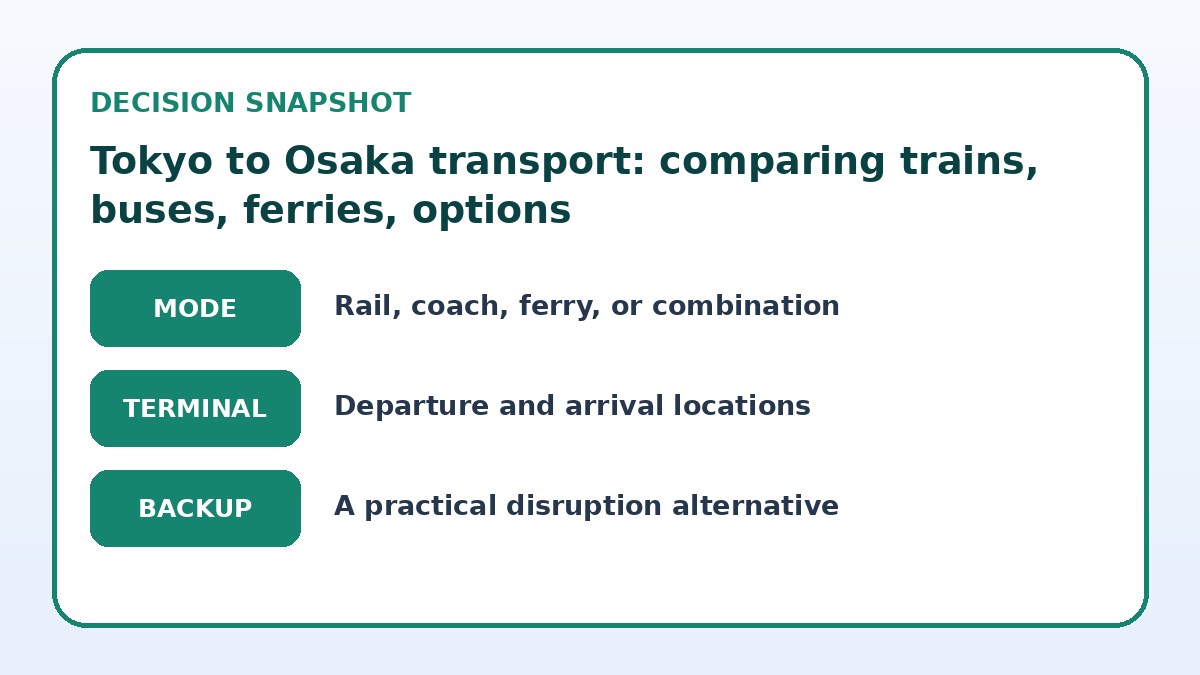
Choose the end-to-end journey plan
| Journey approach | Best for | Friction to check |
|---|---|---|
| High-speed train (shinkansen and express rail) | Solo travelers prioritizing predictable schedules and fast central-to-central door-to-door travel. | May require short local transfers and attention to luggage rules; sometimes more costly than coach or ferry. |
| Intercity coach | Budget-minded solo travelers wanting direct point-to-point drops near neighborhoods or late-evening arrivals. | Fewer departures and longer journey times; luggage bays and terminal distance can increase door-to-door time. |
| Overnight ferry | Travelers who want to combine an overnight trip with accommodation and avoid daytime travel time. | Slower overall; terminals may be farther from central districts and transfers can add complexity. |
| Mixed/connector approach (regional train + coach or ferry) | Solo travelers optimizing cost or schedule by combining modes to reach specific neighborhoods or ports. | Adds transfer steps and risk of missed connectors; requires careful timing and contingency planning. |
Check live intercity options
Look beyond the ride itself and compare terminals, transfers, luggage, and arrival fit.
Luggage and transfer friction for solo travelers
Assess how much luggage you’ll carry and how comfortable you are managing it alone. Trains often have overhead racks or small luggage spaces, while shinkansen services sometimes require reservations for luggage or offer dedicated racks. Coaches commonly have underfloor bays for large suitcases but may limit the number or size of bags carried for free. Ferry cabins or open-berth spaces give you more room to keep bags with you overnight, but you must handle moving luggage on and off at terminal ramps and between your cabin and public areas.
Transfers matter: a single-seat train ride that ends in a central station usually minimizes handling compared with a coach that requires walking between platform, bus bay, and taxi rank. If you plan mixed modes, allow extra time for unloading, transferring across terminals, and security checks. For solo travelers who want low friction, prioritize services with simple boarding procedures, clear luggage policies, and minimal platform changes. If you’re uncertain about baggage allowances or transfer steps, verify details on the operator’s booking page or a reliable aggregator like Trip.com before purchasing.
Timing flexibility and real-world scheduling
Decide whether you need fixed departure times or flexible travel windows. Trains generally run frequently and are easy to move around if your schedule shifts, while coaches and ferries may have fewer daily departures, making missed connections more consequential. For afternoon or evening plans, trains often let you travel later without risking a long wait; however, overnight ferries effectively combine transit and a night’s lodging, which can be useful if you want to travel while saving on accommodation. Consider whether you might prefer a slower daytime coach for scenic, undisturbed travel or a quick daytime high-speed train to maximize time at your destination.
Also account for seasonal travel patterns and local holidays when services can be busier, as well as the likely impact of delays. Solo travelers should prefer options with clear rebooking policies and multiple alternative departures in a day. If you must arrive within a narrow window, choose services with frequent departures or earlier arrivals in case of minor disruptions. Always plan a practical buffer for critical onward connections and verify departure frequency and transfer times directly on provider pages before finalizing any booking.
Compare the practical alternatives
Use the final page to confirm what is actually offered on your dates and save a workable fallback.
Intercity travel checklist
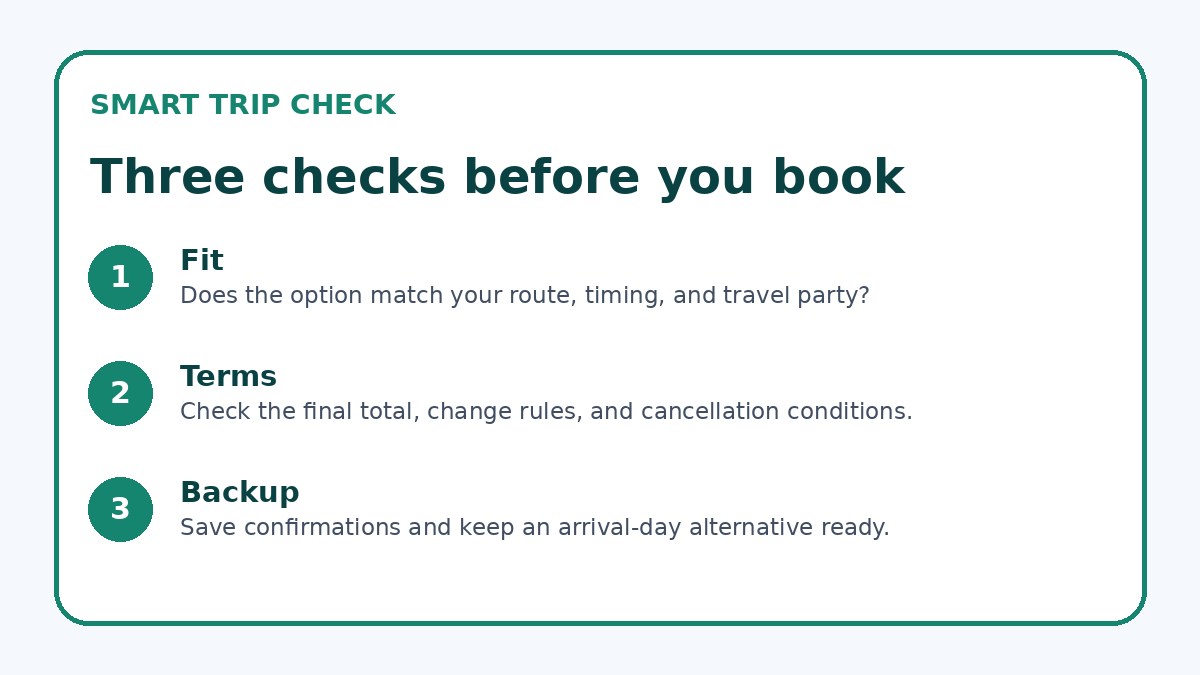
- Map your full door-to-door route, including walks, transfers, and likely taxi time from each terminal to hotel or station.
- Confirm luggage allowances and boarding procedures on the operator’s booking page and note any size or count limits.
- Check frequency of departures for your chosen mode and identify the next two alternate services in case of delay.
- Verify terminal access and late-night onward transport options from arrival points before booking late arrivals.
- Save screenshots of confirmation emails and contact numbers for station information desks and your accommodation.
- If timing is tight, book a flexible or refundable ticket and allow at least one buffer hour for transfers and security checks.
Disruption backup and safe solo-traveler practices
Have a simple backup plan. For trains, know the next few departures and where you could buy a later ticket; for coaches, note alternative companies or nearby bus terminals. If you take a ferry, identify local trains or coach services available from the arrival port. Keep digital and paper copies of your tickets and booking references and store a screenshot of onward transport options in case of poor mobile coverage. Solo travelers should keep an emergency contact and local embassy information handy, and consider travel insurance that covers missed connections or cancellations.
On the ground, minimize disruption stress by booking flexible or refundable tickets if your itinerary is tight, and save the phone numbers of station or terminal information desks. If you expect late arrival in Osaka, prebook accommodation that offers 24-hour check-in or clear late-arrival instructions. For safety, choose well-reviewed, centrally located drop-off points and use daylight hours when possible to handle late transfers. Finally, when provider-specific policies matter — luggage rules, boarding windows, or carriage restrictions — verify those exact details on the operator’s final booking page before you travel.
Rail & Intercity Transport questions travelers ask
Is the train always the fastest way between Tokyo and Osaka for a solo traveler?
Trains, especially high-speed services, are generally the fastest scheduled option between the two cities, offering frequent departures and central stations that reduce local transfer time. However, the fastest door-to-door choice depends on where you start and end: if your Tokyo accommodation is far from a main station or you need to arrive at an Osaka location closer to a coach or regional station, a coach or mixed approach might be more time-efficient overall. Always map total travel time including local connections rather than comparing in-vehicle duration alone.
Can I comfortably manage luggage alone on coaches, trains, or ferries?
You can manage luggage alone on all modes, but policies and boarding procedures differ. Coaches typically store large bags under the bus, requiring one handling step; trains usually have overhead space and limited dedicated luggage racks, and some shinkansen services recommend seat reservations if you have very large suitcases. Ferries allow you to keep baggage in your cabin but involve moving luggage between terminal and vessel. Before you book, verify exact luggage rules and consider the number of transfers and the weight you can comfortably handle solo.
What should I check immediately before booking to avoid surprises?
Before you finalize any ticket, verify departure and arrival terminal names, last-mile transport options and hours, exact luggage allowances, cancellation/change policies, and boarding windows. If you’re mixing providers, ensure connection times are realistic and that there are alternative services later in the day. For provider-specific operational details that change frequently, check the operator’s official booking page or a current aggregator such as Trip.com to confirm schedules, seat availability, and any required documentation.
Final decision note
Choosing between train, coach, ferry, or a mixed itinerary for Tokyo to Osaka comes down to mapping your door-to-door needs: how central your start and end points are, how much luggage you’ll handle, and how flexible your schedule must be. Trains offer speed and frequent departures with simpler city-center access; coaches lower cost but add travel time and sometimes distance to terminals; ferries combine travel and overnight sleep but are slower and can complicate connections. Solo travelers minimize stress by prioritizing terminal proximity, checking luggage rules, planning backups, and confirming operational details on provider booking pages before purchasing.
Continue planning
Check current options and final conditions
Use the provider page to confirm live availability, the final total, cancellation terms, and every condition that matters to your trip.
This evergreen planning guide was created with AI-assisted drafting and a structured quality review. It does not display live prices, schedules, availability, visa guidance, or provider rankings. Verify current details before booking. Some links are affiliate links; we may earn a commission at no additional cost to you.