Short answer: a rental car can improve a Cebu family trip when your itinerary includes multiple coastal towns, hilltop viewpoints, or remote beaches with limited public transport, but it often adds cost, parking hassle, and local driving stress. Decide by comparing the value of door-to-door flexibility against extra time spent navigating, securing insurance, and handling pickup and return logistics. For families with young children or bulky gear, a car can simplify transfers and sightseeing; for short stays centered in Cebu City or Mactan, public transport plus point-to-point rideshares or private transfers usually wins. Read the sections below to test route value, unpack insurance language you must verify on the final booking page, estimate pickup/return friction, and choose a fallback mobility plan so you’re not stranded if driving proves unnecessary.
Route value: when driving genuinely helps your family
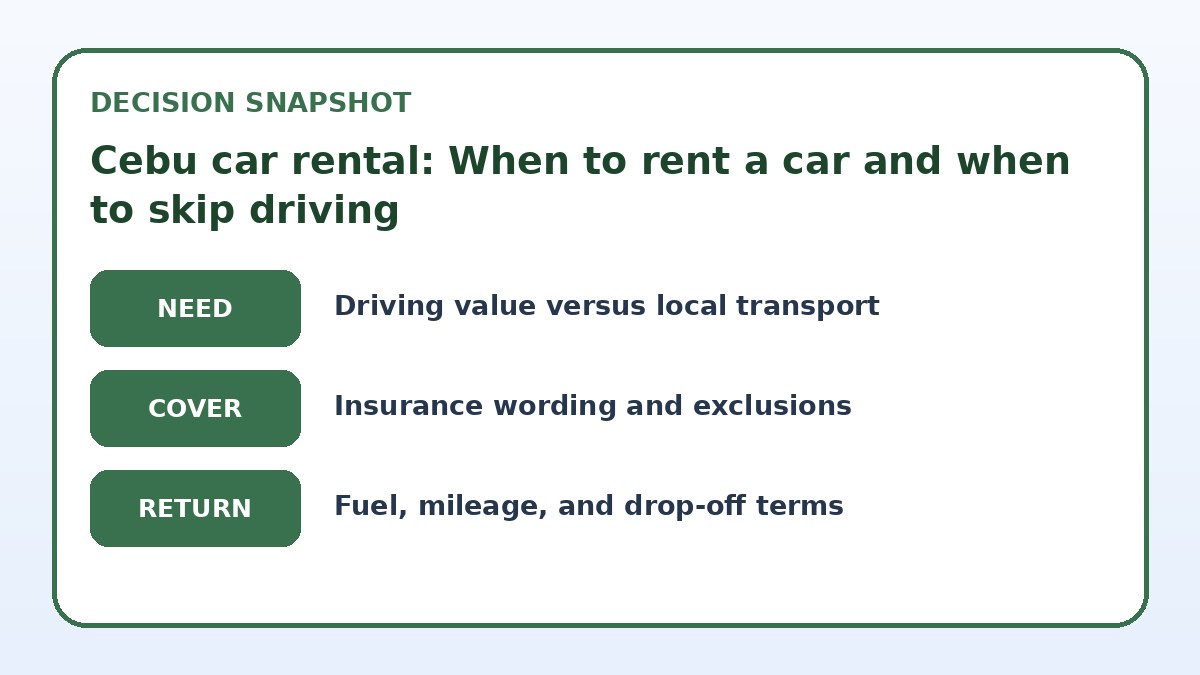
Ask whether a car changes what you can realistically do each day. Driving gives families independence for early starts, late returns, and scenic detours—useful if you plan to visit places where public transport is infrequent, such as remote beaches, waterfalls, or the less-served parts of northern Cebu. If your stay includes an overnight in Moalboal, Oslob, or near the highlands, a car reduces transit friction and lets you carry snorkeling gear, coolers, or a stroller without juggling multiple transfers.
Conversely, if most of your time is in Cebu City, Mactan resort areas, or short hop islands reachable by frequent ferries, public transport, organized day tours, and point-to-point private transfers may be faster and less stressful. Also consider road quality and driving times: long coastal routes can be scenic but slow. Create a sample day-by-day plan and mark trips that would be impossible or awkward without private transport—if many days rely on a car, rental becomes more valuable.
Decide whether driving earns its place
| Mobility strategy | Best for | Cost or friction to check |
|---|---|---|
| Rent a car for the whole trip | Families planning multi-destination road days, early starts, and heavy gear. | Higher costs, driving stress, parking and pickup/return hassle; verify insurance and cross-island rules. |
| Rent a car only for specific day trips | Families who mainly stay in the city but want a few flexible excursions. | Saves money overall but adds pickup time and repeated rental admin for each use. |
| No rental: private transfers + point-to-point rides | Short stays centered in Cebu City or resort areas where convenience matters more than flexibility. | Less independence and potential higher per-trip cost, but much lower driving responsibility and stress. |
| No rental: public transport and organized tours | Budget-minded families who are comfortable with local transport rhythms and scheduled departures. | Less privacy and less control over timing; may require more coordination with kids and gear. |
Check live rental choices only after the route test
Use the exact driver, dates, pickup point, and return plan to compare current conditions.
Insurance wording and what to verify before you book
Insurance wording matters more than headline phrases. On the provider’s final booking page, verify the collision damage waiver (CDW) and whether it includes or excludes certain damages such as windscreen, undercarriage, or tire damage. Check the excess (deductible) amount you’ll pay for claims, and whether you can reduce it with an extra waiver. Don’t rely solely on marketing words like “fully covered”; look for explicit coverage lists and exclusions.
Also confirm third-party liability limits, passenger injury coverage, and whether any local taxes or compulsory insurances are included. If you plan to cross provincial boundaries or pick up on one island and return on another, verify cross-island permissions and any extra fees. Keep screenshots or PDFs of the final contract page after booking and carry a printed copy of the insurance summary when you pick up the car.
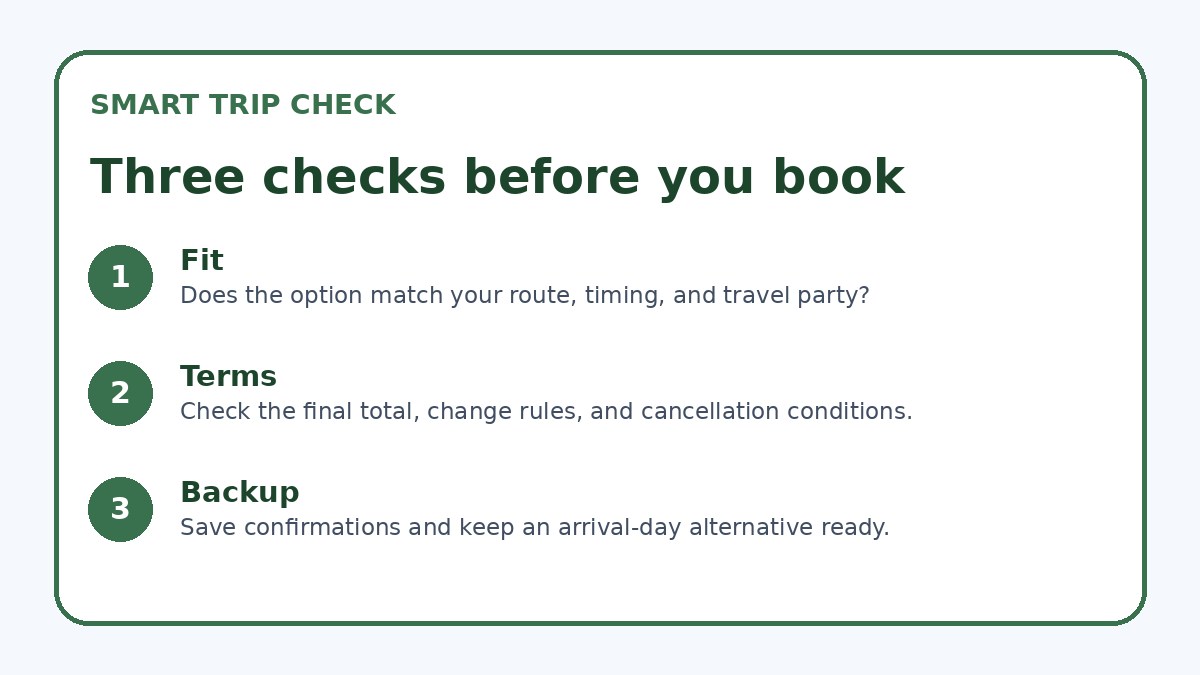
Compare the full rental conditions
Confirm insurance wording, exclusions, deposit, fuel, mileage, and return terms on the final page.
Pickup and return friction families should plan for
Pickup and return can be the longest parts of a rental. At airports, expect counters that may require waiting, extra local taxes, and inspection procedures. Reserve a child seat in advance and confirm it’s age-appropriate and securely installed; many providers have limited correct-size seats. Ask about fuel policy (full-to-full is simplest), what documentation you must present, and whether the provider will inspect and photograph existing damage. Allow buffer time to avoid rushing a long drive after pick up.
Returning the car also requires planning: confirm the drop-off location and any after-hours return procedures, and factor in time for a joint inspection. If you’re swapping islands, check whether cross-island returns are permitted—some contracts forbid drop-offs on other islands or charge hefty fees. Finally, plan parking at hotels and attractions in advance; many city hotels charge for parking or have limited spaces, and beach parking can be informal and unsecured.
Car rental terms to verify
- Create a day-by-day outline marking which attractions require a car for access and estimate door-to-door times.
- On the rental provider’s final booking page, screenshot insurance details showing CDW, excess amount, and listed exclusions.
- Confirm child-seat availability, size/age suitability, and whether a professional installation is guaranteed at pickup.
- Ask the provider about cross-island pickup/drop-off rules and any additional fees for returning on a different island.
- Budget extra time for airport pickup and an exit inspection at drop-off; factor this into arrival and departure plans.
- If skipping a car, prebook private transfers for airport legs and at least one full-day organized excursion covering remote sites.
Non-driving fallback: a reliable plan if you skip the car
Create a fallback mobility plan before you commit: combine scheduled private transfers for airport and long single-day trips, book group or private island tours for snorkeling or whale-watching, and rely on local rideshares or tuk-tuks for shorter city journeys. For families, prebooked transfers reduce stress because drivers wait with signage and can handle luggage and child seats if arranged in advance. Use scheduled tours to reach remote attractions; they usually bundle transport and a local guide, cutting navigation burden.
Also map essential services—hospitals, pharmacies, supermarkets—and note how to reach them via public transport or a short taxi. Keep contact numbers for your accommodation’s recommended drivers or transfer services. With a layered fallback (prebooked transfers + point-to-point rides + organized day tours) you’ll keep flexibility without taking on the overhead of driving and parking.
Car Rental & Road Trip questions travelers ask
Is driving in Cebu difficult for visitors who don’t know local roads?
Driving in Cebu varies: city traffic in Cebu City can be congested, with aggressive local driving patterns and frequent traffic controls, while rural coastal roads are narrower and may have uneven surfaces. If you’re comfortable reading local signage and using a reliable offline map, driving outside the city is manageable, but be prepared for slower transit times. For families, consider whether the stress of urban driving and parking outweighs the convenience of a car. If uncertain, try a single-day rental first or use a private transfer to test local conditions before committing to multiple rental days.
What specific insurance terms should families prioritize when renting?
Prioritize collision damage waiver (CDW) coverage details, the excess (the amount you must pay after a claim), and exclusions such as tires, windscreen, and undercarriage. Verify third-party liability limits and confirm if passenger injury or medical coverage is included. Look for explicit wording about whether theft protection applies and whether the policy is voided by off-road use. Always save the final booking page or policy PDF, and make sure emergency contact numbers and local claims procedures are visible before you pick up the car.
Can I rely on child seats from rental providers in Cebu?
Many providers offer child seats, but availability and suitability vary. Confirm the seat type (infant, convertible, booster), its certification or expiry date, and whether professional installation is included or free. If you have strict safety preferences or a very young child, consider bringing your own travel car seat or a portable solution that meets your standards. Whatever you choose, check the seat thoroughly at pickup for proper fit and secure attachment, and document its condition with photos as part of the vehicle’s inspection.
Final decision note
Deciding whether to rent a car in Cebu for a family trip comes down to route value and comfort with local driving. If your itinerary includes multiple coastal day trips, remote beaches, or you’re traveling with small children and lots of equipment, a rental can pay back in convenience and saved coordination time. However, for short stays centered on Cebu City, Mactan resorts, or when you prefer not to drive in unfamiliar traffic, a layered non-driving plan—private transfers for long hops plus rideshares and organized tours—usually gives the best balance of convenience and lower stress. Whatever you choose, verify insurance wording, child-seat availability, cross-island rules, and pickup/return procedures on the provider’s final booking page so there are no surprises at pickup.
Continue planning
Check current options and final conditions
Use the provider page to confirm live availability, the final total, cancellation terms, and every condition that matters to your trip.
This evergreen planning guide was created with AI-assisted drafting and a structured quality review. It does not display live prices, schedules, availability, visa guidance, or provider rankings. Verify current details before booking. Some links are affiliate links; we may earn a commission at no additional cost to you.