If you’re traveling to Busan on business, renting a car can feel like a timesaver — but it can also add complexity if you don’t understand the insurance wording in your rental contract. The practical answer: drive only if your itinerary needs flexible access outside central Busan, multiple client sites, or late-night meetings; otherwise use taxis, metro and short-term hire for fewer risks. Before you sign, focus on four phrases most contracts use: Collision Damage Waiver (CDW) or Loss Damage Waiver (LDW), Third-Party Liability, Excess (or deductible) amount, and “waiver conditions” that can void coverage. This article explains when driving genuinely improves your trip, how to read the key insurance terms, what to expect at pickup and return, and a clear non-driving fallback so you can plan with confidence.
Does driving actually improve a Busan business trip?
Start here: compare your itinerary to the city’s layout and typical meeting locations. Central Busan — areas like Seomyeon, Haeundae, and Nampo — are compact and well served by subway lines and taxis; parking can be scarce near client offices and hotels. Driving pays if you have multiple client visits in outlying districts, need to transport samples or equipment, or plan early-morning departures for nearby industrial parks. For short stays with clustered meetings, the time you spend finding parking and paying for it often removes any speed advantage.
Also factor in meeting timing and flexibility. Late-night meetings or last-minute site visits in industrial or coastal zones can make a rental worthwhile because public transport frequency drops and taxis may be limited. Conversely, if most stops are inside Busan’s transit network and you can schedule meetings during metro hours, relying on public transit and occasional taxis reduces administrative overhead, eliminates insurance uncertainty, and removes the risk of claims or damage charges after a busy workday.
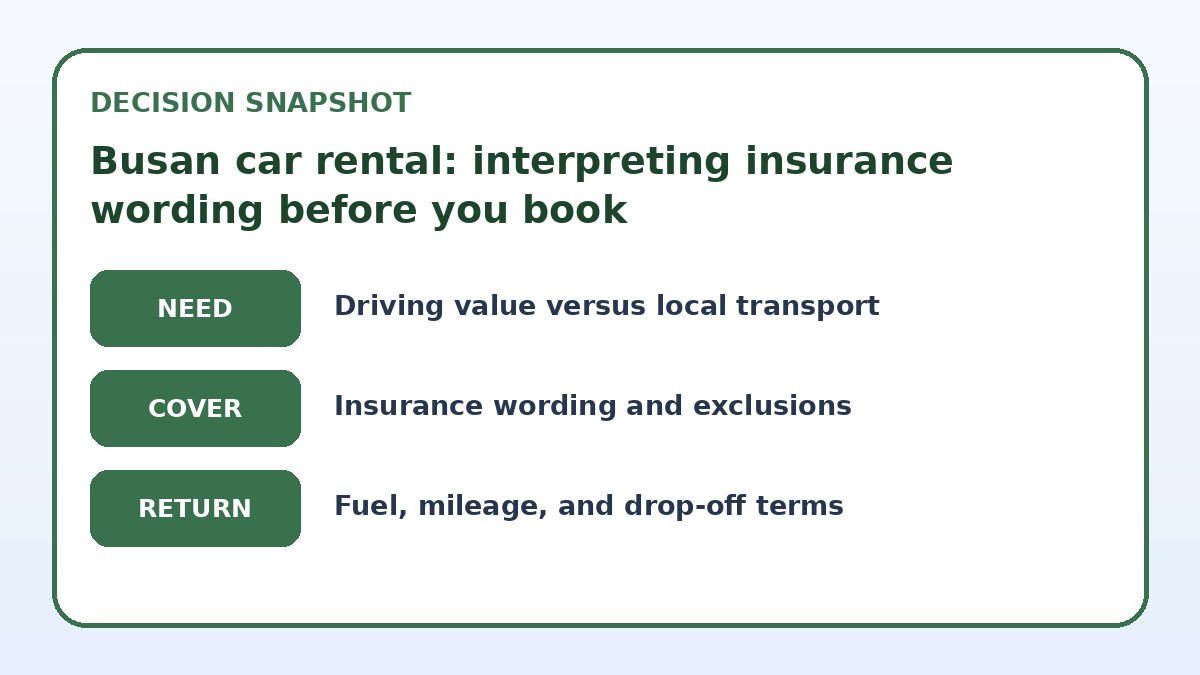
Decide whether driving earns its place
| Mobility strategy | Best for | Cost or friction to check |
|---|---|---|
| Rent a self-drive car | Business itineraries needing full schedule control and equipment transport | Higher administrative overhead, insurance wording to interpret, parking and return friction |
| Taxi and ride-hailing | Short stays with meetings concentrated in central Busan | Less privacy for equipment, per-trip costs add up, slightly less schedule control |
| Short-term chauffeur/private car hire | Multi-stop days where time equals productivity and expense policy allows per-day hire | Higher per-day cost but removes rental insurance complexity and parking hassle |
| Public transit plus occasional hire | Cost-conscious trips with flexible timing and meetings near subway stations | Limited late-night or remote access; may require careful itinerary batching |
Check live rental choices only after the route test
Use the exact driver, dates, pickup point, and return plan to compare current conditions.
How to read the insurance wording that matters
Contracts use a few standard terms repeatedly; learn to translate them. Collision Damage Waiver (CDW) or Loss Damage Waiver (LDW) usually reduces your financial liability for damage to the rental car, but it rarely covers all costs and often has an excess — the maximum you must pay before the waiver applies. Third-Party Liability covers damage or injury you cause to others; verify the limit. ‘Supplemental insurance’ offers broader cover but check whether it replaces or only supplements your existing policies.
Watch for common exclusions and conditions written in small print: off-road use, driving under influence, unauthorized drivers, use on toll or ferry routes, and leaving keys in the vehicle can all void cover. Also check whether the waiver requires a credit card hold equal to the excess, whether the local office enforces color or top-up fees, and whether the insurer requires a police report for any claim. On the provider’s final booking page confirm the excess amount, what triggers voiding conditions, and exactly which third-party amounts are guaranteed.
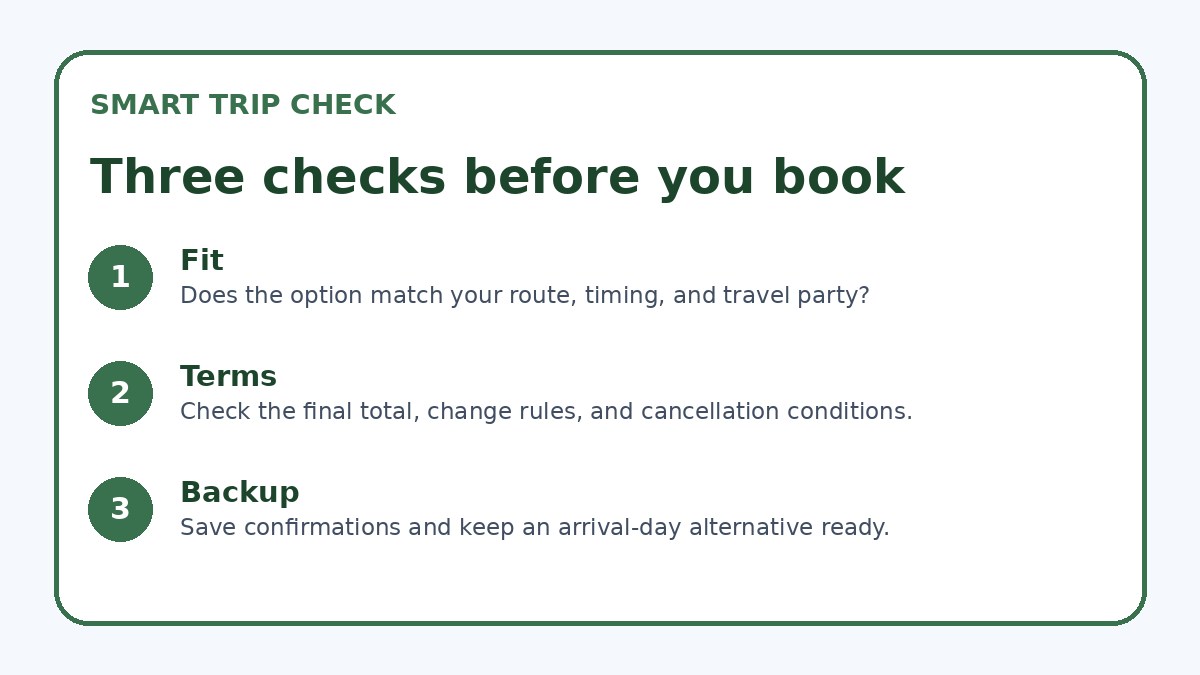
Compare the full rental conditions
Confirm insurance wording, exclusions, deposit, fuel, mileage, and return terms on the final page.
Pickup and return friction — what to plan for
Pickup can take longer than you expect. Agents will inspect the car with you and note scratches and dents; take timestamped photos or a short video from multiple angles. Expect a credit card hold matching the excess or full damage estimate; some companies accept cash but prefer cards. Ask for a printed or emailed copy of the vehicle condition report and the insurance terms that apply to your reservation. If you’ve bought any waivers through your travel card or employer, bring proof to avoid duplicate coverage and charges.
Return issues commonly cause unexpected bills: unreported dings discovered later, missing fuel documented differently, or alleged interior damage. Return the car during office hours if possible so staff can sign off on condition. If returning out of hours, take dated photos showing odometer and fuel level and scan the drop-off receipt or gate ticket. On the final booking page verify the after-hours drop policy, fuel refill rules, and the insurer’s damage-reporting timeframe so you can contest charges promptly if needed.
Car rental terms to verify
- Compare the rental agreement’s excess (deductible) and confirm the exact amount on the final booking page before you book.
- Photograph the car from all angles with timestamps at pickup and again at return; keep images and filenames tied to your reservation number.
- Bring printed or digital proof of any third-party coverage (corporate insurance, travel card) and confirm with the rental counter whether it replaces or stacks with their waivers.
- Ask the agent to mark any preexisting damage on the contract and request a signed copy or email confirmation of the vehicle condition report.
- Confirm the provider’s fuel policy and near-hour return procedures on the final page so you can avoid refueling or out-of-hours penalties.
- Record the claim reporting process and timeline shown on the booking page so you can submit police reports and photos within required windows.
Non-driving fallback: low-friction alternatives in Busan
If you decide driving is unnecessary, create a fallback plan that keeps your schedule reliable. Combine the metro for core-city travel with taxis or app-based ride services for last-mile convenience; taxis are plentiful and metered, and ride apps let you track routes and receipts. For trips to ports, industrial areas, or intercity routes, consider pre-booked airport or corporate shuttles, point-to-point private cars for specific site visits, or short-term chauffeur services that remove rental insurance altogether.
For multi-stop days, batch meetings by district and share a car service or hire a local driver for the day rather than renting. This approach keeps staff productive, avoids the administrative burden of inspecting and insuring a vehicle, and gives you a single invoice for expense reporting. On the booking page for any provider verify cancellation terms, driver licensing and ID verification, and whether receipts meet your company’s expense-policy requirements.
Car Rental & Road Trip questions travelers ask
Does my personal car insurance or corporate policy usually cover rentals in Busan?
Some personal and corporate policies extend coverage to rental cars, but the terms vary widely. Before relying on that coverage, contact your insurer or corporate risk manager to confirm whether it applies in South Korea, whether it covers CDW/LDW or only third-party liability, and whether there are country-specific exclusions. If your policy covers rentals, get written confirmation of covered amounts and required documentation for claims. Also verify whether using an international credit card’s rental protection requires you to decline the rental company’s CDW at pickup — the rental company may still require a hold on your card.
What wording indicates that a damage waiver will not apply to certain incidents?
Look for exclusion language and conditional phrases: terms like “void if driver under influence,” “not covered for off-road use,” “no cover for unauthorized drivers,” or “void if keys left in vehicle” explicitly list scenarios where waivers don’t apply. Also note mandatory reporting requirements — phrases requiring an immediate police report or a specific contact number — and temporal limits for filing claims. On the rental firm’s final page, verify those exact exclusions and the steps they demand; any verbally promised exception should be confirmed in writing before you drive away.
If I return a car after hours and later receive a damage claim, how should I respond?
First, gather your proof: time-stamped return photos showing the car, fuel level, and gate or drop-box receipt. Contact the rental company immediately and request their post-return inspection report. If the provider charges you, ask for the damage invoice, repair estimates, and the inspection photos they used. If disputes escalate, file a claim through your card or insurer using the documentation you collected and follow the provider’s stated dispute process shown on the booking page. Keep all emails and reference numbers for company expense reporting and potential chargeback requests.
Final decision note
For business travelers to Busan, the right choice depends on the shape of your schedule. Rent a car when multiple remote sites, equipment transport, or off-hours needs make transit flexibility critical — but only after you decode the insurance wording, verify the excess, and document the vehicle thoroughly at pickup and return. If your meetings are clustered in central neighborhoods, rely on the metro, taxis, or a short-term chauffeur to avoid insurance uncertainty and parking friction. In every case, check the rental provider’s final booking page for exact excess amounts, exclusions, after-hours return policy, and the claim filing process so your company can approve the expense and you can travel with predictable risk.
Continue planning
Check current options and final conditions
Use the provider page to confirm live availability, the final total, cancellation terms, and every condition that matters to your trip.
This evergreen planning guide was created with AI-assisted drafting and a structured quality review. It does not display live prices, schedules, availability, visa guidance, or provider rankings. Verify current details before booking. Some links are affiliate links; we may earn a commission at no additional cost to you.