For most business travelers moving between Rome and Florence, a direct regional or high-speed rail trip will be the most practical choice because it balances city-center terminals, minimal transfers, and low door-to-door friction. However, the right option depends on where your meetings start and finish, how much luggage or equipment you carry, and whether you need tight schedule control or flexible contingency plans. In this guide I start with the clear practical recommendation, then unpack the tradeoffs — terminal fit, luggage and transfers, timing flexibility, and what to do if disruption strikes — so you can choose the end-to-end plan that gets you to meetings on time and with minimal hassle.
Terminal fit: start and end points matter more than the ride
The practical value of any option starts with where it drops you off and picks you up. Trains arrive in the central stations of Rome and Florence, which typically put you closest to hotels, business addresses and taxi ranks. For business travelers whose schedules hinge on punctual transfers, a station near your meeting district reduces the need for an extra taxi or long tram rides. If your meeting is outside central Florence or in a suburban office park, verify the local access from the station and whether a short taxi will still be simpler than a rental car.
Driving or chauffeur services offer true door-to-door control when your itinerary has multiple off-center stops, early departures, or late finishes. However, the convenience of a car comes with tradeoffs: city-center parking, restricted traffic zones, and the need to negotiate pickups and drop-offs at both ends. When considering a coach or mixed bus+train option, check where buses terminate—some stop at peripheral terminals that add a transfer to the heart of the city. Match your terminal choice to the exact locations of meetings, hotels, and client sites rather than judging options solely by in-transit time.
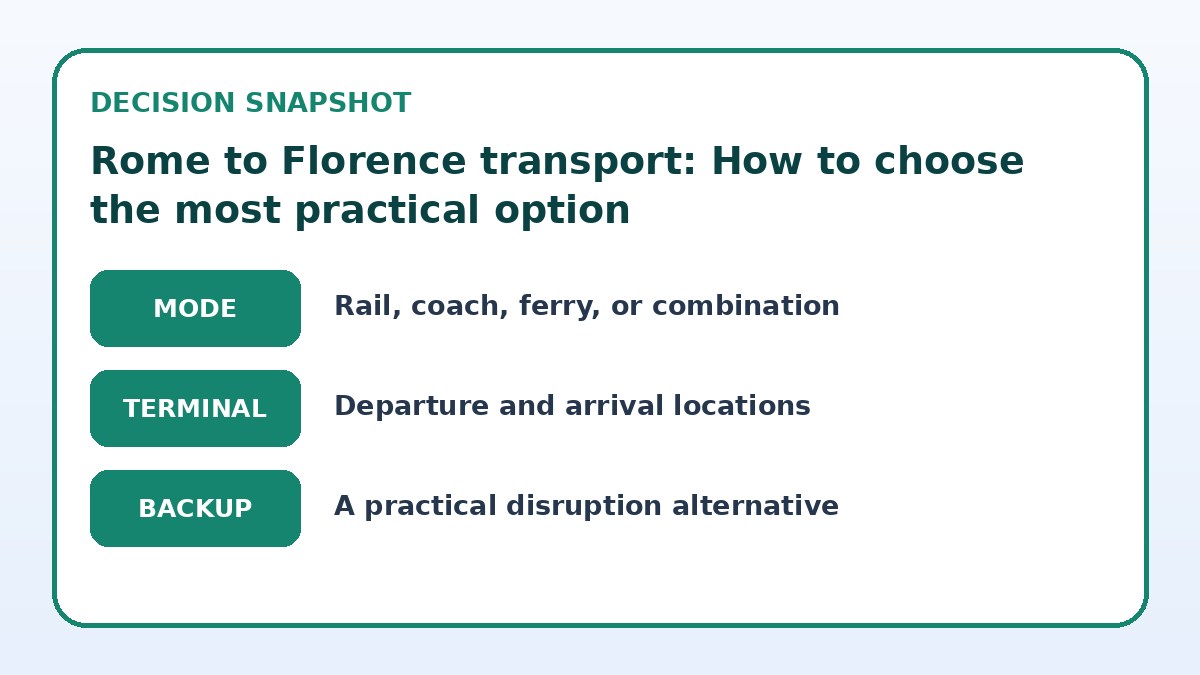
Choose the end-to-end journey plan
| Journey approach | Best for | Friction to check |
|---|---|---|
| Direct high-frequency rail | City-center to city-center travel with minimal transfers and predictable transit links. | Less useful if meetings are in remote suburbs or you have unusually bulky cargo requiring a vehicle. |
| Private car or chauffeur | Door-to-door control, multiple off-center stops, or carrying equipment that can’t be hand-carried. | Adds parking and traffic uncertainty, plus higher coordination and potential urban access restrictions. |
| Coach or bus (possibly mixed with rail) | Lower-cost or single-luggage simple journeys where central arrival is not required. | Often ends at peripheral terminals and increases transfer friction and schedule vulnerability. |
| Mixed itinerary (drive + park + train, or taxi + train) | Combines flexibility and cost control for complex itineraries that start or end outside core areas. | Introduces extra handoffs and timing complexity; requires careful buffer planning and verified connections. |
Check live intercity options
Look beyond the ride itself and compare terminals, transfers, luggage, and arrival fit.
Luggage and transfer friction: what you’re carrying changes the decision
Business travelers often travel with a carry-on plus a garment bag, sample cases, or tech equipment. Trains typically allow easy onboard storage and short walks between platform and street, minimizing heavy lifts. Even so, consider the number of steps, escalator availability, and distance between platforms and street-level exits—some stations are large and busy. If you have multiple heavy cases or bulky presentation materials, a direct chauffeur or private transfer eliminates handling and waiting, though you'll need to confirm vehicle size and secure parking at arrival addresses.
Coaches may impose luggage compartment limits or require longer waits at peripheral terminals, increasing the handling steps required. If you plan a mixed itinerary (for example, drive-to-park + train), account for time and effort moving from car to platform and whether you need luggage assistance. Wherever you book, verify luggage allowances and transfer procedures on the final provider page before purchase, and consider packing or shipping options for samples or exhibition materials if avoiding multiple handlings is critical.
Timing flexibility: schedules, connections and the value of buffer time
Business trips are rarely flexible; meetings change, and delays ripple. High-frequency rail corridors between Rome and Florence provide more departure options, letting you pick a trip with a time cushion before your meeting. If you require absolute predictability, consider booking a service with fewer implied connections and avoid itineraries that require tight transfers. When comparing options, factor in realistic transfer times at both ends, check local traffic patterns for ground transfers, and plan for check-in or security time if you switch to air travel or private terminals.
Driving gives you control over departure timing but exposes you to variable traffic conditions and the stress of urban navigation. Coaches often have fixed timetables and may be less frequent, reducing last-minute flexibility. For itineraries with multiple appointments the same day, lean toward options that let you arrive early and depart late without complex logistics; that may mean an earlier train arrival or a reserved private transfer. Always build in at least one reliable contingency slot if a meeting runs long or transport is delayed.
Compare the practical alternatives
Use the final page to confirm what is actually offered on your dates and save a workable fallback.
Intercity travel checklist
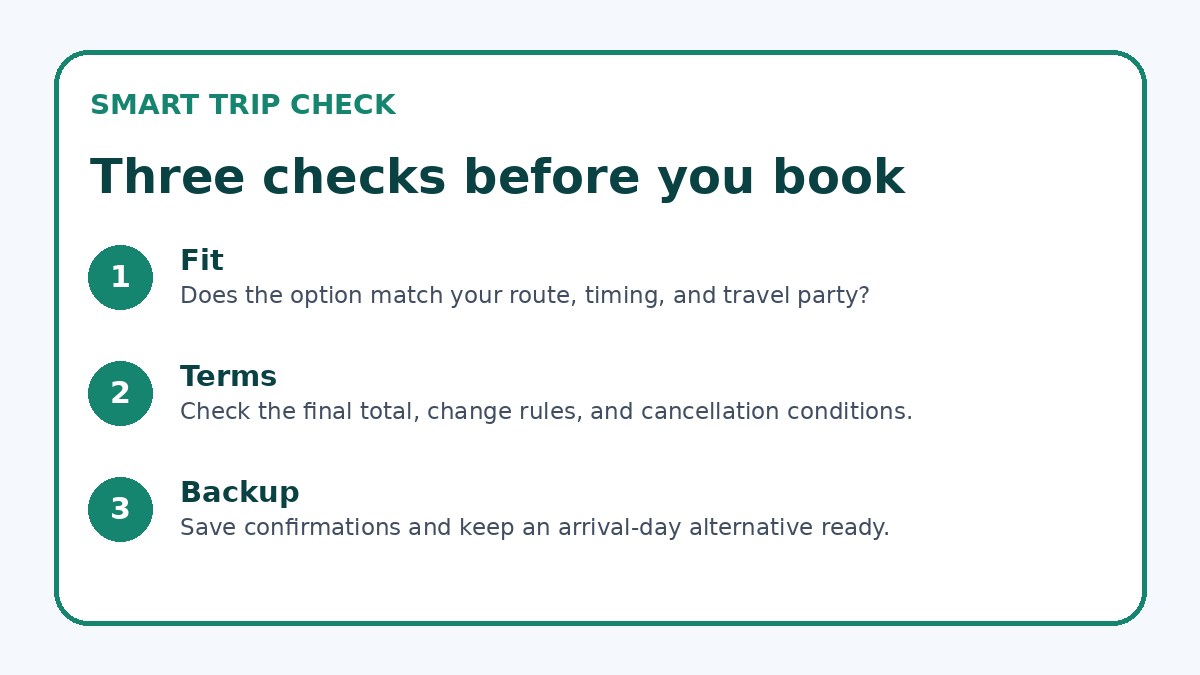
- Confirm the exact arrival and departure terminals for every leg on the operator’s official booking page before finalizing.
- Estimate door-to-door time by adding realistic transfer times, check-in needs, and local traffic patterns for your exact addresses.
- Verify luggage allowances and carriage rules on the provider page, and plan vehicle size if you need to transport bulky equipment.
- Identify at least one alternate transport option and a local taxi app or company for same-day backups.
- Reserve flexible or refundable tickets if schedule uncertainty could force a change; confirm change fees and timelines.
- Store provider contact details, booking screenshots, and a short contingency plan in an easily accessible place on travel day.
Disruption backup: realistic alternatives and on-the-day decisions
Prepare a simple, realistic backup for the most likely failures: a delayed train, road closure, or full taxi rank. Identify one alternate rail service, a nearby taxi company with app-based booking, and a short-stay hotel near your arrival point if an overnight becomes necessary. If you rely on a chauffeur, confirm their cancellation and reroute policy and have a rapid taxi app and local numbers ready. On the day, monitor provider updates and be prepared to trade a slightly higher fare for a guaranteed seat that preserves your meeting schedule.
When booking, check the provider’s final page for refund, exchange and change fees, and whether seat reservations or flexible tickets are available; these conditions can be decisive for business travel. Trip.com can be used as one place to compare current availability and conditions, but always verify critical details—cancellation terms, exact terminal information, and luggage rules—on the operator’s official page before committing. Keep contacts, screenshots of bookings and a simple plan B so you can act quickly if disruption happens.
Rail & Intercity Transport questions travelers ask
Should I always choose the fastest train between Rome and Florence for business travel?
Not necessarily. The fastest train reduces in-transit time but may not minimize total door-to-door journey if station locations, transfer times, or luggage handling add friction. Evaluate the fastest option against where it drops you relative to your meeting location, the time needed to get from station to venue, and whether you’ll need taxis or local transit on arrival. For tight schedules, a slightly slower train that arrives at a more convenient time or platform might yield a smoother overall experience. Always check departure and arrival stations and platform access details on the official operator page before booking.
How much buffer time should I build for transfers between train and meeting venues in Florence?
Build buffer time based on a realistic assessment of walking distance, taxi availability, and possible station crowds. A flexible buffer for business travel typically allows for platform navigation, brief waits for taxis or ride-hail, and a margin for minor train delays. If you need to prepare before your meeting—change clothes, connect equipment, or print materials—add extra time for those tasks. Exact buffer length depends on your personal tolerance for risk and the consequences of lateness; confirm local transfer conditions and plan conservatively if consequences are significant.
Is hiring a chauffeur or renting a car worth it for a single-day Rome to Florence business trip?
Consider a chauffeur or rental if your schedule includes multiple out-of-center stops, you carry sensitive equipment, or you need guaranteed privacy and onboard workspace. For single downtown-to-downtown trips, rail often offers lower friction and avoids parking and restricted traffic issues. If you do opt for a car, confirm parking options at your destinations, understand any urban access restrictions, and verify cancellation or reroute policies in case of delays. Compare the total door-to-door time and complexity—not just the driving hours—before deciding.
Final decision note
Choosing the most practical Rome to Florence option for a business trip means prioritizing door-to-door ease over headline travel time. Start by mapping where your meetings and accommodations sit relative to arrival and departure terminals, then weigh luggage handling, how tightly you must keep to a schedule, and realistic disruption scenarios. Trains generally win for city-center itineraries; cars or chauffeurs make sense for off-center needs and heavy equipment; coaches and mixed options can work when peripheral terminals are acceptable. Verify terminal locations, luggage rules and change/refund terms on provider pages before you book, and keep a clear backup plan to protect your meeting schedule.
Continue planning
Check current options and final conditions
Use the provider page to confirm live availability, the final total, cancellation terms, and every condition that matters to your trip.
This evergreen planning guide was created with AI-assisted drafting and a structured quality review. It does not display live prices, schedules, availability, visa guidance, or provider rankings. Verify current details before booking. Some links are affiliate links; we may earn a commission at no additional cost to you.