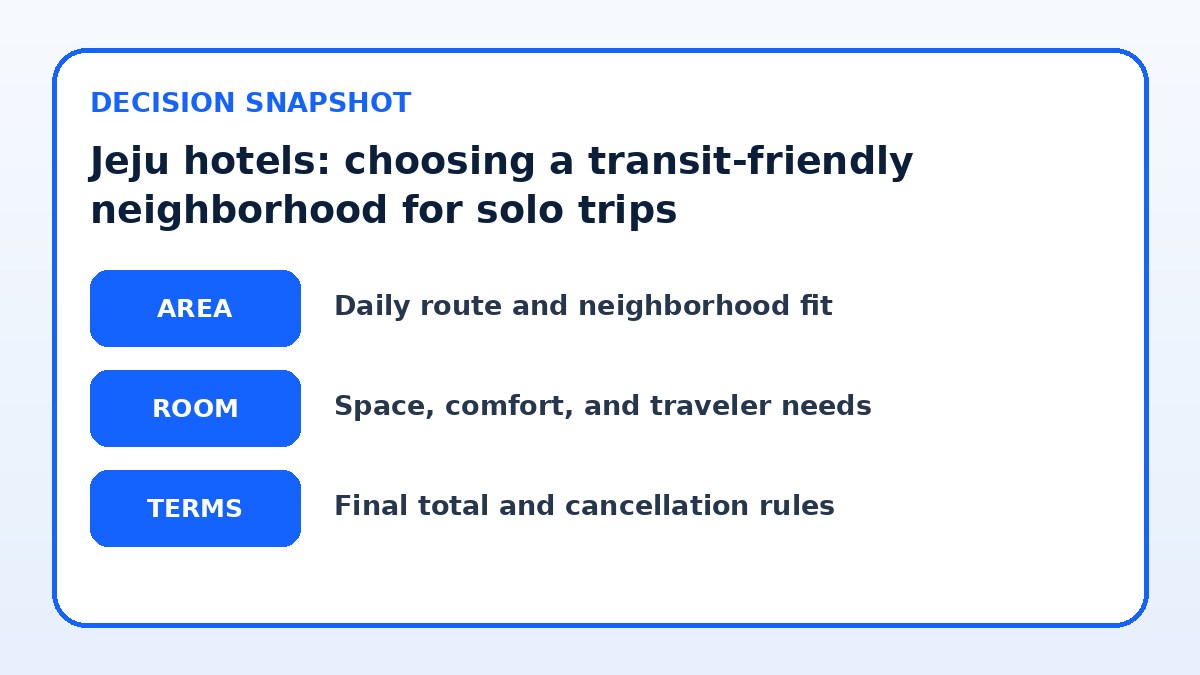
Choose your stay area first, then narrow to a hotel — that’s the practical route for solo travelers on Jeju. Start by matching where you’ll spend most of your time (airport arrival, west-coast day trips, Seogwipo attractions, or night cafés in Jeju City) to neighborhoods with the transport links that reduce daily friction. Pick an area with reliable bus connections, easy taxi access, or proximity to the airport/ferry depending on your arrival and departure plans. Once the neighborhood is set you can filter room type, budget, and hotel services that matter to solo travelers (single rooms, luggage storage, 24-hour reception). This article gives a clear decision path: how each neighborhood fits typical solo itineraries, what daily route pain points to expect, what room or party needs to prioritize, and the exact booking terms and checks you should complete before confirming.

Check live stays in the areas that fit
Use your dates and party size to compare current rooms after you narrow the neighborhood fit.
Neighborhood fit: match area to your itinerary
Make the stay-area decision by asking where you will actually spend hours each day. If your plan is museum-hopping, café sessions, and occasional night markets, Jeju City (especially the east side near traditional markets and cafes) puts you within walkable distances and frequent local bus routes. For a South Coast focus—waterfalls, Olle trails, and the Jungmun resort zone—base in Seogwipo to cut transit time to major sights. If your schedule starts or ends with an early flight or you prefer minimizing transfers, the airport area or Yongduam/nearby east-coast neighborhoods reduce arrival stress.
Think beyond single attractions. Some solo travelers favor a base that supports day trips (buses heading to Hallasan, routes to Seongsan or west-coast beaches), while others prefer a compact neighborhood to minimize evening navigation. Identify the one or two places you’ll visit most often and pick the neighborhood that has direct, frequent transport lines to those spots. That initial choice narrows dozens of hotel options into a manageable shortlist that already fits your movement pattern.
Choose an area-selection strategy
| Area approach | Best for | Tradeoff to check |
|---|---|---|
| Stay near Jeju International Airport | Travelers with early/late flights or quick transfers | Limited evening dining and fewer scenic walking options compared with city centers |
| Base in Jeju City east/central | Solo travelers who want nightlife, cafes, and frequent local buses | Can require longer trips to southern and some east-coast attractions |
| Base in Seogwipo/south coast | Visitors focusing on southern sights, waterfalls, and coastal trails | Fewer late-night transport options and longer transfers to the north or airport |
| Choose a rural/coastside guesthouse | Quiet stays and close access to nature trails or beaches | Lower public transport frequency; more reliance on taxis or organized tours |
Daily-route friction: what adds time or stress
Daily friction comes from poor bus frequency, long waiting times for taxis, luggage-handling pain, and late-night transport gaps. Even when a hotel is close to a bus stop, infrequent buses or confusing routes can turn a short distance into a long day. Check whether the neighborhood has night buses or easy access to reliable taxi ranks — important when you return late from tours or evening dining. For quieter coastal neighborhoods, confirm that onward transport options exist after sundown so you’re not stranded or forced to pay premium taxi fares.
Also weigh the physical layout: hilly streets, long stair-only accesses, or hotels located down narrow alleys increase the hassle when you’re hauling a suitcase alone. If you plan to switch areas mid-trip, prioritize hotels that offer luggage storage and flexible check-in policies. Finally, consider safety and lighting for evening walks; well-lit streets and visible hotel entrances reduce anxiety on return trips, a small but meaningful component of daily travel comfort for solo visitors.
Now compare like with like
Keep the same dates, guests, room needs, and cancellation preferences while you compare the final choices.
Room and party needs: single travelers’ practical filters
Solo travelers typically need a clean, private room with enough storage for one person’s gear, a quiet environment for restful nights, and hotel staff who can help with transport advice. Filter listings for single-occupancy rooms or small doubles and confirm bed sizes and bathroom types (private vs. shared). Look for amenities that reduce friction: luggage hold for early arrivals or late departures, laundry services for multi-day trips, and clear reception hours so you can plan arrivals after evening tours or later flights.
If you’re social, consider guesthouses and small boutique hotels that host common areas where other travelers gather. If you prefer quiet, choose business-style hotels with soundproofing and 24-hour service. For day-trip logistics, check whether the property can arrange or recommend reliable drivers, book local tours, or provide printed bus schedules — but always verify any transfer or tour details on the provider’s booking page before you commit.

Hotel booking check before payment
- Confirm the hotel’s nearest bus stop name and typical routes to your top two attractions or the airport.
- Ask the hotel about luggage storage availability and any fees or time limits for early drop-off or late pickup.
- Verify reception hours and the hotel’s late-check-in procedure if you expect to arrive after normal hours.
- Check room occupancy rules, bed size, and whether single-occupancy pricing or ID is required at booking.
- Request written confirmation of any arranged transfers, shuttle pickup points, and the driver’s contact if applicable.
- Compare cancellation, prepayment, and deposit conditions on the hotel’s official page before completing your reservation.
Booking terms and final checks before you confirm
Before you click book, inspect a hotel’s cancellation policy, prepayment rules, and any deposit or ID requirements listed on the provider page. Don’t assume government or local policies; the hotel’s booking page is the authoritative source for check-in hour limits, late arrival procedures, and whether a credit card imprint or cash deposit is required. If you need airport pick-up, verify whether the service exists, what times it covers, and where the meeting point is — again, on the official booking or hotel site.
Compare room photos with recent guest reviews and the property’s own descriptions for accuracy; discrepancies are common and matter for solo travelers relying on specific amenities. If transport connectivity is decisive, call or message the property to ask about the nearest bus stops, approximate walking time, and typical taxi wait times. Use Trip.com or another OTA to compare live availability and booking terms, but confirm anything essential directly with the hotel before finalizing to avoid surprises.
Hotel Guide questions travelers ask
Is it better to stay in Jeju City or Seogwipo for a four-day solo trip?
Choose based on your priorities. If your four days center on museums, markets, cafés, and easy evening movement, Jeju City keeps you in a walkable urban hub with frequent local buses. If your focus is southern coastline sights, waterfalls, and Olle walks, Seogwipo places you nearer those attractions and cuts daily transit time. Consider where your flights arrive and depart, and whether you want to reduce transfer stress; use the neighborhood fit advice to pick the single area that minimizes most of your travel time.
How can I judge bus connectivity for a hotel listing before I arrive?
Look for the exact bus stop name in the hotel description and then compare it against local bus maps or the operator’s route info. Check typical service frequency for the times you’ll travel (morning, midday, evening) and whether direct services run to your main sights. If the listing is vague, message the hotel to ask specific questions: nearest stop name, walking time, and the main routes serving it. Confirm anything decisive directly with the hotel to avoid relying on outdated third-party descriptions.
Are taxis a reliable fallback for solo travelers in Jeju?
Taxis are generally available in main towns and near transit hubs, which makes them a practical fallback for short trips or late returns. In rural areas, however, waits can be long and availability limited after certain hours. If you plan itineraries that use remote beaches or trails, either arrange return transfers through the hotel or accept the added cost and time of taxis. Always verify typical taxi wait times with your hotel and have the hotel’s address written in Korean for drivers unfamiliar with a small guesthouse location.
Final decision note
For solo travelers on Jeju, the most effective booking strategy is to pick the neighborhood that already solves most of your daily transport needs, then choose a hotel within easy walking distance of reliable stops or taxi ranks. That sequence reduces daily friction, keeps evening logistics simple, and narrows hotel choices to properties that meet your solo-specific needs like luggage storage, clear reception times, and helpful local advice. Before you finalize, verify booking terms, confirm any transfers, and double-check the nearest bus stop names with the property. Use an OTA such as Trip.com to compare live availability, but always cross-check critical transport and policy details directly with the hotel.
Continue planning
Check current options and final conditions
Use the provider page to confirm live availability, the final total, cancellation terms, and every condition that matters to your trip.
This evergreen planning guide was created with AI-assisted drafting and a structured quality review. It does not display live prices, schedules, availability, visa guidance, or provider rankings. Verify current details before booking. Some links are affiliate links; we may earn a commission at no additional cost to you.