If you’re traveling from Seoul to Gyeongju for the first time, the most practical departure airport depends less on price and more on how you want to travel that day. For many travelers, minimizing transfers and baggage risk while matching arrival time with ground connections matters more than shaving a few minutes of flight time. This guide gives a clear recommendation up front, then walks you through the route-versus-fare tradeoff, connection and baggage considerations, schedule fit for different itineraries, and the fare conditions you should check before clicking book. Prepare your exact travel dates, number of travelers, and baggage needs now — those details change which airport is most practical. I’ll also show four decision approaches so you can choose the one that matches your priorities for a smoother Seoul to Gyeongju transfer.

See live routes for your exact travel day
Compare direct and connecting choices with the same baggage and traveler details.
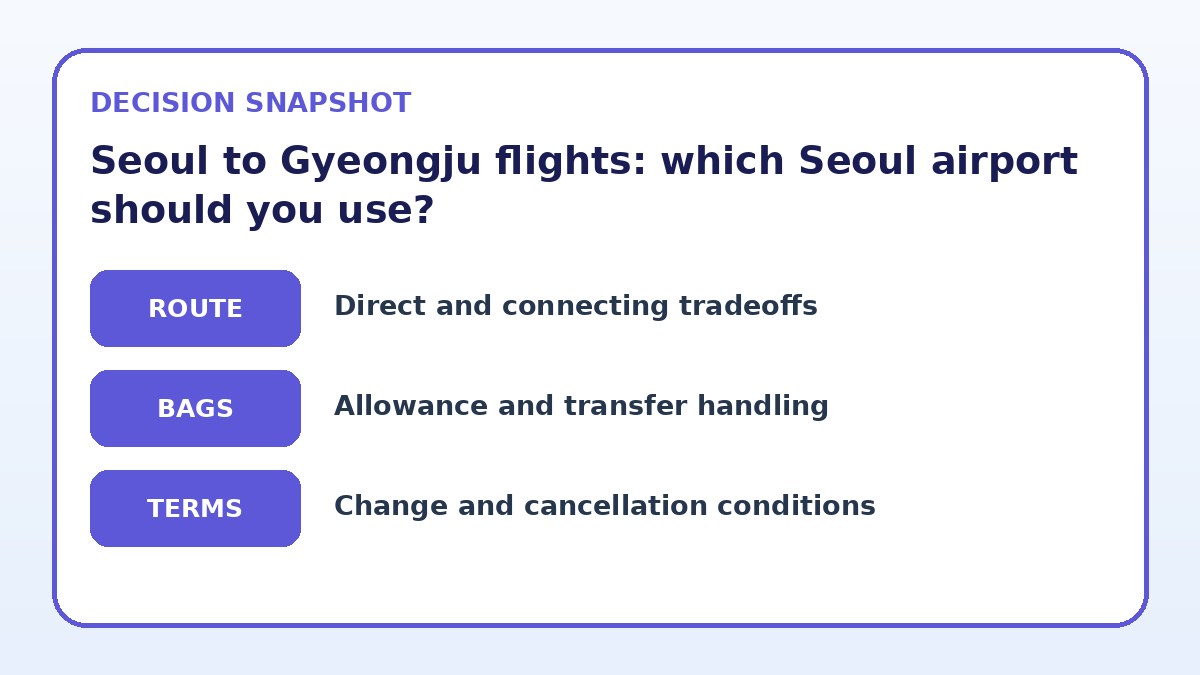
Practical answer first: route-versus-fare tradeoff
For most first-time visitors making a Seoul to Gyeongju trip, the practical choice is the airport and itinerary that minimizes transfer complexity even if the fare is slightly higher. That often means choosing the departure airport that offers the most direct onward ground or air connections to Gyeongju, reducing the chance of missed links or long waits. Think of the trip as a single door-to-door journey: a cheaper flight that requires a long shuttle or multiple transfers can cost more in time, stress, and potential additional transport fares.
When you compare options, treat the fare as one part of a larger equation that includes transfer time, check-in and security lines, baggage handling, and how arrival time aligns with onward trains, buses, or rental car pick-up. For example, a flight that lands earlier but requires a confusing connection may be less practical than a later flight landing closer to the correct transit hub. Before searching live options, note exact travel dates, traveler count, and baggage requirements so you can judge tradeoffs accurately.
Routing and connection risk: what to verify
Routing matters more than airport name: find out whether an itinerary is direct to the closest airport serving Gyeongju or requires a transfer. If trains or buses are part of the plan after arrival, align flight landing times with scheduled ground departures and allow extra buffer for baggage collection and immigration if applicable. For itineraries that involve a domestic connection, verify connection minimums on the carrier’s booking page and whether through-checked baggage is available; if not, you’ll need time to collect and re-check bags.
Also check where each Seoul airport sits in the city and how long it takes to reach the train or bus terminal you plan to use. Different airports offer different transfer modes and frequencies; compare those options and their real-world reliability. If an itinerary offers a late arrival or tight connection, consider the connection risk: missed connections mean rebooking fees or night stays, both of which change the practical cost of a seemingly cheap ticket.
Compare flight-selection strategies
| Flight strategy | Best for | Risk to check |
|---|---|---|
| Prioritize fewest transfers (route-focused) | Travelers who want predictable door-to-door time and low connection risk | May cost more than options prioritizing base fare savings |
| Prioritize lowest upfront fare (price-focused) | Budget-minded travelers who are flexible with time and transfers | Could add time, extra transfer costs, and higher baggage risk |
| Prioritize schedule fit (time-focused) | Those matching flights to specific trains, tours, or check-in windows | Might require paying a premium to hit exact times |
| Prioritize baggage and family convenience (comfort-focused) | Families and travelers with large luggage who want minimal handling | Often reduces the number of carriers and flight choices available |
Recheck the complete itinerary
Confirm airports, connection handling, baggage, and change conditions before deciding.

Baggage, schedule fit and traveler type
Your baggage profile should drive your choice when possible. Travelers with heavy checked luggage, sports equipment, or children often benefit from itineraries with fewer handoffs and simpler ground transfers. If a flight requires a domestic connection where bags must be reclaimed and rechecked, add time and stress to your plan. For travelers with only carry-on, a tight connection may be acceptable, but always leave a cushion for delays on arrival into Seoul.
Schedule fit is a personal decision: morning departures can give you more daytime hours in Gyeongju, while late-morning or afternoon flights may reduce the chance of early-morning travel stress. Match flight times to your planned arrival activities and accommodation check-in. If you’ll catch a scheduled train or bus, verify those ground departure times and work backwards to set a safe arrival window at the airport, then select the airport and flight that meet that window reliably.
Flight details to verify
- Note your exact travel dates, number of travelers, and total baggage (carry-on plus checked) before searching for flights.
- Check the final booking page for the carrier’s baggage allowance, change/cancellation fees, and whether baggage is through-checked on connecting itineraries.
- Confirm the airport names and terminals shown on the booking page; verify transfer options and travel time to your onward transport in Gyeongju.
- Match flight arrival times with train or bus departure schedules and allow at least one hour extra for domestic connections or baggage reclaim.
- If traveling with children or large equipment, prefer itineraries with single-plane segments or supervised transfers to reduce handling steps.
- Compare the total door-to-door cost including airport transfers, local buses or taxis, bag fees, and any required overnight stays.
Fare conditions and what to confirm before booking
Fare conditions determine how flexible and expensive a change or cancellation will be — crucial if plans are uncertain. Before you pay, read the carrier’s or ticketing agent’s final page to confirm baggage allowances, change and cancellation fees, and whether fares include seat selection or other ancillaries. Those add-ons can alter the value of an itinerary that looks cheaper at first glance. Also verify whether your booking allows through-checked baggage and if protective measures like refunds or re-accommodation are offered for missed connections.
Finally, confirm the exact arrival and departure airports shown on the final booking page; some search results abbreviate or combine airports and routing options. If ground connections or inter-airport transfers are needed, check who is responsible and whether transfer windows are sensible. If using a third-party search tool, open the carrier’s official booking page to validate the fare rules and baggage policy because those provider-specific facts can change and will be enforced at check-in.
Flight Guide questions travelers ask
Which Seoul airport is easiest for a first-time traveler heading to Gyeongju?
There isn’t a one-size-fits-all airport; the easiest choice depends on your onward plan. Pick the airport that gives the simplest and most reliable connection to Gyeongju — whether that’s a direct onward ground service, a short transfer to a long-distance train station, or a single connecting flight. Before booking, verify arrival times, transfer modes, and whether checked bags will be through-checked. If in doubt, prioritize fewer transfers and longer connection buffer to reduce stress for your first trip.
How much time should I allow between arrival in Seoul and onward transport to Gyeongju?
Allow time for disembarking, passport/immigration and baggage (if applicable), plus the trip from the arrival terminal to the ground transport departure point. For domestic connections or local ground departures, plan at least an hour buffer; for international arrivals that require immigration or baggage reclaim, plan additional time according to your comfort with risk. Always consult the carrier’s specified minimum connection times and add cushion for traffic, ticket lines, or unexpected delays.
What fare rules should I check when comparing Seoul to Gyeongju flights?
Review change and cancellation fees, refundability, baggage policy, and whether seats or services are included or sold separately. Confirm if the fare allows through-checked baggage on connecting legs and whether the carrier provides rebooking assistance for missed connections. Check the exact terms on the final booking page and save a copy of the fare conditions. If a third-party site lists an itinerary, open the operating carrier’s page to verify those provider-specific rules before paying.
Final decision note
Choosing the most practical departure airport for Seoul to Gyeongju travel comes down to balancing route simplicity, baggage handling, schedule fit, and fare rules. Start by listing your exact dates, traveler count, and baggage needs; then compare door-to-door time and total costs rather than base fares alone. Prioritize fewer transfers if you want predictability, or prioritize schedule fit if you must meet a specific ground departure. Always confirm provider fare conditions and baggage rules on the carrier’s final booking page before paying. For a quick comparison of live availability you can check Trip.com or carrier sites, but validate any critical details there before you finalize your booking.
Continue planning
Check current options and final conditions
Use the provider page to confirm live availability, the final total, cancellation terms, and every condition that matters to your trip.
This evergreen planning guide was created with AI-assisted drafting and a structured quality review. It does not display live prices, schedules, availability, visa guidance, or provider rankings. Verify current details before booking. Some links are affiliate links; we may earn a commission at no additional cost to you.