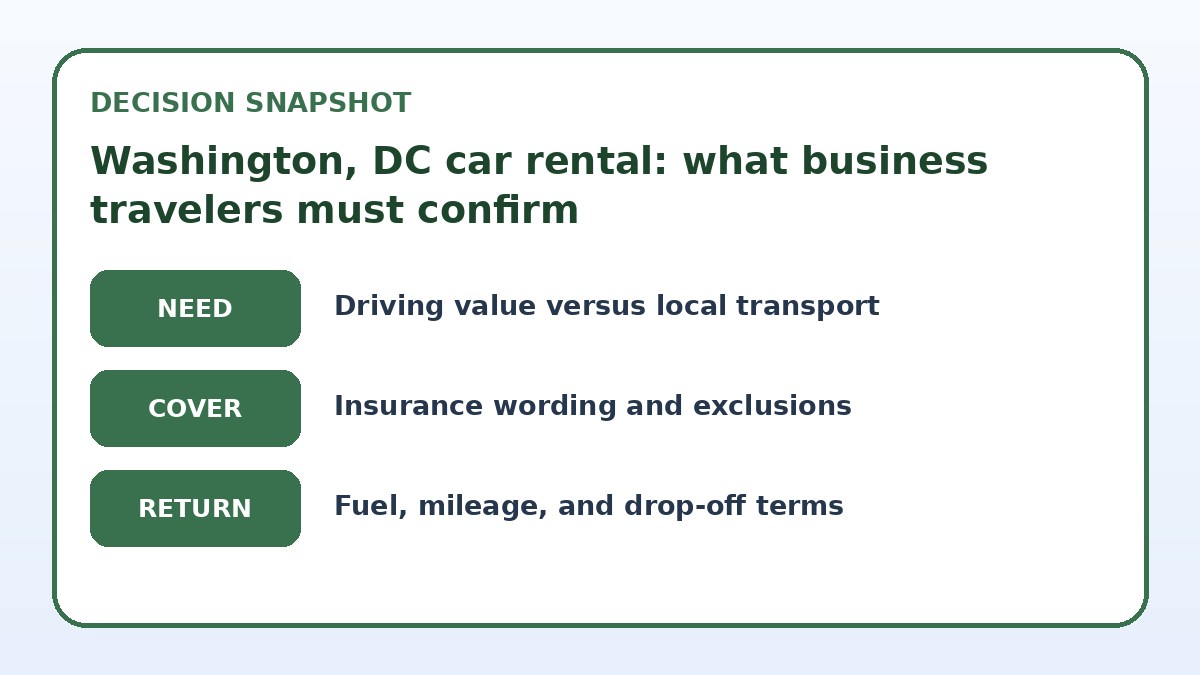
Practical answer first: for most short business trips limited to central DC, you probably won’t need a rental car—public transit, walking and rideshares often save time and parking hassle. But if your schedule includes out-of-city meetings, frequent site visits around the metro area, or carrying equipment, renting can be the better choice. Before you click “reserve,” verify three rental contract points: the fuel-return requirement (full-to-full, pre-purchase, or other), the mileage allowance or per-mile fees, and how damage and liability are defined in the insurer wording. These details determine actual cost and convenience more than vehicle class. This article walks you through route value, insurance wording to look for, pickup and return friction, and a clear non-driving fallback plan so you can decide with confidence.

Does driving add value for your Washington, DC itinerary?
Start by mapping every appointment, hotel and daytime commitment. If all your meetings cluster inside downtown, the National Mall area, or within a few blocks of a Metro station, driving generally adds friction: parking is limited, meters and garages add time, and security checkpoints can slow exits. Conversely, if your agenda includes suburban sites in Maryland or Virginia, meetings spread across the Capital Region, or late-night returns when transit is less reliable, a rental can save door-to-door time and give you flexibility to carry materials or visit multiple locations in a single day.
Count transit and last-mile time as part of the comparison: include the walk from parking to a building, potential shuttle waits, or rideshare surge windows. Consider whether you’ll need to move between meeting locations quickly or travel outside regular transit hours. If driving only saves a few minutes on each leg but creates predictable parking or fuel headaches, it may not be worth it. Use this routing value test to decide whether to proceed with rental research or plan for a non-driving fallback.
Decide whether driving earns its place
| Mobility strategy | Best for | Cost or friction to check |
|---|---|---|
| Full rental (self-drive) | Multiple suburban meetings, equipment transport, flexible schedules | Higher parking, fuel, and insurance admin; must verify fuel and mileage clauses carefully |
| Hybrid: transit plus rideshare | Downtown appointments and quick client hops within Metro coverage | Less flexibility early/late; rideshare costs can spike and carry limits on bulky items |
| Point-to-point car service or chauffeur | High-value meetings with tight timing or when you must work in transit | Potentially higher per-trip cost but avoids parking and refueling management |
| No-car shipping plus transit | When you need to move materials but want to avoid driving | Requires planning ahead and may have delivery or pick-up time windows |
Check live rental choices only after the route test
Use the exact driver, dates, pickup point, and return plan to compare current conditions.
Insurance wording to verify (and who pays what)
Don’t assume words like “insured” mean full coverage for business use. Rental agreements separate physical damage waivers, liability insurance, and optional protections like theft or roadside assistance. Look for explicit wording about what the collision damage waiver (CDW) covers and any exclusions for commercial or business use. Your company’s travel policy or corporate card often covers damage or loss, but the wording on the rental provider’s final booking page will say whether a CDW is accepted in lieu of another policy and whether a deductible applies. If your card or company policy has limits, you may need to add supplemental coverage.
Also confirm liability limits listed on the booking page; state minimums may be insufficient for third-party injury or property claims. If you will drive other employees, check whether additional drivers are covered and whether the contract charges per-driver fees. If international staff or non-U.S. licenses are involved, verify acceptability and required documentation on the provider’s terms. When a phrase could change provider responsibility, write down the exact sentence from the provider’s final page to present to your finance or risk team if needed.

Compare the full rental conditions
Confirm insurance wording, exclusions, deposit, fuel, mileage, and return terms on the final page.
Pick-up, return friction, and fuel policy details to check
Pickup location and return logistics can turn a cheap rate into a lost-productive-time decision. Airport counters often add shuttle time and wait lines; city-center locations may be quicker but have limited hours. Confirm the provider’s documented after-hours return process on the confirmation page and whether returns to a different location incur a fee. Note where the fuel station options are near your pickup and usual routes—having convenient refueling options avoids surcharge moments late on a return.
Fuel policy language is decisive: full-to-full typically requires you return the tank at the same level to avoid a refueling service charge; prepaid or fuel purchase agreements may let you skip refueling but often cost more per gallon. The final booking page will state how refueling charges are calculated and whether a fuel service fee or minimum charge applies. Write down the exact fuel clause and sample per-gallon or service fees shown on the booking summary to compare true cost between options.
Car rental terms to verify
- On the rental provider’s final booking page, copy the exact fuel policy phrase and any per-gallon or service fee examples for comparison.
- Confirm mileage allowance or per-mile rate on the booking summary and calculate expected miles for your planned routes.
- Ask your company travel or risk manager to provide written confirmation of corporate insurance coverage and acceptable deductible limits.
- Verify pickup and after-hours return procedures, including where keys are left and any out-of-hours penalties listed on the booking confirmation.
- Note whether additional drivers are allowed and their exact listed fees; add them to the reservation if multiple employees will drive.
- Compare total expected cost (rate + estimated fuel + parking + insurance add-ons + potential mileage fees) against the cost of point-to-point services for your itinerary.
Non-driving fallback: efficient options when a car isn’t right
If you decide against a rental, plan a reliable alternative in advance. For central Washington, DC, combine Metro trips with targeted rideshares for last-mile connections—this hybrid approach cuts parking hassle and often reduces cost for short hops. For evening or late-night returns, pre-schedule a ride via a trusted ride-hailing app or your hotel’s recommended driver to avoid surge pricing and long waits. If you need to carry materials, consider a local courier, same-day luggage service, or shipping items ahead to the hotel to preserve mobility without committing to a vehicle.
For meetings outside transit corridors, book point-to-point car service or a local chauffeur for the day; this can be more cost-effective than a full rental when factoring fuel, parking and insurance. Whatever fallback you choose, confirm cancellation terms and estimated door-to-door times for the typical windows in your schedule. Keep these backup options written in your itinerary so you can pivot quickly if traffic, parking, or meeting changes make driving unattractive.
Car Rental & Road Trip questions travelers ask
Will my corporate credit card or company insurance cover rental car damage for business use?
Coverage varies. Corporate credit cards and company policies often provide some protection, but the exact terms differ by issuer and policy. You must check the card’s benefit guide and your employer’s travel insurance wording for specific language about commercial or business use, exclusions, and deductible amounts. On the rental provider’s final booking page, confirm whether a CDW is required, whether the provider accepts third-party coverage, and whether any written proof of corporate insurance is requested at pickup.
How do I avoid fuel surcharges when returning a rental in Washington, DC?
The simplest way is to return the vehicle with the same fuel level if your contract is full-to-full; keep the receipt to document refueling. If you prepay for fuel, compare the provider’s per-gallon price shown on the booking page to local station prices to judge value. Avoid vague terms; get the exact fuel-charge example or calculation from the final booking summary so you can compare it to filling the tank yourself near the return location and decide which is cheaper for your schedule.
What parking and driving rules should I verify to prevent surprises in central DC?
Rather than relying on memory, check parking options near each meeting venue—street meters, loading zones, and garage policies differ by block. On the rental confirmation page or provider FAQ, note any restrictions on where you can legally park or whether they advise against certain zones. Also ask about toll processing and associated administrative fees, and check whether the supplier adds a toll device charge or uses license-plate billing with service fees. For all these items, capture the provider’s exact fee descriptions to present to your finance team if questioned.
Final decision note
For business travel in Washington, DC, the decision to rent a car hinges on route value and contract details rather than daily rate alone. If meetings take you across the broader metro area, require equipment transport, or need late-night flexibility, a rental can be the smarter tool—provided you confirm fuel policy, mileage rules, and insurance wording on the provider’s final booking page. If most activity sits downtown, pair transit with rideshares or point-to-point car service to avoid parking and refueling friction. Use the checklist above before booking and keep written copies of the exact fuel, mileage, and coverage clauses so accounting and risk teams can reconcile costs without surprises.
Continue planning
Check current options and final conditions
Use the provider page to confirm live availability, the final total, cancellation terms, and every condition that matters to your trip.
This evergreen planning guide was created with AI-assisted drafting and a structured quality review. It does not display live prices, schedules, availability, visa guidance, or provider rankings. Verify current details before booking. Some links are affiliate links; we may earn a commission at no additional cost to you.