For couples deciding between direct and connecting New York City to Toronto flights, the core tradeoff is simple: direct flights often save time and simplify logistics, while connecting itineraries can lower fares or open better schedules. Start your decision by confirming the exact travel dates, departure airports in New York City you prefer, and whether you need checked baggage or flexible tickets. Couples should also agree on priorities—minimizing airport time, keeping costs low, or maximizing comfort—and use those priorities to weigh direct versus connecting options. Before you open any booking site, have passenger full names, frequent flyer numbers (if applicable), seat preferences, and a valid method of payment ready. That preparation makes comparing live options and fare rules faster and reduces the chance you’ll miss a connection or buy a ticket that doesn’t suit both travelers.

See live routes for your exact travel day
Compare direct and connecting choices with the same baggage and traveler details.
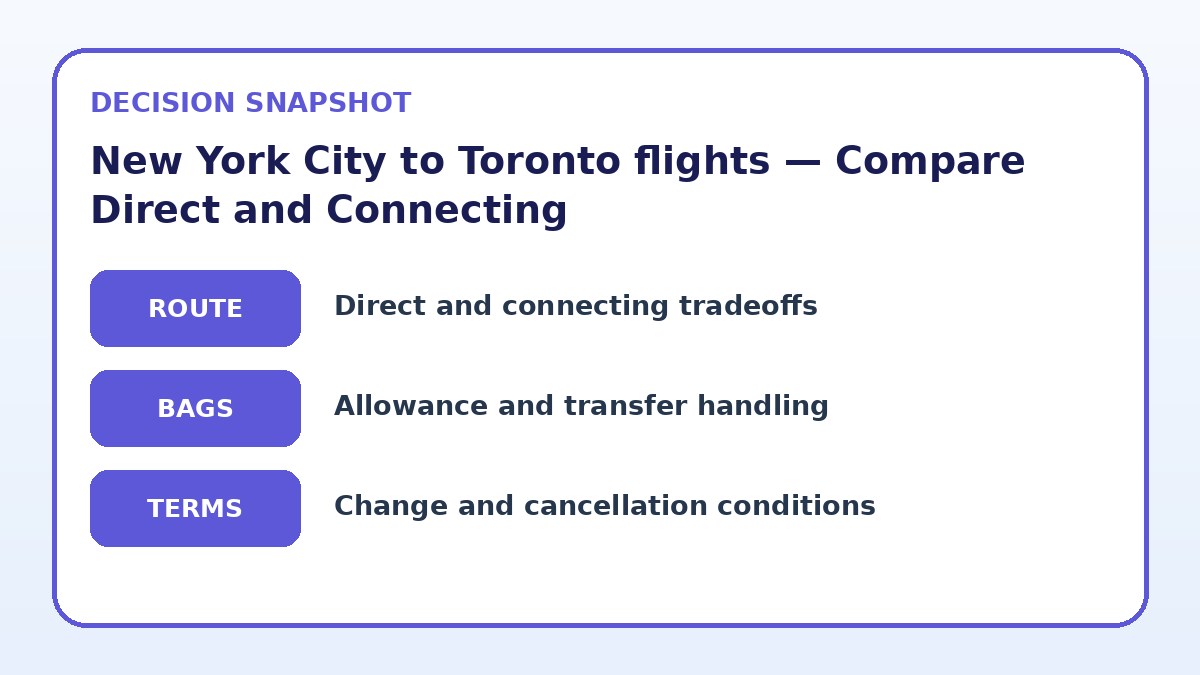
Routing: direct vs connecting choices and how to compare
Direct flights between New York City and Toronto are the most straightforward—one takeoff, one landing, and fewer itinerary elements to manage. Connecting options route you through a third city and can change your departure airport or arrival timing, sometimes for a lower fare or an otherwise unavailable schedule. When comparing routes, look beyond flight times: consider which New York airport the itinerary uses (multiple NYC airports can add transfer time) and whether the connection airport requires a terminal change that could lengthen a layover.
To compare objectively, build a small matrix with departure time, arrival time, total travel time, and number of transfers for each candidate flight. Add estimated transit time to and from each airport at both ends; a short direct flight from a farther NYC airport may be slower overall than a connecting itinerary from the nearest airport. Before committing, confirm on the airline or booking site the same-day minimum connection time and whether both passengers will stay on the same reservation for easier rebooking if irregular operations occur.
Baggage and connection risk: protecting luggage and peace of mind
Baggage handling differs between direct and connecting itineraries. On a single-plane direct routing, checked bags are straightforward—less handling, fewer transfers, and lower odds of mishandling. With connections, baggage may be transferred between aircraft or even require re-checking when changing carriers or ticketing families. Couples should verify on the final booking page whether checked bags are included, whether you need to collect and re-check luggage during the connection, and the carrier’s policy on delayed or missing bags.
Connection risk also includes the chance of a missed transfer due to delays. For couples traveling together, a missed connection can complicate seat assignments and onward arrangements. When using connecting flights, choose longer but reasonable layovers at airports with efficient transfer processes. If you require tight timing—celebration dinner reservations or a timed event—prioritize itineraries with buffer time or consider direct options to reduce stress and keep your schedule intact.
Compare flight-selection strategies
| Flight strategy | Best for | Risk to check |
|---|---|---|
| Direct nonstop flights | Couples prioritizing simple logistics and minimal travel time. | Usually fewer scheduling choices and sometimes higher base fares compared with connections. |
| Single-connection itineraries with generous layovers | Couples seeking lower fares while keeping a comfortable transfer buffer. | Longer total travel time and increased exposure to baggage or connection issues. |
| Tighter connections with short layovers | Couples willing to risk faster door-to-door time to save money or time. | Higher chance of missed connections and stressful transfers, especially with separate tickets. |
| Mixed-carrier connections or multi-ticket plans | Cost-conscious couples who can absorb extra planning and risk mitigation. | Greater responsibility for luggage and rebooking; protections vary and require careful verification. |
Recheck the complete itinerary
Confirm airports, connection handling, baggage, and change conditions before deciding.

Schedule fit: matching flight times to couple priorities
Schedule fit is both practical and personal. Couples heading to Toronto for a short weekend should prioritize arrival and departure windows that maximize time at the destination and minimize overnight travel if that disrupts sleep or plans. Direct flights commonly provide predictable blocks of time to plan around, while connecting flights can open earlier or later windows that better match meeting, tour, or restaurant reservations but might add uncertainty.
Discuss travel rhythms with your partner: are you early risers who can take the earliest flight, or do you prefer departing later to avoid rushed mornings? Also factor in how you’ll get to and from the airport in New York City—traffic patterns and public transit schedules affect which flights are realistic. Use calendar planning: plug each candidate flight’s arrival and departure times into your itinerary to visualize the day and make a decision aligned with joint priorities.
Flight details to verify
- Confirm exact travel dates and full traveler names before searching fares to avoid rebooking fees or name-correction issues.
- Decide whether you need included checked baggage or seat selection and filter search results accordingly.
- Note preferred NYC departure airport and estimate transit time there for each flight option.
- Check minimum connection times and whether baggage is auto-transferred on connecting itineraries.
- Compare the fare rules on the carrier’s final booking page, including change and cancellation penalties.
- Book both passengers on the same reservation when possible to simplify rebooking and protect through-checking.
Fare conditions and booking details to verify before purchase
Fare conditions determine flexibility and potential extra costs. Low fares on connecting itineraries sometimes come with strict change and cancellation rules, separate baggage fees, or restrictions that complicate a couple’s travel if plans shift. Always inspect the fare class and ticketing rules on the provider’s final booking page: confirm change fees, refundability, name-correction policies, and the penalty for rebooking or cancelling just in case one traveler’s plans change.
Also check how the fare treats each passenger—are fares identical for both travelers, or does a fare bundle price out differently? If you’re shopping on third-party sites, cross-check the same itinerary on the operating carrier’s booking page before paying. Trip.com can be used to compare current availability and conditions, but verify final fare rules, baggage allowances, and seat assignment options directly with the airline or the booking provider before completing payment.
Flight Guide questions travelers ask
Should couples always pick a direct flight between New York City and Toronto?
Not necessarily—direct flights reduce transfer stress and cut total travel time, which suits many couples. However, connecting flights can unlock better departure or arrival times, or lower fares that free up budget for activities in Toronto. The right choice depends on your priorities: if convenience and predictability top the list, direct is usually preferable; if saving money or fitting a tight schedule is more important, a connection may be worth the tradeoff. Always compare total door-to-door time and the carrier’s connection protections before booking.
How long should a layover be for a comfortable connection when traveling as a couple?
Aim for a layover that gives you enough time to deplane, change terminals if needed, and move together without rushing—this often means at least 60–90 minutes for domestic connections, and more if terminals are distant or you must clear additional checks. For peace of mind, choose longer connections when flying into or out of busy airports or when you’re carrying checked baggage that must be rechecked. Check the operating carrier’s minimum connection times on the final booking page and add buffer time if you want to avoid stress.
What should couples verify about baggage rules before booking a connecting itinerary?
Confirm whether checked bags transfer automatically between flights on the same ticket and whether different carriers require you to reclaim and re-check luggage during the layover. Also check size and weight allowances, any fees for additional bags, and policies for delayed or mishandled baggage. If a connecting option involves separate tickets, understand that you may be responsible for collecting and rechecking bags—factor that into your layover planning and contingency plans in case of delays.
Final decision note
For couples traveling between New York City and Toronto, the decision between direct and connecting flights comes down to a few practical choices: prioritize convenience and predictability, or accept more complexity to save money or fit a particular schedule. Begin by agreeing on priorities, gather exact travel dates and traveler details, and compare total door-to-door time, baggage handling, and fare rules across candidates. Verify connection times and baggage transfer on the carrier’s final booking page before buying, and consider booking both passengers on the same reservation to simplify any changes. Thoughtful preparation makes either option work smoothly for a stress-free trip together.
Continue planning
Check current options and final conditions
Use the provider page to confirm live availability, the final total, cancellation terms, and every condition that matters to your trip.
This evergreen planning guide was created with AI-assisted drafting and a structured quality review. It does not display live prices, schedules, availability, visa guidance, or provider rankings. Verify current details before booking. Some links are affiliate links; we may earn a commission at no additional cost to you.