For most business travelers making Paris to Amsterdam transport decisions, the practical answer is: prioritize trains when terminal fit and schedule align, but choose a coach, car, or mixed option if last-mile convenience or flexible luggage needs outweigh travel time. Decide first what matters for this trip: minimizing door-to-door time, avoiding city-center transfers, ensuring easy luggage handling, or preserving contingency options for schedule changes. Business trips often have asymmetric priorities—one person arriving late matters more than shaving 20 minutes off travel time—so match the intercity mode to your calendar constraints and meeting locations. This guide explains how to compare rail, coach, car, and combined journeys by terminal fit, luggage and transfer friction, timing flexibility, and a practical disruption backup so you can pick the option that keeps your day running smoothly.
Terminal fit: where you start and where you need to end
Terminal fit is the single most practical factor for business travelers. A train that arrives in a central station may be far better than a shorter flight that lands at an out-of-town airport requiring an extra transfer. Before booking, map the pickup or meeting address to the arrival and departure points: the time and cost of the taxi, shuttle, or rail link at each end will materially affect door-to-door duration. Consider whether you prefer the predictability of a central rail station or the privacy and potential direct access a car can offer.
Also factor in arrival terminal facilities you rely on—quiet waiting areas, meeting rooms, luggage storage, or easy taxi ranks—though verify such services directly on provider booking pages. For evening or early-morning journeys check typical local transit availability; a mode that looks fast on paper may leave you stranded if local transport is scarce. In short, prioritize the arrival location that minimizes transfers and hassle relative to where you need to be for work.
Choose the end-to-end journey plan
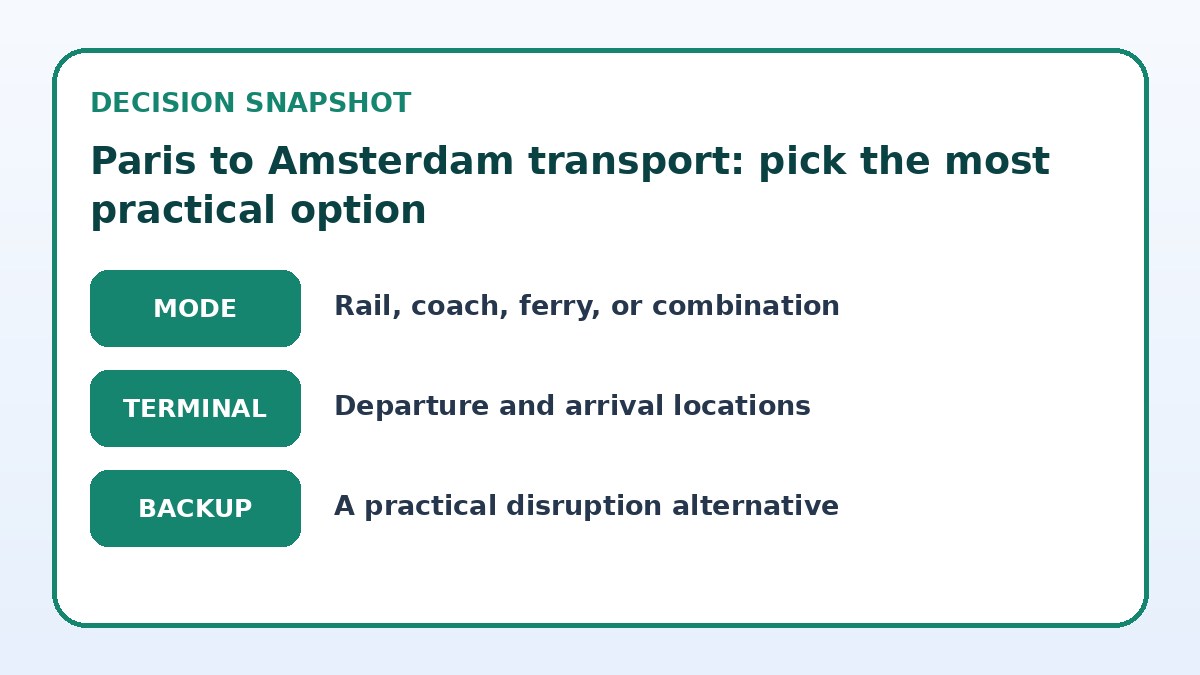
| Journey approach | Best for | Friction to check |
|---|---|---|
| All-rail (direct or with a single connection) | City-center to city-center business trips with predictable schedules and easy station access | Less control over last-mile if your meeting is far from the station; verify station-to-office transfers |
| Coach or intercity bus | Lower luggage friction and simpler single-bag handling when you don’t need minimal travel time | Often longer door-to-door times and potentially fewer departure times—check terminal drop-off locations |
| Car or chauffeur (door-to-door) | Maximized control, minimal transfers, and odd-hour departures to match meeting schedules | Vulnerable to road traffic and parking constraints; calculate likely delays and parking proximity |
| Mixed plan (train plus taxi/ride-hail or flight plus transfer) | When no single mode matches both arrival location and schedule—optimizes convenience and speed | More moving parts increase the chance of a missed connection; confirm transfer windows and contact points |
Check live intercity options
Look beyond the ride itself and compare terminals, transfers, luggage, and arrival fit.
Luggage and transfer friction: what you actually have to move
Business travelers often travel with a carry-on plus a briefcase, or with presentation materials and equipment that complicate transfers. Trains often allow more relaxed luggage carriage with easier access on and off the vehicle, while coaches and budget flights can have stricter hold baggage rules and offloading times. If your trip requires multiple short transfers, each handoff magnifies friction—stairs, elevator waits, or long walks between platforms add real time and stress.
When comparing options, list every transfer from door to door and time the likely walking distances, elevator waits, and check-in queues where relevant. For chauffeur-driven or rental-car choices, factor in trunk space, secure storage for sensitive materials, and whether drivers can help load and unload. Always verify luggage rules, transfer distances, and any vehicle accessibility details on the provider’s final booking page before making a decision.
Timing flexibility: schedules, cancellations, and how rigid your day is
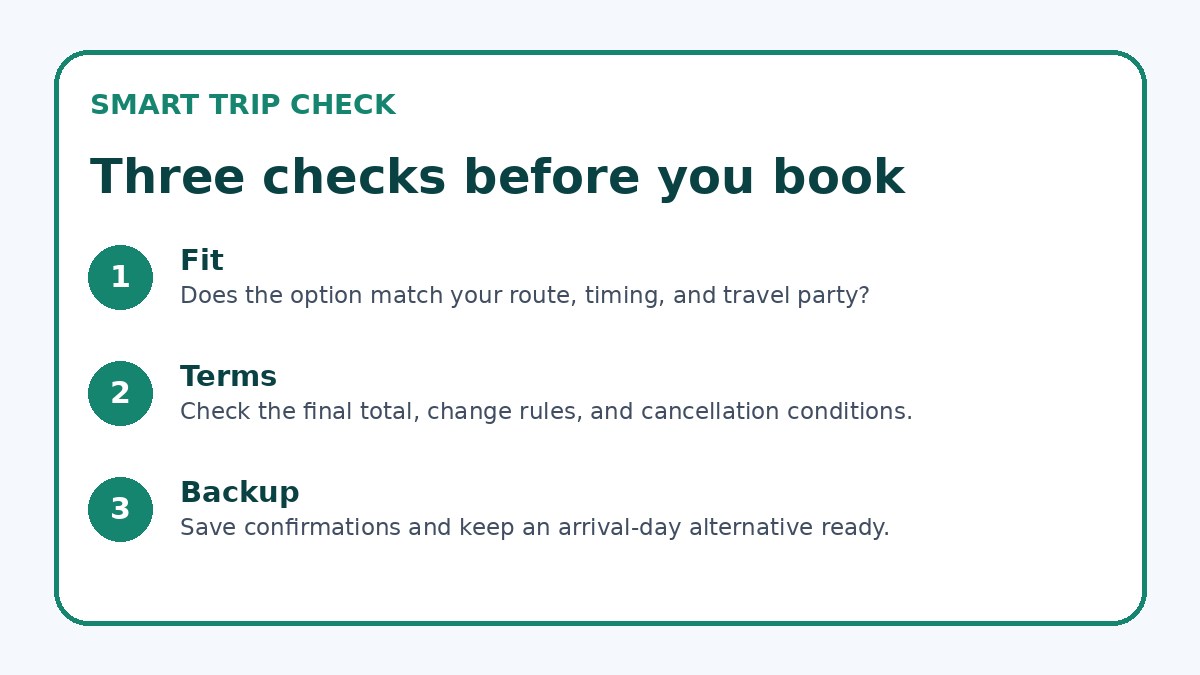
Ask whether your schedule tolerates variability. Trains typically offer multiple departures with predictable running patterns, making them easier to rebook within the same day. Coaches may run less frequently but sometimes provide evening or overnight windows useful for saving a hotel night. Driving gives maximum control over departure time but is vulnerable to traffic delays; plan buffer time if meetings are fixed. For trips where missing a single appointment is costly, choose the mode with the most frequent reliable alternatives.
When comparing services, check how easy it is to change or cancel and what the practical rebooking options are at short notice; again, confirm these policies on the booking pages. If you need to arrive at a strict time, prefer modes with multiple departures or straightforward same-day alternatives so you can adapt if the primary option is delayed or full.
Compare the practical alternatives
Use the final page to confirm what is actually offered on your dates and save a workable fallback.
Intercity travel checklist
- Map door-to-door time: from your origin address to final meeting location including transfers.
- Verify station or airport-to-office transfer options and typical durations on provider booking pages.
- Confirm luggage allowances and whether carry-on or checked items require extra handling.
- Check provider rebooking and cancellation terms so you can adapt if schedules change.
- Save local taxi or chauffeur contact details and payment methods on your phone before departure.
- Pack an essentials kit (chargers, portable battery, printed directions, quick snacks) for delays.
Disruption backup: practical contingency planning
A realistic disruption backup matters more than theoretical reliability claims. Decide your fallback before you leave: is a later train acceptable, would a private transfer be booked on short notice, or is a local flight a viable emergency option? For critical meetings, identify two alternate routes with different failure modes—if rail is disrupted, a car or coach might still operate; if road traffic is jammed, a direct longer-distance train could bypass it. Make sure your fallback is reachable from your departure point without excessive extra transfers.
Prepare by storing contact and booking details for local taxi or chauffeur services, and ensure your mobile payment or local transit app is set up in advance. If you depend on company travel policies for emergency bookings, confirm authorization limits and process to avoid delays when switching modes. Lastly, keep a packed essentials kit to handle unexpected two- to four-hour waits without losing business productivity.
Rail & Intercity Transport questions travelers ask
Should I prioritize travel time or door-to-door convenience for business trips?
Prioritize door-to-door convenience when missing meetings has higher cost than a slightly longer journey. A slightly slower option that drops you closer to your meeting without extra transfers often reduces stress and risk. If meetings can be rescheduled or timing is flexible, prioritize fastest end-to-end travel. Always map the entire trip and compare how much time transfers add, then choose the mode that minimizes overall disruption to your schedule.
How much buffer time should I add for transfers and possible disruptions?
Add at least 30–90 minutes depending on the number of transfers and time of day: shorter buffers for simple station-to-station transfers, larger buffers for airport links or rush-hour roads. Consider the consequences of being late—if the meeting is high stakes, err toward the higher end of that range and choose modes with frequent alternatives. Confirm local transit frequencies and on-the-ground transfer distances on provider pages to refine your buffer.
When is booking a mixed itinerary worthwhile for Paris to Amsterdam transport?
A mixed itinerary pays off when a single mode cannot satisfy both your arrival location and timing needs—for example, a fast train that arrives at an inconvenient station or a flight that saves time but requires a long transfer. Use mixed plans if they reduce door-to-door time or provide reliable backups; however, ensure each segment allows enough time for connection and verify transfer services and luggage handling on the final booking pages.
Final decision note
For business travel between Paris and Amsterdam, the practical choice depends less on abstract speed and more on door-to-door fit. Start by mapping where you need to be and what you must carry, then compare terminal proximity, transfer friction, timing flexibility, and realistic disruption backups. Trains often provide predictable city-center arrivals, coaches lower strap-and-go friction, cars give total control, and mixed itineraries can combine the best parts of each. Always confirm luggage rules, transfer details, and rebooking options on the provider’s booking pages before you commit, and have a pre-planned contingency to keep your day on track.
Continue planning
Check current options and final conditions
Use the provider page to confirm live availability, the final total, cancellation terms, and every condition that matters to your trip.
This evergreen planning guide was created with AI-assisted drafting and a structured quality review. It does not display live prices, schedules, availability, visa guidance, or provider rankings. Verify current details before booking. Some links are affiliate links; we may earn a commission at no additional cost to you.