Practical answer first: for most first-time visitors, choose the fastest, simplest itinerary you can afford that includes checked-bag allowance matching your luggage and at least 60–90 minutes between any planned connections or transfers. That means comparing direct and indirect options, confirming baggage rules on the booking page, and adding airport transfer time to your schedule. This guide walks you through the tradeoffs between saving money and risking missed connections, how to organize carry-on versus checked baggage for Korea’s stations and airports, what schedule padding to use depending on your arrival or departure point in Seoul, and the exact items to have at hand when you check flight details. Prepare the travel dates, number of travelers, and baggage plan before you search so you can read fares and policies accurately.

See live routes for your exact travel day
Compare direct and connecting choices with the same baggage and traveler details.
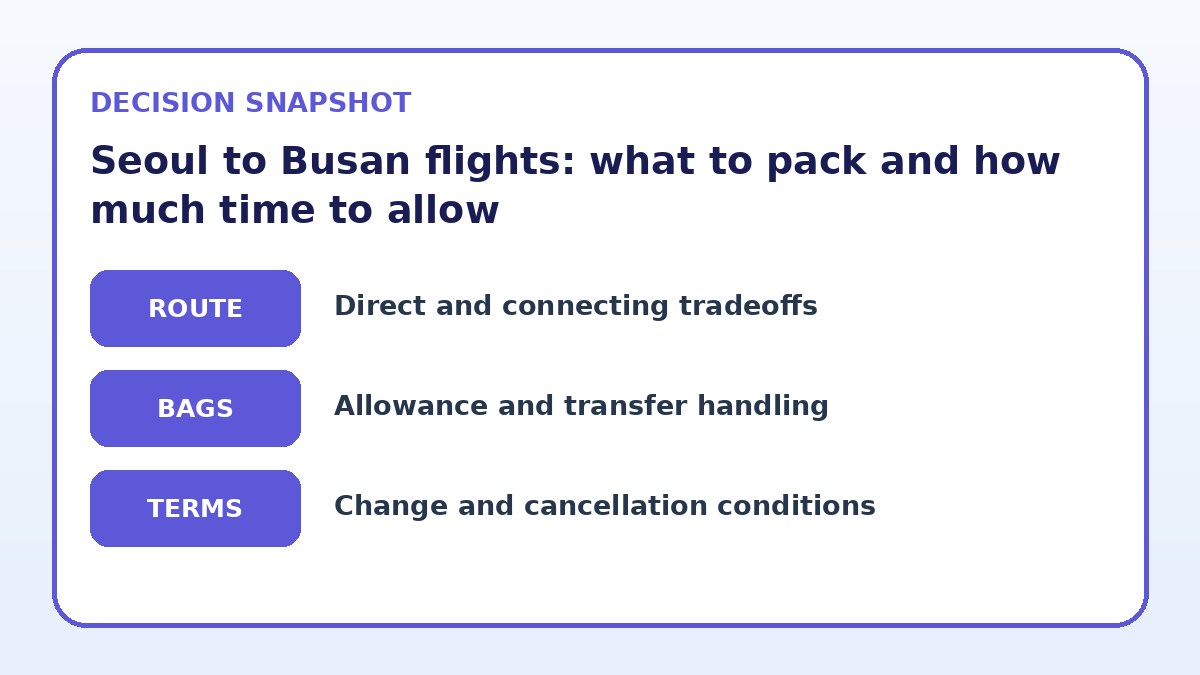
Routing: direct versus connecting choices
When you compare Seoul to Busan flights, the first tradeoff is obvious: direct services shorten travel time, simplify baggage handling, and reduce the chance of a missed connection. For first-time visitors, a direct flight or a single, guaranteed connection on one ticket is usually the clearest option—there are fewer decisions at intermediate airports, and your checked bag (if ticketed through) is typically transferred automatically. Still, a connecting itinerary may present lower fares or better departure times. If you consider a connection, verify whether both flight legs are on one ticket, because separate tickets usually leave you responsible for transferring baggage and re-checking in.
If a connection is necessary, study the minimum connection time policy published by the operating carrier and the transfer airport’s layout. Allow additional buffer for passport control, security lines, or inter-terminal shuttles if your route requires them. Train or bus transfers between city terminals in Seoul can add unpredictable delays during rush hours, so measure door-to-door travel time from your lodging to the departing terminal. Finally, when evening or overnight connections appear, check whether you’ll need an extra night’s accommodation if a disruption occurs.
Baggage and connection risk: how to match allowance to trip needs
Plan baggage around your itinerary before you search. Decide whether you will travel with carry-on only or require a checked bag, and then confirm the precise size, weight, and quantity allowances on the carrier’s booking page. Many fares list a basic carry-on and limited personal item; checked-bag rules and fees vary by fare class. If you rely on a connecting itinerary booked as separate tickets, treat checked baggage as your responsibility—plan extra time and a contingency if you must re-check or collect and re-drop luggage at the transfer airport.
If you’re carrying sports equipment, oversized items, or an instrument, contact the airline in advance to learn special handling procedures and potential surcharges. For quick domestic flights, travelers often save time and hassles by limiting checked luggage to one medium bag or taking carry-on only. Also consider how you will move between airports or from the airport to the city: lighter packing speeds up customs and ground transport, and makes sudden itinerary changes less stressful.
Compare flight-selection strategies
| Flight strategy | Best for | Risk to check |
|---|---|---|
| Book the fastest nonstop flight | Travelers valuing simplicity and minimal connection risk | Usually higher fares and potentially stricter baggage inclusions |
| Choose a single-ticket connecting itinerary | Those balancing lower fares with airline-checked baggage transfers | Still vulnerable to delays but baggage is usually transferred automatically |
| Buy two separate low-cost legs | Budget-conscious travelers willing to self-manage transfers | You assume full responsibility for missed connections and rechecking baggage |
| Pick a flexible/flexible-change fare | Travelers who prioritize rebooking ease and schedule changes | Higher upfront cost but reduces stress if plans shift |
Recheck the complete itinerary
Confirm airports, connection handling, baggage, and change conditions before deciding.
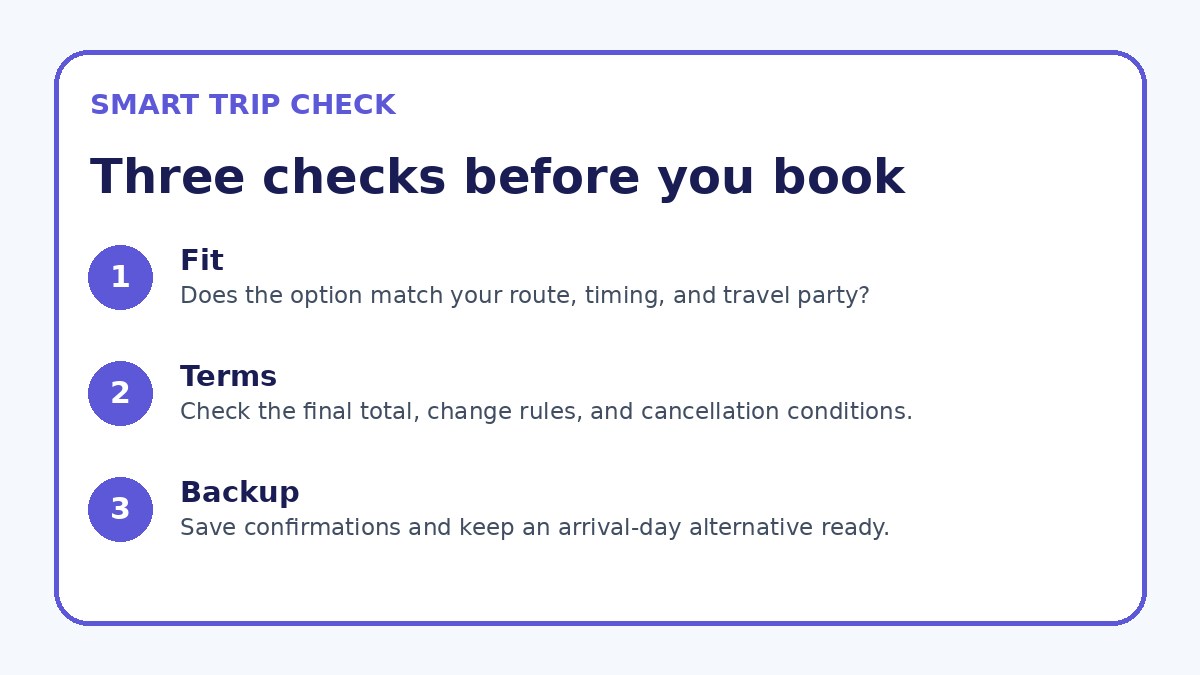
Schedule fit: timing your day around airports and transfers
Craft your schedule with realistic buffers. For a domestic Seoul to Busan flight, add door-to-door padding: travel time to the Seoul departure point (airport or city terminal), recommended airport arrival time for your fare class, security/passport control time if applicable, and local ground transfer time on arrival in Busan. Morning and evening peak traffic into and out of the city or slow public-transit times can add 20–45 minutes to transfers. If your outbound leg is early morning or late evening, factor labor-hour limits for ground transport and the possibility of limited public transit.
If you plan to transfer between air and rail (for example, flying into Busan and then taking a train), confirm station locations relative to terminals and whether shuttle or local metro services operate when you arrive. Build extra time if you must purchase rail tickets in person or account for luggage transfers to train storage areas. When planning same-day round trips, be conservative: allow more time than the airline’s minimum connection guidance, especially on unfamiliar routes and during busy travel windows.
Flight details to verify
- Write down exact travel dates, number of passengers, and preferred departure/arrival times before searching fares.
- Decide carry-on versus checked baggage and measure your luggage to confirm size and weight compliance with the airline.
- Open the airline’s final booking page to read the fare rules, baggage policy, and refund/change conditions before purchase.
- Map door-to-door travel time from your lodging to the Seoul departure point and add at least 60–90 minutes buffer for connections.
- If booking separate tickets, plan at least double the minimum connection time to collect and recheck baggage if needed.
- Save screenshots or PDFs of your booking confirmation and the carrier’s baggage and change rules for quick reference at check-in.
Fare conditions and booking checks to verify before purchase
Before you hit buy, check three things on the carrier’s or booking site’s final page: exact baggage inclusions with sizes and weights, ticket change and refund conditions, and whether the fare includes seat selection or priority boarding if you care about those. Fare names can be similar while including very different rules; read the section labelled ‘fare rules’ or ‘baggage policy’ on the final booking screen. If you use a comparison site, open the airline’s booking page to confirm later changes to policies or fees that a comparison engine might not show.
If you’re considering a low-fare carrier or a basic economy-style ticket, anticipate extra fees for checked baggage, seat selection, and even printing a boarding pass at the airport. If you require guaranteed connections or flexible changes, select a fare that explicitly allows rebooking or adds transfer protection. Keep a copy or screenshot of the booking terms and your itinerary; this makes it easier to resolve discrepancies during check-in, baggage drop, or when calling customer service.
Flight Guide questions travelers ask
How much airport arrival time should a first-time traveler allow for a Seoul departure?
Aim to arrive at the Seoul departure point with enough time to complete check-in, security, and any terminal transfers—generally add an extra buffer above the airline’s stated minimum. For domestic departures, many travelers choose 60–90 minutes before departure to allow for baggage drop, security lines, and unexpected delays. If you need to reach an airport or terminal via traffic-congested roads or a multi-leg public transit trip, add 30–45 minutes more. Confirm recommended arrival time on the airline’s website and consider local transit schedules on your travel dates.
Can I put my checked bag through to the final destination when I have separate tickets?
If your flights are on separate tickets with different carriers, you should assume your checked bag will not be automatically transferred between flights. That means you will likely need to collect your luggage at the intermediate airport, clear any necessary controls, and re-check it with the next carrier—so plan extra time. If you want through-checked baggage, book both legs on a single ticket or choose airlines that explicitly offer interline agreements and confirm this on the booking page prior to purchase.
What should I confirm about baggage rules before booking Seoul to Busan flights?
Before booking, verify the exact carry-on dimensions and weight, the number and size of permitted checked bags, and any applicable fees for extra or oversized items on the airline’s booking page. Also check whether items like sports equipment or instruments require advance notice. Review change and refund policies tied to the fare class in case you need to modify plans. Finally, if you’ll be making connections, confirm whether baggage is included and will be transferred automatically when purchased on a single ticket.
Final decision note
For first-time visitors traveling Seoul to Busan, prioritize simplicity: match your baggage plan to the fare and give yourself generous schedule buffers. A direct flight or a single-ticket connection with the right checked-baggage allowance minimizes transfer tasks and reduces stress. If you choose separate tickets to save money, factor in extra time to collect and re-check luggage and accept the added risk. Always prepare exact travel dates, passenger counts, and baggage needs before searching; then verify the airline’s baggage rules, change and refund terms, and any transfer requirements on the final booking page. If you want a quick place to compare live availability, you may check Trip.com as one of several search options, but always confirm policy details with the carrier before purchase.
Continue planning
Check current options and final conditions
Use the provider page to confirm live availability, the final total, cancellation terms, and every condition that matters to your trip.
This evergreen planning guide was created with AI-assisted drafting and a structured quality review. It does not display live prices, schedules, availability, visa guidance, or provider rankings. Verify current details before booking. Some links are affiliate links; we may earn a commission at no additional cost to you.