Practical answer up front: if you’re traveling from Seoul to Jeonju with extra luggage, prioritize a direct KTX or express train if you can comfortably lift and wheel your bags short distances to platforms; choose a coach if you want less handling but expect limited storage access en route; and pick a private transfer or kombi van if you need true door-to-door service and help loading/unloading. The decision comes down to how much handling you can manage, how close your origin and destination are to stations or parking, and how much you value predictable luggage access during the trip. Read on for how each option fits terminal layout, luggage friction, timing flexibility, and disruption backup so you can decide and what to check on booking pages before you commit.
How to choose between train, coach, and private transfer
Start by mapping door-to-door time rather than ride time. Plot how long it takes to get from your Seoul lodging to the departure point (station or bus terminal), add estimated transfer time for handling luggage, and then the arrival-side time to reach your Jeonju address. If you live near Seoul Station or Yongsan Station, trains minimize walking of heavy bags; if you’re far from stations, a coach terminal or private pickup may save effort despite a longer road journey.
Next, decide how much handling you want the trip to involve. Trains and coaches both require moving luggage from vehicle to terminal storage and back; private transfers let you load once. Consider the number and size of bags: oversized items may not fit convenient train luggage racks and could be cumbersome on buses—contact carriers to confirm limits. Ultimately, pick the mode that reduces the most physical handling given your party’s strength and mobility.
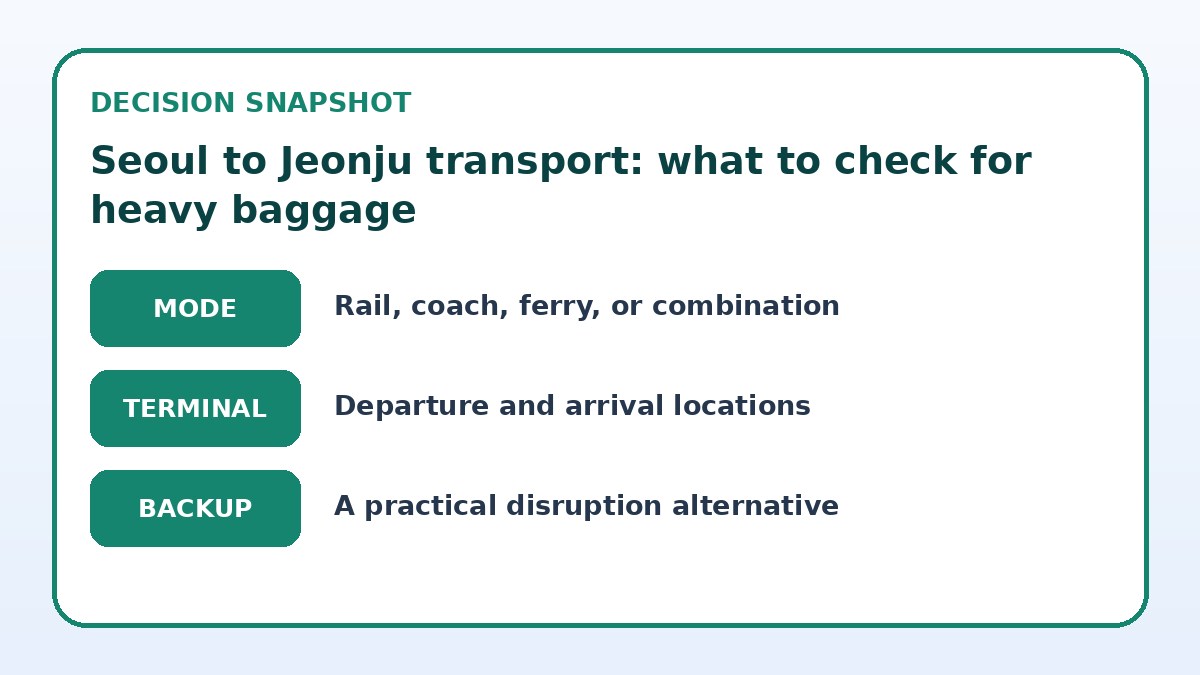
Choose the end-to-end journey plan
| Journey approach | Best for | Friction to check |
|---|---|---|
| Direct express train (station-to-station) | Travelers who can lift and wheel luggage a short distance and want the fastest, most punctual rail journey | May require stairs, platform transfers, and temporary self-storage or lifting onto racks |
| Long-distance coach (terminal-to-terminal) | Groups with large suitcases who prefer one-time loading into an underfloor hold | Slower road travel and luggage inaccessible during the trip; terminals may be farther from city centers |
| Private transfer or van (door-to-door) | Those who need minimal handling, door pickup, or help loading oversized items | Higher cost and depends on traffic; verify vehicle capacity and driver assistance before booking |
| Hybrid: express train plus local taxi | Travelers balancing speed with reduced walking—train for the main leg, taxi for last-mile convenience | Requires coordination between services and buffer time for luggage collection and meet-ups |
Check live intercity options
Look beyond the ride itself and compare terminals, transfers, luggage, and arrival fit.
Terminal fit and luggage friction at departure and arrival
Examine the stations and terminals where you’ll start and finish. Seoul’s major train stations have elevators and escalators but expect walking between entrances and platforms; buses often load luggage underneath the coach, removing bags from sight for the journey. At Jeonju, some smaller stops may not have covered transfer zones, meaning you might move luggage across outdoor platforms. If stairs are unavoidable, factor in either a porter service, luggage delivery company, or a companion to help.
Check vehicle and platform access before you book. Trains may require lifting bags onto racks or into overhead space, while coaches put baggage in a hold—easy to stow but inaccessible during the trip. Private transfers should be confirmed for trunk volume and whether the driver will assist with loading. On booking pages, verify stated luggage allowances, whether assistance is offered, and whether accessibility features like ramps or elevators are present.
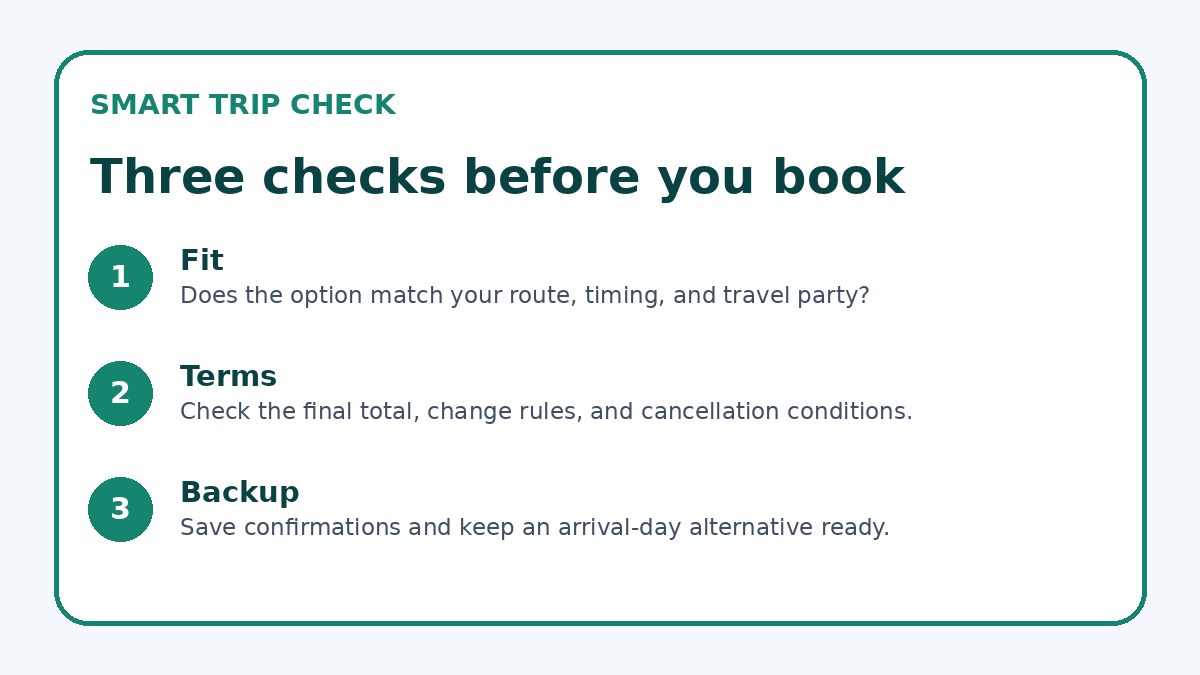
Timing flexibility and managing transfers
If your schedule is tight, choose the option with the least margin for delays between segments. Direct trains reduce connections and are typically more punctual than road travel. However, if you’re carrying many heavy items, arriving earlier to stations to allow for check-in and loading might be necessary. Reserve extra buffer time for elevators, ticketing queues, or moving through crowded stations—these small waits can add significant strain when handling large suitcases.
For flexible travel, coaches and private transfers can free you from strict train timetables—some coach services run frequently and private drivers can depart at your convenience. A useful hybrid is to take a fast train for the intercity part and pre-book a taxi or licensed van for the last mile in Jeonju. When mixing modes, allow at least 30–60 minutes between scheduled arrival and your onward pickup to accommodate luggage collection and any minor delays.
Compare the practical alternatives
Use the final page to confirm what is actually offered on your dates and save a workable fallback.
Intercity travel checklist
- Measure and weigh your largest suitcase to check vehicle and train luggage limits before booking.
- Confirm elevator/escalator availability and station entrances at both Seoul departure and Jeonju arrival on official station pages.
- Reserve a taxi or private van ahead when you need door-to-door pickup and specify trunk dimensions and driver assistance.
- Pack a small daypack with essentials to avoid accessing large checked luggage during short stops or delays.
- Take photos of your luggage and attach a visible name tag plus a secondary contact phone number.
- Save contact numbers for the carrier’s service desk, your driver, and a local taxi company in case you need an immediate backup.
Disruption backup: options if your plan goes wrong
Predictable backups make travel with heavy luggage less stressful. If a train is canceled or delayed, having a pre-saved taxi company or a coach alternative means you can get moving without multiple heavy-lift cycles. Identify a nearby 24-hour taxi stand or ride-hailing service that allows larger vehicles so you can consolidate bags in one trip. If you’re on a budget and stranded, look for station luggage storage to keep bags safe while you arrange onward travel, but verify size limits and opening hours first on official pages.
Also prepare for missed connections: keep a small, accessible daypack with essentials to avoid unloading everything. If relying on a private transfer, get the driver’s contact number and confirm a short grace period for delays. For all options, have digital copies of bookings and receipts, and note the nearest staffed desk or information center at both origin and destination so you can ask staff for assistance with luggage handling in case of disruption.
Rail & Intercity Transport questions travelers ask
Can I take oversized suitcases on KTX or intercity trains between Seoul and Jeonju?
Many trains offer space for suitcases but size and placement rules vary. Before you book, check the rail provider’s luggage policy on the official page: measure your bag, verify maximum dimensions and whether large items must be stored in designated areas, and confirm whether staff can help with lifting at stations. If you’ll struggle to lift a heavy case onto a rack, plan for a porter, a taxi that can load directly, or a luggage delivery service to avoid multiple handlings.
Is it easier to travel by coach with extra bags rather than by train?
Coaches typically have an underfloor hold where larger suitcases are loaded once and remain inaccessible but secure during the journey. That makes loading and unloading simpler for heavy items. However, road travel can be slower and coaches often stop at terminals that are less central than train stations. Think about final drop-off convenience: if the bus terminal is farther from where you stay in Jeonju, the coach’s storage convenience could be offset by extra local transfers.
How should I plan last-mile transport in Jeonju with several large suitcases?
If your accommodation is a short walk from Jeonju station, a train-to-walk plan might work; otherwise pre-book a taxi or local freight-capable van. When booking a taxi, request a larger vehicle or minivan and confirm the driver will assist with loading. For hotels or guesthouses, message your host in advance about arrival and luggage size so they can prepare staff or recommend meet-up points. Always allow extra time for unloading at your final door to avoid rushing.
Final decision note
Choosing the right Seoul to Jeonju transport when you have extra luggage boils down to balancing physical handling, door-to-door convenience, and schedule needs. Trains are efficient if you can manage short walks and platform lifts; coaches reduce handling but may add final-mile complications; private transfers eliminate transfers at the cost of higher rates and traffic exposure. A hybrid plan—fast train for the long distance, pre-booked taxi for the last mile—often gives the best mix of speed and minimal lifting. Before you finalize any booking, verify luggage allowances, vehicle size, station access, and driver assistance on the carrier or booking page. If you want to compare current options and availability, you can also check Trip.com as one of several comparison tools.
Continue planning
Check current options and final conditions
Use the provider page to confirm live availability, the final total, cancellation terms, and every condition that matters to your trip.
This evergreen planning guide was created with AI-assisted drafting and a structured quality review. It does not display live prices, schedules, availability, visa guidance, or provider rankings. Verify current details before booking. Some links are affiliate links; we may earn a commission at no additional cost to you.