For a short hop like Los Angeles to Las Vegas, the core decision for solo travelers usually comes down to route versus fare: pay a bit more for a direct flight that saves time and reduces connection risk, or accept one stop to chase a lower fare or better schedule. That tradeoff is particularly practical for solo travelers because you carry fewer logistical dependencies, can move faster through airports, and can choose how much risk and complexity you want. Before you search, have exact travel dates, your preferred Los Angeles airport, whether you’re carrying checked bags, and how tight your onward plans in Las Vegas are. With those details you can compare total journey time, transfer complexity, baggage handling, and cancellation/change policies on the airline’s booking page — and, if you like, cross-check current availability on Trip.com.

See live routes for your exact travel day
Compare direct and connecting choices with the same baggage and traveler details.
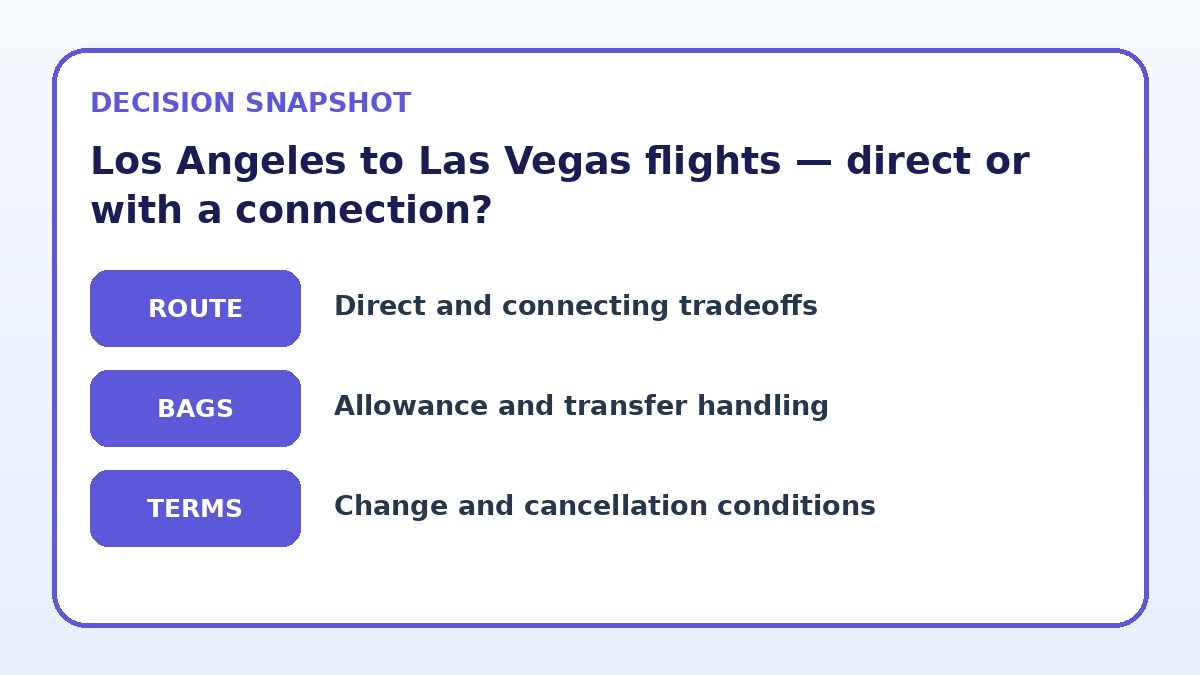
Routing: comparing direct and connecting itineraries
When you search for Los Angeles to Las Vegas flights, filter results to show non-stop routes first so you can see the time savings. Direct flights typically cut total travel time substantially because there’s no transfer between planes or terminals; you arrive and are able to leave the airport faster. By contrast, connecting itineraries might route through another city or a different airport and add transfer time, even if the airborne time is similar. For solo travelers who value a quick door-to-door journey or have a tight event schedule in Las Vegas, non-stop service often wins on convenience.
Connecting flights can be attractive when direct options are limited by schedule or price, or when you need an early departure or late return not offered non-stop. If you consider a connection, compare total elapsed time and the length of the layover — very short layovers increase missed-connection risk, while very long ones eat into your day. Also check whether the connection requires changing terminals or re-clearing security; those details can change a 60-minute layover from reasonable to risky. Always view the full itinerary and transfer notes on the airline’s final booking page.
Baggage and connection risk for solo travelers
Baggage handling differs by ticketing structure. On a single ticket with the same airline or alliance, checked bags are usually tagged through to the final destination; that reduces the hands-on work during a connection. However, if you mix carriers on separate tickets or have a self-transfer situation, expect to collect and re-check bags — and to go through security again. Solo travelers should be realistic about how many checked or carry items they can reasonably manage during hurried transfers and should verify baggage allowances and transfer rules on the booking confirmation.
Missed connections are less frustrating when you travel light and can switch flights without needing to retrieve checked bags. If your itinerary includes tight transfer windows, factor in potential delays and your tolerance for risk. Look for itineraries that give at least the minimum recommended transfer time for the airport pair and check the airport layout mentally: long walks or shuttle rides between terminals can turn an hour into a scramble. When in doubt, booking a non-stop option eliminates most baggage-transfer worries.
Compare flight-selection strategies
| Flight strategy | Best for | Risk to check |
|---|---|---|
| Book a non-stop scheduleed flight | Travelers who value speed, low connection risk, and simplicity. | Usually higher base fares and fewer scheduling slots; check baggage and change rules. |
| Choose a single-ticket connecting itinerary with one carrier | Those seeking lower fares while retaining through-checked baggage and rebooking protection. | Longer total travel time and possible tight layovers; verify minimum connection time and terminal changes. |
| Mix-and-match separate tickets for each leg | Budget-focused solo travelers who can absorb extra risk and manage transfers alone. | No carrier responsibility for missed connections; you must recheck bags and rebook if delays occur. |
| Use a timed multi-leg itinerary with a long layover | Solo travelers wanting to lower stress and include a short stopover without rushing. | Longer door-to-door time and possible additional airport expenses during the layover. |
Recheck the complete itinerary
Confirm airports, connection handling, baggage, and change conditions before deciding.
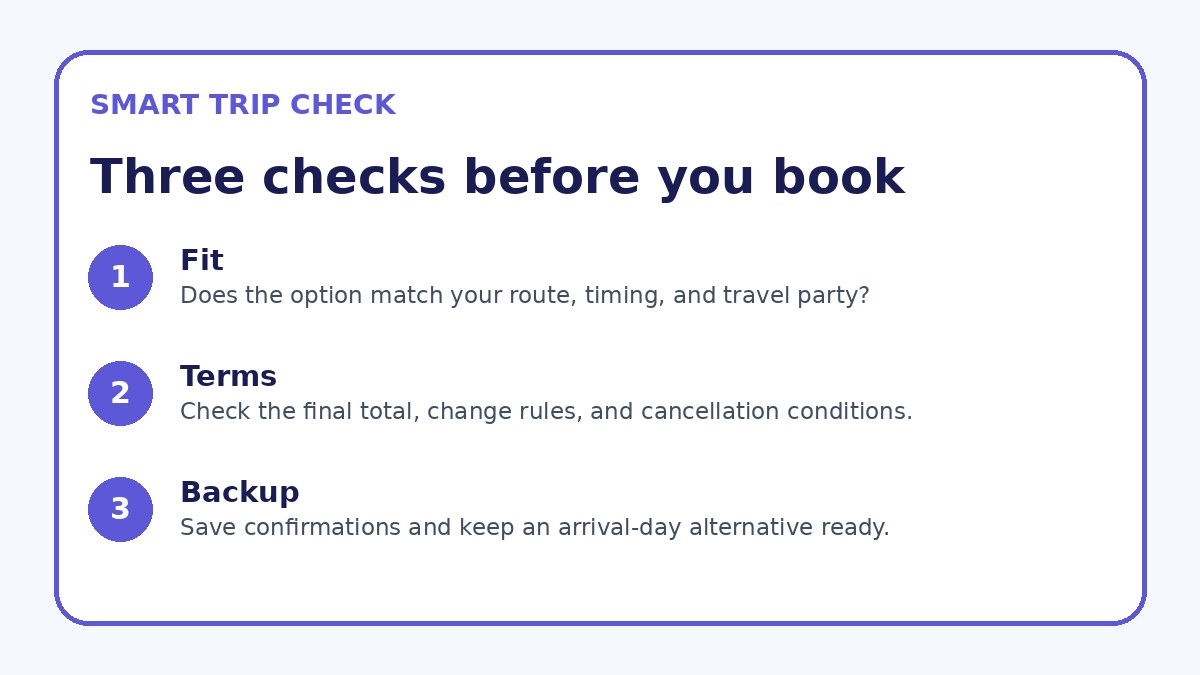
Schedule fit and solo traveler priorities
Decide what you prioritize: minimizing time on the ground, saving money, or maximizing flexibility. Direct flights save time and reduce complications, which suits solo travelers who prefer simplicity or are traveling for a specific event with fixed timing. If you need to arrive early morning or return late at night and non-stops don’t match, a connecting option may offer the schedule you need. Evaluate whether an earlier departure with a connection would still leave you with sufficient rest and energy for your plans in Las Vegas.
Also consider backup plans. Solo travelers can more easily absorb last-minute changes but also bear the full responsibility for rebooking and navigating airports. If your schedule is flexible, a connecting flight that reduces the fare might be worthwhile; if your schedule is rigid, favor non-stop service. Before booking, line up a realistic cushion for travel delays and think through what you would do if your inbound flight was delayed: is there another same-day option, and would you be willing to change plans on the fly?
Flight details to verify
- Confirm exact travel dates, preferred departure airport in Los Angeles, and preferred arrival airport in Las Vegas before searching fares.
- Decide whether you will check luggage or travel carry-on only, and verify the baggage allowance on the airline’s final booking page.
- Check whether potential connections are on the same ticket and whether bags will be tagged through to Las Vegas.
- Compare total door-to-door travel time, including layover length and terminal transfer requirements.
- Read fare conditions for changes, cancellations, and refunds on the carrier’s booking confirmation before payment.
- Have a backup plan for missed connections: note alternate same-day flights and the airline’s rebooking policy.
Fare conditions and what to verify before booking
Fare differences between direct and connecting options can come from carrier pricing strategy, fare class restrictions, and refundable or changeable ticket policies. Always check the fare rules shown on the airline’s final booking page: for solo travelers, the key things are change and cancelation fees, how refunds are issued, and whether the fare includes seat assignment or priority boarding. Low-cost carriers often advertise low headline fares but add fees for bags, seat selection, and flexibility — add those up before deciding if a connection’s apparent savings are real.
When comparing itineraries, read the fine print about checked bags and same-ticket protection. If both legs are on one ticket, the airline generally handles rebooking if a connection is missed, subject to their policy; if legs are on separate tickets, that protection usually doesn’t apply. Also confirm whether the fare allows online check-in across legs and whether you’ll need to reprint boarding passes at a transfer point. Verify all these points on the carrier’s booking confirmation and contact customer service if anything is unclear.
Flight Guide questions travelers ask
Is it worth connecting to save money on a short route like Los Angeles to Las Vegas?
For many solo travelers, the modest savings from a connecting itinerary on a short route must be weighed against added time, transfer hassle, and connection risk. A single-stop itinerary may be worth it if the schedule you need only exists with a connection or if the price gap covers extra expenses like a checked bag or a longer airport wait. If your time is limited or you prefer a straightforward trip, a non-stop flight often makes more sense even if it costs more. Always calculate total trip time, extra fees, and your tolerance for managing transfers alone before deciding.
How much layover time should I allow when booking a connecting flight between Los Angeles and Las Vegas?
Aim for a layover that comfortably accounts for terminal changes, security queues, and possible delay on your inbound leg. For domestic connections you generally want at least enough time to deplane, move between gates or terminals, and pass through security again if required; solo travelers who prefer less stress should add extra buffer beyond the airline’s minimum. Check the specific airport map and whether shuttle connections are needed, and verify the recommended minimum connection time on the carrier’s site or booking confirmation.
What should a solo traveler verify on the airline’s booking page before finalizing a Los Angeles to Las Vegas itinerary?
Before booking, check the fare rules for change and cancellation fees, confirm baggage allowances and charges, and verify whether the itinerary is a single ticket that covers all legs. Also confirm check-in procedures, whether bags are checked through to your final destination, and the total travel time including layovers. If any transfer requires a terminal change, look up the airport layout. If details are unclear, contact the carrier to confirm; you can also compare live availability and conditions on Trip.com but rely on the airline’s booking page for authoritative fare terms.
Final decision note
Solo travelers choosing between direct and connecting Los Angeles to Las Vegas flights should balance time, risk, and cost. Non-stop service wins for speed and simplicity, which reduces the chance of missed connections and baggage headaches. Connecting itineraries can save money or provide better departure times, but they require careful attention to total travel time, whether bags transfer on the same ticket, and the fare rules governing changes. Prepare exact dates, airport choices, and baggage needs before you search, read the carrier’s fare conditions, and have a realistic buffer for delays. That approach will help you pick the option that best aligns with your energy, schedule, and tolerance for complexity.
Continue planning
Check current options and final conditions
Use the provider page to confirm live availability, the final total, cancellation terms, and every condition that matters to your trip.
This evergreen planning guide was created with AI-assisted drafting and a structured quality review. It does not display live prices, schedules, availability, visa guidance, or provider rankings. Verify current details before booking. Some links are affiliate links; we may earn a commission at no additional cost to you.