If you want the quickest, simplest path across Canada, pick a direct Toronto to Vancouver flight; it gets you there with one takeoff and one landing, fewer decisions, and less baggage handling. If you prioritize lower fares, specific departure times, or want to visit an extra stop along the way, a connecting itinerary can make sense. For first-time visitors, weigh travel time against cost and risk: connecting flights can save money but introduce more points of failure (missed connections, extra security lines, or longer total travel days). As you prepare to book, compare total trip time, layover length and airport(s), ticket change and rebooking policies, and whether the same airline issues all legs. Use the practical checklist below when you run live searches and verify details on the airline or booking page — Trip.com can be one place to compare current availability and rules, but confirm baggage allowances, minimum connection times, and protection options directly with carriers.
Practical answer up front: which to book
For most first-time visitors making a single trip from Toronto to Vancouver with limited fuss, a direct flight is the sensible default. Direct flights reduce the number of critical moments — boarding, disembarking, navigating another airport, and passing through security again — so they lower the chance of connection problems and usually feel less tiring. If your priority is to maximize sightseeing time in Vancouver or to arrive fresh for a meeting or event, the time savings of a direct service can be decisive.
Choose a connecting itinerary when your priorities include lower fares, flexible timing, or an intentional stopover. Connections can also expand your departure and arrival time options, which matters if you need an early or late departure that direct services do not offer. Remember that not all connections are equal: short, well-timed layovers on the same ticket with the same carrier are less risky than long airport changes or separate-ticket combos that offer no protection for missed flights.
Time, comfort and how to measure travel cost
Total travel time matters more than flight time alone. When comparing options, add up scheduled flight durations, expected layovers, arrival-to-door transit time at both airports, and time to clear baggage claim and customs if relevant. A direct flight’s scheduled block time may be slightly longer or shorter than the sum of two legs, but it eliminates the intermediate wait. Comfort also includes the number of seat changes, the time spent in busy airport terminals, and whether you can stay on the same plane for what some airlines call a direct service.
When considering cost, look beyond the headline fare. Compare baggage allowances, change and cancellation fees, seat selection charges, and the cost of food during long layovers. If a low-cost connecting itinerary requires separate tickets, factor in the risk of paying for a missed second leg or for rebooking. For first-time visitors unfamiliar with Canadian domestic connections, a slightly higher fare on a single-ticket connection or a direct flight can be worth the reduced hassle and added protection.
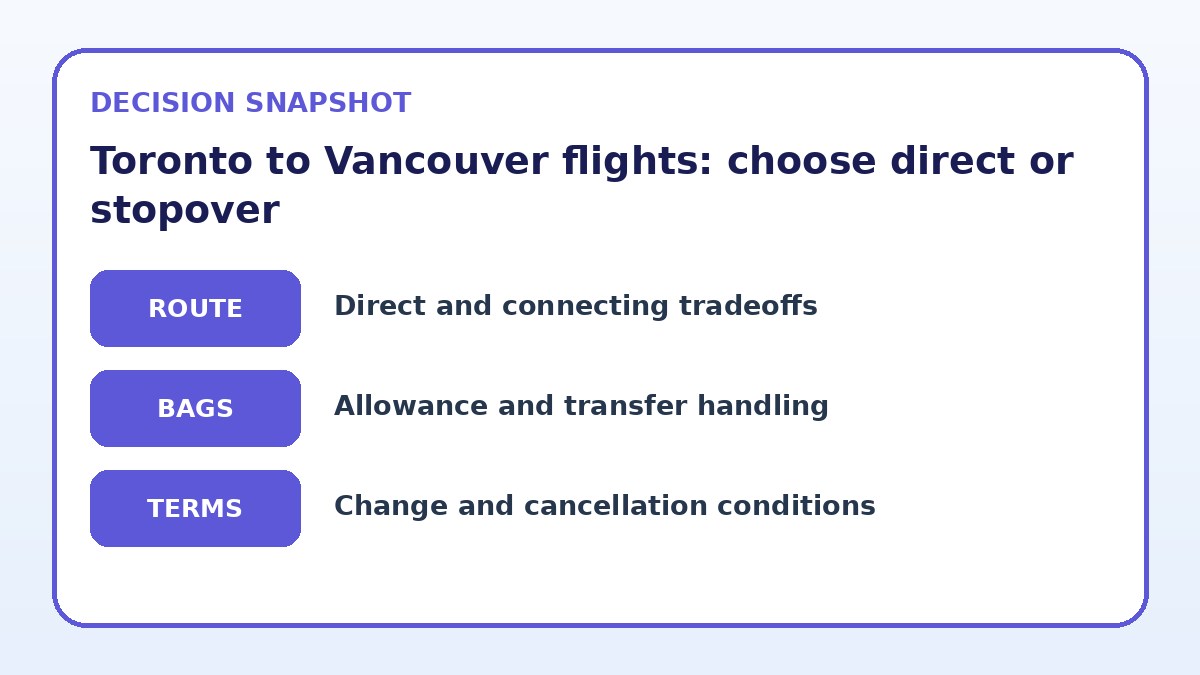
| Approach | Best for | Tradeoff to check |
|---|---|---|
| Direct flight | Travelers prioritizing speed, simplicity, and fewer handoffs | Usually fewer schedule choices and sometimes higher base fares |
| Single-ticket connecting flight | Passengers who want more schedule options with carrier protection | Longer total travel time and more time in airports |
| Separate tickets or mixed carriers | Budget-focused travelers willing to assume connection risk | No automatic rebooking or baggage transfer if a delay breaks the first leg |
| Intentional stopover | Travelers who want to visit a second city en route | Adds cost and planning complexity; may require extra luggage handling |
Risk management and booking mechanics
Confirm whether the entire itinerary is on one ticket with protected connections. Single-ticket itineraries usually give the carrier responsibility for rebooking you on later flights if a delay makes you miss a connection. Separate tickets remove that protection: if the first flight is delayed, the second airline can treat you as a no-show. Also check whether baggage is through-checked; transferring bags yourself during a short connection creates extra time pressure and stress.
Examine minimum connection times at the airports involved and the layout of the connecting airport(s). Some airports require inter-terminal transfers that take substantial time, while others have adjacent gates. If a connection requires passing through security again or switching between domestic and international terminals, add buffer time. Consider buying travel protection that covers missed connections or look for flexible fares that permit changes with modest fees.
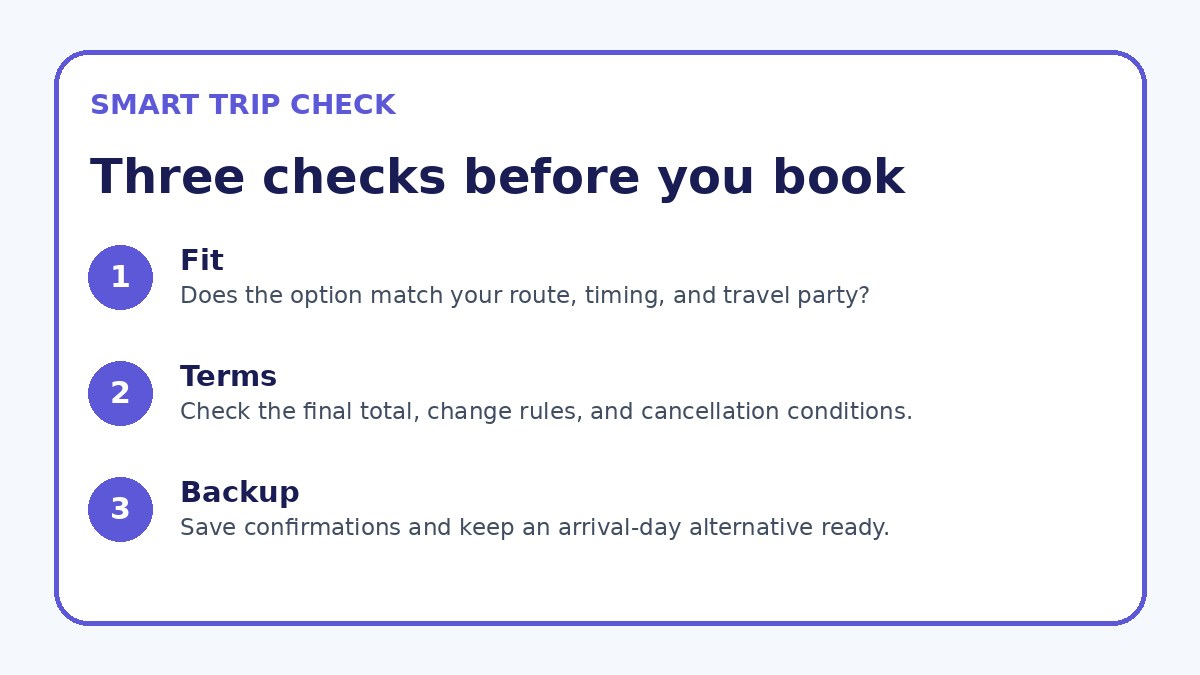
Before you book
- Check whether the itinerary is issued on a single ticket and whether connections are protected by the carrier.
- Add scheduled flight times, layover durations, and expected airport transfer time to estimate total door-to-door travel time.
- Compare baggage allowances and fees across all legs before selecting the lowest headline fare.
- Verify minimum connection times and whether terminal changes or security rechecks are required at any layover airport.
- Confirm change, cancellation, and rebooking policies on the airline or booking page before purchase.
- Consider buying trip interruption or missed-connection protection if you choose tight connections or separate tickets.
Practical choices for first-time visitors to Vancouver
If you aim to arrive in Vancouver ready to explore, prefer early-afternoon or evening arrival times that allow you to reach your hotel without rushing. Direct flights often land at predictable times and make it easier to plan airport transfers and first-night accommodations. If you’re jet-lagged or traveling with young children, prioritize fewer transitions and a straightforward transfer from plane to hotel.
If you want to visit another Canadian city en route, build an intentional stopover with enough time for a short excursion rather than squeezing in a tight connection. When planning multi-day stopovers, check visa and entry requirements for transit through different provinces and confirm whether you need to recheck luggage. For independent planners on tight budgets, connecting flights can be a smart tool, but plan ample layover time and verify rebooking and baggage rules before you buy.
Frequently asked questions
How much extra time should I allow for connections when booking Toronto to Vancouver flights?
Allow at least enough layover time to cover deplaning, gate transfers, and security checks; for domestic-to-domestic connections, aim for at least 60–90 minutes on the same carrier and longer if you need to change terminals or airlines. If you’re unfamiliar with the connecting airport, prefer more buffer to reduce stress and risk. When flights are on separate tickets, add more cushion to account for possible delays and the time needed to recheck baggage. Always verify the airline’s published minimum connection time for your specific routing on the booking page.
Can I check my bags through to Vancouver on a connecting itinerary?
If your entire itinerary is on a single ticket and the airlines in your itinerary have an interline agreement, baggage is often checked through to your final destination — but not always. For separate-ticket itineraries or when switching between carriers without an agreement, you may need to collect and recheck baggage during the layover. Check the booking confirmation and airline baggage policy to confirm through-checking, and verify at check-in desk; the airline’s final booking page will state transfer procedures and whether you must reclaim luggage during your layover.
Are connecting flights a good idea if I’m traveling with kids or a lot of luggage?
For families and passengers with heavy or bulky luggage, direct flights are typically easier because they reduce the number of times you handle bags and pass through security. Shorter travel days and fewer transitions are less stressful for children. If you must take a connecting flight, choose longer layovers that give you breathing room to move between gates and reassemble the group, and confirm baggage transfer policies so you won’t need to carry suitcases through a terminal change. Evaluate whether the savings justify the extra logistics before booking.
Final planning note
For first-time visitors deciding between direct and connecting Toronto to Vancouver flights, start with the outcome you value most: speed and simplicity or lower cost and flexibility. Direct flights keep things straightforward and reduce connection risk; connecting itineraries expand choices and can lower fares but add complexity. Before booking, compare total travel time, ticketing (single versus separate tickets), baggage handling, and rebooking protections. Verify all operational details on the airline or booking page — Trip.com can be used to compare current options, but always confirm baggage rules, minimum connection times, and change fees with the carrier. A modest fare premium for a direct or single-ticket connection is often worthwhile for peace of mind on your first trip.
Continue planning
Check current options and final conditions
Use the provider page to confirm live availability, the final total, cancellation terms, and every condition that matters to your trip.
This evergreen planning guide was created with AI-assisted drafting and a structured quality review. It does not display live prices, schedules, availability, visa guidance, or provider rankings. Verify current details before booking. Some links are affiliate links; we may earn a commission at no additional cost to you.