Short answer: for most solo travelers staying inside Busan’s city center and using public transit, a rental car usually adds hassle rather than value; but if your plan includes remote coastal routes, early-morning hikes, or flexible day trips beyond the metro area, a car can meaningfully improve your itinerary. This guide helps you decide by focusing on where driving truly adds route value, what to check in insurance wording, the practical friction of pickup and return, and sensible non-driving fallbacks you can use instead. Read on to quickly map your planned stops against driving benefits, identify the exact coverage and fees to verify on a final rental page, and pick an alternative mobility strategy if you decide not to drive.

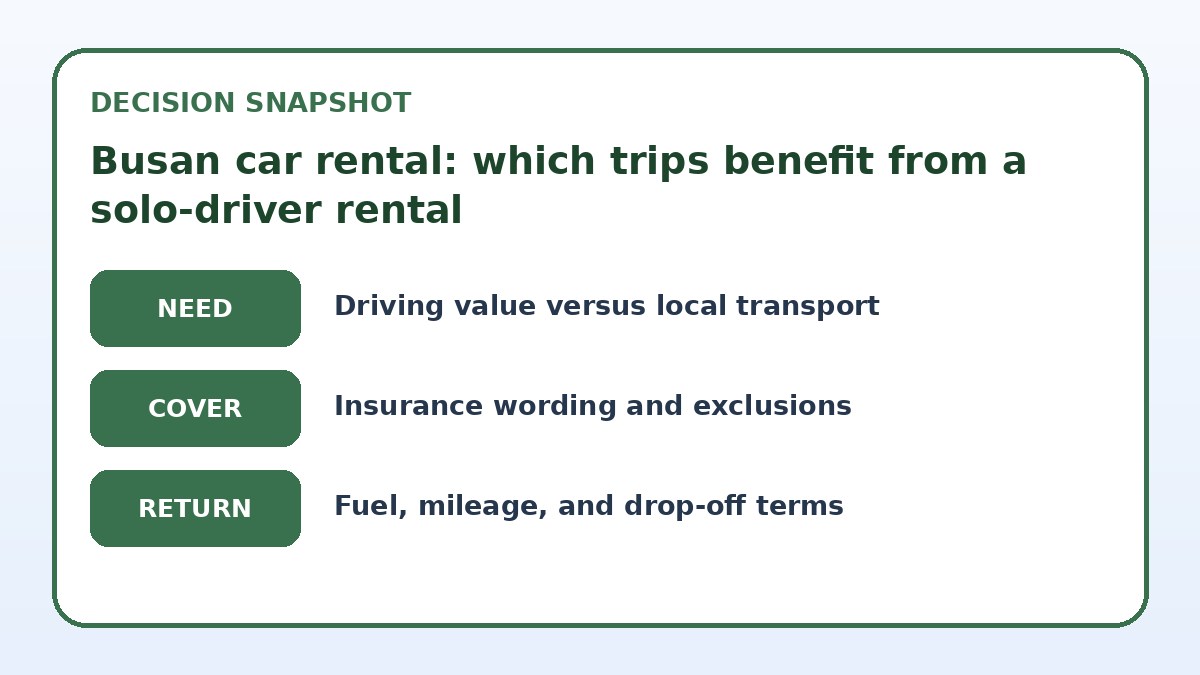
Route value: where driving genuinely improves your Busan trip
Decide by mapping your planned stops on a map and asking whether transit serves them efficiently. Busan’s subway and urban buses cover dense areas like Haeundae, Seomyeon and the port district very well; in those zones you’ll save time and money by using public transport and walking. Conversely, if your must-see list includes cliffside viewpoints, isolated beaches, or rural villages with limited service, a car removes waiting and connection overhead and lets you time visits for sunrise, sunset or photography.
Estimate the number of intersite transfers and whether they happen at awkward hours. Solo travelers who prefer flexibility — spontaneous detours, sunrise drives, or packing equipment like surfboards or camera gear — will find the car’s convenience worth the extra steps. But if your days are museum-heavy, café-hopping, or centered on neighborhoods with dense transport options, that convenience rarely pays off after you factor parking, tolls, and the mental load of unfamiliar driving.
Decide whether driving earns its place
| Mobility strategy | Best for | Cost or friction to check |
|---|---|---|
| Full rental car for the whole trip | Solo travelers with remote-day itineraries, flexible schedules, or bulky gear. | Highest convenience but adds parking hassle, tolls, insurance complexity, and potential stress driving unfamiliar roads. |
| Short-term rental for select days only | Those who need a car for one or two rural day trips but want to avoid city driving. | Saves city parking time yet requires extra pickup/return steps and careful fuel/planning for non-rental days. |
| Public transit + taxis/ride-hail | Visitors centered in Busan’s urban neighborhoods seeking low-cost, low-stress movement. | Less flexible for remote sites or odd-hour travel and can add wait times for certain routes. |
| Public transit + private transfer for remote legs | Solo travelers who want transit savings but need reliable access to remote attractions. | Costs more than transit alone for the transfer leg but avoids parking and driving stress across the whole trip. |
Check live rental choices only after the route test
Use the exact driver, dates, pickup point, and return plan to compare current conditions.
Insurance wording: exactly what to verify before you click book
Insurance descriptions on booking pages can be confusing. On the provider’s final rental page, verify the total liability limit, what physical damage cover (CDW/LDW) actually excludes, and any listed deductibles you’d be responsible for after a claim. Check whether optional waivers reduce your deductible and whether those waivers are refundable. Also look for rules about driving outside specific regions or onto unpaved roads; some rentals explicitly limit where you may drive.
Confirm whether third-party insurance or credit-card coverage applies, and what documentation the provider requires for those coverages to be valid. If you rely on your credit card’s rental coverage, compare its exclusions with the rental company’s requirements — for example, some companies void coverage if you rent certain vehicle classes or decline the company’s waivers. Note any language about roadside assistance and whether flatbed recovery for accident damage is included or extra.
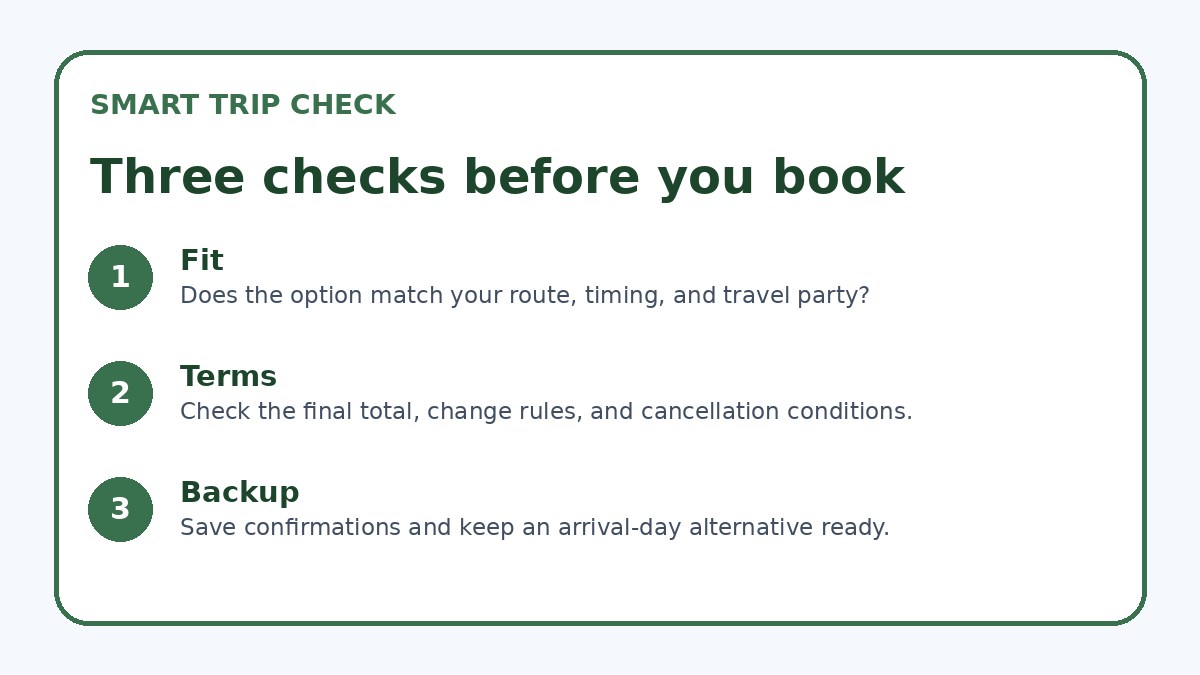
Compare the full rental conditions
Confirm insurance wording, exclusions, deposit, fuel, mileage, and return terms on the final page.
Pickup and return friction: practical pain points for solo renters
Pickup can be simple at downtown offices but slower at airport counters during peak arrivals. Expect identity and driving-license checks, credit-card holds, and optional upsells that take time to process. Ask whether the provider requires an international driving permit (IDP) or accepts your home license; check the waiting list for transfers from the airport if the desk is offsite. For solo travelers, luggage management during pickup and late returns is a real friction point — confirm parking for a quick handover and the company’s after-hours return procedure.
Returning the car can also carry hidden costs: fuel policies (full-to-full is easiest), late-return fees, and final vehicle inspections that can lead to damage claims. Take timestamped photos and note fuel levels at pickup and drop-off. If you’ll be returning the vehicle at night or to an airport lot, verify lighting, security, and whether a staff signature or dropbox receipt is required. These practical details can change the convenience calculus for a solo traveler more than base rental cost.
Car rental terms to verify
- Map your daily stops and mark which ones lack frequent public transit service before deciding to rent.
- On the final rental page, confirm liability limits, deductible amounts, and whether waivers reduce your out-of-pocket exposure.
- Verify whether your driver’s license plus an IDP is required and prepare the exact documents the provider lists.
- Note pickup and return procedures, after-hours drop-off rules, and whether a documented receipt is issued at return.
- Photograph the car at pickup from all angles and record the fuel level to avoid post-rental disputes.
- If skipping a car, pre-book any necessary private transfers for early starts or remote-day excursions.
A non-driving fallback: how to cover the trip without a rental
Create a fallback plan before canceling a potential booking: list transit links for your key stops, mark efficient taxi or ride-hail corridors, and identify one reliable private transfer for any early starts or remote drop-offs. Use the subway for the city core, supplement with local buses for coastal routes where they run, and reserve intercity buses or regional trains for longer legs outside Busan. For early-morning hikes or remote coastal points, pre-book a taxi or arrange a driver through your accommodation to avoid last-minute scrambling.
If you’re carrying gear or prefer door-to-door service, consider timed shuttle services or short-term private transfers for single long legs while relying on transit for the rest of the trip. Trip.com can be useful as a place to compare current availability for transfers and regional buses, but always verify schedules, stop locations and luggage allowances on the final booking page. Having a fallback keeps your itinerary flexible without paying the hidden costs and worry of driving in unfamiliar conditions.
Car Rental & Road Trip questions travelers ask
Will driving in Busan be difficult for a solo traveler used to driving in their home country?
Difficulty depends on experience and comfort with foreign traffic patterns. Busan’s major roads are modern and well signed, but mountainous terrain, narrow coastal lanes, and occasional heavy metropolitan traffic can be challenging. If you’re comfortable driving in busy cities and on highways, you can manage, but if you prefer low-stress travel, consider staying transit-based. Also verify whether your license plus an international driving permit (IDP) is accepted by the rental provider on the final booking page to avoid surprises.
How much extra time should I budget for rental pickup and return?
Build in time for identity checks, contract signing, optional insurance decisions, and vehicle inspection at pickup — this can take 20–60 minutes depending on queues. For returns, allow time for the final inspection and any disputes, plus driving and parking time to the office. If you arrive by plane late at night, confirm after-hours procedures. Solo travelers should plan conservatively so pickup and drop-off don’t eat into early departures or late flights.
Can I rely on taxis and ride-hailing instead of renting a car for coastal or rural day trips?
Taxis and ride-hailing can cover many gaps, but availability and cost vary for remote routes and very early or late trips. For single long legs to remote attractions, a pre-booked private transfer often provides the most reliable, comfortable option without requiring you to drive. Compare estimated fares and availability before your travel day, and when booking through aggregator pages like Trip.com, always confirm the provider’s exact pickup point, luggage policy, and cancellation terms on the final booking page.
Final decision note
For most solo travelers visiting Busan’s urban neighborhoods, public transit and selective taxis/ride-hail offer a lower-stress, often cheaper way to see the city. Rent a car if your itinerary includes remote coastal drives, infrequent bus lines, or early-morning photography and you value door-to-door flexibility. If you opt to rent, carefully review insurance wording, required documents, pickup and return rules, and any region restrictions on the provider’s final booking page. If you decide against driving, combine subway travel with targeted transfers or short rentals for a balanced, low-hassle trip.
Continue planning
Check current options and final conditions
Use the provider page to confirm live availability, the final total, cancellation terms, and every condition that matters to your trip.
This evergreen planning guide was created with AI-assisted drafting and a structured quality review. It does not display live prices, schedules, availability, visa guidance, or provider rankings. Verify current details before booking. Some links are affiliate links; we may earn a commission at no additional cost to you.