Short answer: for most families visiting Hong Kong, renting a car adds flexibility for out-of-town day trips and transporting bulky gear, but it’s often unnecessary for central-city sightseeing where public transport is faster and easier. Before you book, weigh whether your itinerary includes remote beaches, cross-border drives, or multiple hotels with limited transit access—those are the scenarios where a car meaningfully improves family comfort. If you choose to drive, plan around pick-up and return friction (airport vs. city desk), confirm insurance wording (especially cross-border limits), and prepare a realistic parking plan for each stop. This guide explains the tradeoffs, shows four mobility approaches to compare, and gives practical checks to complete on the final booking pages so you know exactly what you’re buying.
Does driving genuinely improve your family trip?
Ask whether a car changes what you can do with children in a single day. For families aiming to visit remote beaches in the western New Territories, heritage villages, or to base in a suburban hotel while exploring multiple attractions, a car reduces transfer time and simplifies carrying strollers, snacks, and changes of clothes. Conversely, if your plan focuses on Victoria Harbour, Central, Kowloon markets, or island-hopping by ferry, driving puts you at a disadvantage: traffic, scarce parking, and frequent short-distance walking make public transit quicker and less stressful.
Also consider who will drive and local driving comfort. Hong Kong’s traffic patterns include dense urban driving, frequent one-way streets, and busy tunnels; if the primary driver is not confident in that environment or if you prefer to relax and share childcare duties, driving may not be worth the tradeoff. Finally, evaluate route value: if a rented car only saves a single transfer but adds parking headaches and extra fees, public transit plus targeted taxis or rideshares could be the smarter family choice.
Decide whether driving earns its place
| Mobility strategy | Best for | Cost or friction to check |
|---|---|---|
| Rent a car for the whole trip | Families needing door-to-door flexibility, multiple rural day trips, or transporting strollers and bulky gear. | Higher parking and insurance complexities; urban driving and expensive short-distance parking. |
| Rent for selected days only | Families who want both city convenience and occasional long excursions without constant parking headaches. | Extra coordination for pickup/return; possible repeat authorization and paperwork at each rental start. |
| Public transit + taxis/rideshares | Families staying in central areas who prioritize avoiding driving stress and frequent short hops. | Less control carrying gear; may be slower to reach remote spots and require multiple transfers with kids. |
| Private driver or chauffeur hire | Families who want door-to-door convenience without local driving responsibilities or insurance worries. | Typically higher cost and dependence on correct scheduling; less spontaneous than self-driving. |
Check live rental choices only after the route test
Use the exact driver, dates, pickup point, and return plan to compare current conditions.
Insurance wording, liabilities, and what to confirm
Insurance terms vary and the booking page is your single reliable source. Confirm which drivers are covered (named drivers only or any licensed driver), whether a collision damage waiver (CDW) is included or optional, and the size of any liability excess you’d pay after an incident. Look for exclusions such as off-road use, driving in restricted border areas, or carrying more passengers than the policy allows. If you plan cross-border travel (for example, into parts of the Pearl River Delta), verify explicitly whether that is permitted and what extra insurance is required.
Also check policy language on child seats, windscreen and tyre cover, and roadside assistance response times. If your family needs a child seat or booster, confirm if the supplier provides one and whether it meets local standards; if you bring your own, verify installation liability. Finally, note what you must show at pick-up to activate cover—credit card type, passport, driving license translation, and proof of additional driver status—so you don’t face surprises at the counter.
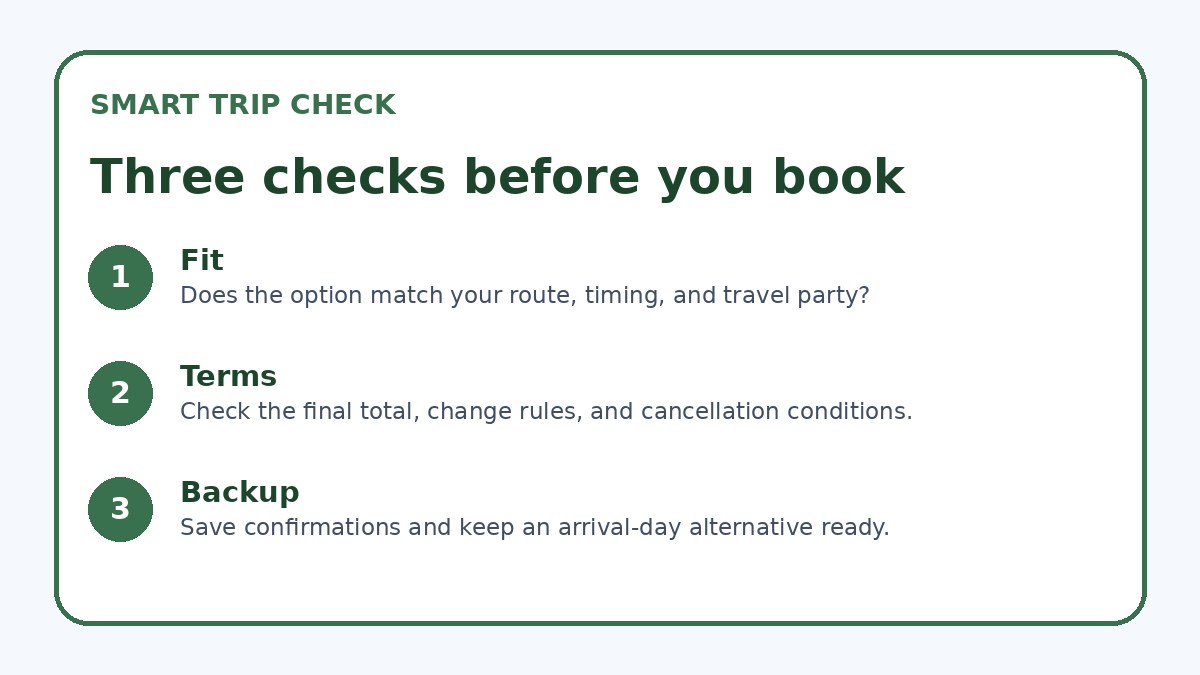
Compare the full rental conditions
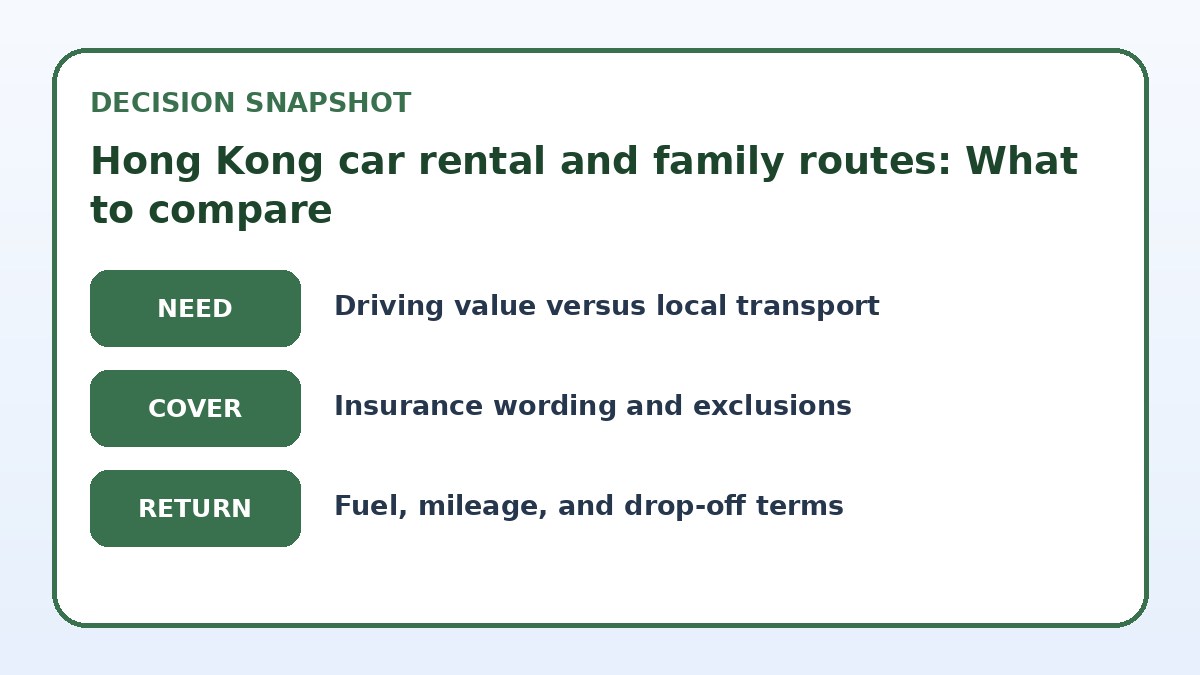
Confirm insurance wording, exclusions, deposit, fuel, mileage, and return terms on the final page.
Pickup, return friction and practical logistics
Pickup and return logistics can add unexpected hours to your day. Airport desks often offer convenience but can involve long queues and additional rental surcharges; city-based garages may be faster but require a transfer with luggage. Check the exact pickup instructions on the booking page—some vendors require photo ID and credit card in the driver’s name at the desk, others use automated kiosks with different document requirements. Consider the impact of traffic at typical pickup and return times and whether your flight times or ferry schedules force you into after-hours handling that carries extra fees.
Also plan parking at each place you’ll stop. Hotels, attractions, and public piers vary widely in availability and price. If you rely on street parking, understand time limits and payment methods for meters; if you expect long stays at a single base, check whether your hotel offers guest parking and whether height or license plate restrictions apply. A small upfront parking plan can prevent multiple small frustrations and keep the drive convenient for everyone.
Car rental terms to verify
- On the rental booking page, confirm exactly which drivers are covered and whether additional drivers must be registered before pick-up.
- Verify the collision damage waiver terms, excess amount, and any optional cover like zero-excess or windscreen protection.
- Check child-seat availability, standards, and whether there is an extra fee or requirement to reserve one in advance.
- Confirm pick-up and return locations, opening hours, after-hours procedures, and any one-way drop fees shown on the final page.
- Look up parking options for each overnight stay and major attraction and note any height, plate, or reservation restrictions.
- If planning cross-border travel, verify explicit permission and required permits or insurance endorsements on the supplier’s final terms.
Fallback plans when you decide not to rent
Create a realistic non-driving itinerary that covers the same goals: identify direct public-transport routes, calculate transfer times with strollers, and list taxi or rideshare legs that substitute for the car. For beach days or outlying nature spots, check scheduled ferries and the distance from piers to beaches; where public transport is sparse, budget for a taxi pickup both ways. If you have bulky gear, consider using luggage storage or hotel concierge services to avoid carrying items on trains and buses.
Also consider hybrid approaches: rent for a single day to do a long excursion while relying on transit in the city, or use car hire from a suburban base to access a cluster of attractions that would otherwise each require separate taxi trips. Whatever you choose, keep essential confirmations ready: child-seat availability, final insurance language if you rent for a day, and the exact address of pickup and nearest parking to your chosen hotel.
Car Rental & Road Trip questions travelers ask
Is driving in Hong Kong difficult for visitors accustomed to right-side driving?
Driving in Hong Kong is on the left. If you’re used to right-side driving, expect a learning curve with lane positioning, roundabouts, and right-turn differences. Urban roads are often narrow, and signage assumes left-side driving behaviors; tunnels and toll roads require attention to lane assignments and payment methods. If you or another family member lacks confidence, consider hiring a driver for longer day trips, or keep to centrally located activities relying on public transport, which is typically efficient and well-signed for visitors.
Can I use my foreign driving license to rent a car in Hong Kong?
Policies vary by supplier and country of issue. Many rentals require an International Driving Permit (IDP) alongside your national licence or a certified translation for certain licenses. The rental booking page and the supplier’s terms will list accepted documentation and any age restrictions or additional fees for young or senior drivers. Always bring the physical license, passport, and the credit card used for booking to the pickup desk to avoid delays or refusal.
How should families handle child seats and booster requirements?
Check the rental provider’s child-seat policy on the booking page: some include seats free, others charge and require advance reservation. If you bring your own seat, confirm whether the supplier or your airline allows it and whether installation liability changes. Be mindful of local standards and installation compatibility with the rental vehicle. If you expect to use taxis, ask whether child seats are permitted in that service or whether you should reserve a larger car to accommodate a seat safely.
Final decision note
Deciding whether to rent a car in Hong Kong for a family trip comes down to route value and convenience versus parking, insurance, and local driving comfort. If your plan focuses on city neighborhoods, ferries, and easy-access attractions, public transit with targeted taxis will usually be simpler. If your family itinerary includes multiple rural day trips, sprawling parks, or lots of luggage and baby gear, a car—or a hybrid plan of selective rental days—can save time and stress. Before booking, read the rental booking page carefully for driver coverage, CDW/excess terms, child-seat options, pickup/return instructions, and any cross-border restrictions, and use that information to finalize the most practical mobility approach for your family.
Continue planning
Check current options and final conditions
Use the provider page to confirm live availability, the final total, cancellation terms, and every condition that matters to your trip.
This evergreen planning guide was created with AI-assisted drafting and a structured quality review. It does not display live prices, schedules, availability, visa guidance, or provider rankings. Verify current details before booking. Some links are affiliate links; we may earn a commission at no additional cost to you.