If you and your partner are deciding how to travel from Sydney to Canberra, the practical choice usually comes down to a few trade-offs: directness versus flexibility, comfort versus cost, and how much door-to-door time matters. For many couples the fastest stress-minimising option is a single vehicle door-to-door — a private car or rideshare — but trains and coaches can be more relaxing and avoid city traffic. Ferries are not a practical direct option for Sydney–Canberra; any water crossing adds time and transfers, so include them only as a scenic detour combined with road or rail. This guide shows how to compare train, coach, car/rideshare and combined multimodal trips, focusing on terminal fit, luggage and transfers, scheduling flexibility, and a disruption backup. Use the decision checklist and FAQs to pick the option that fits your relationship’s travel priorities and how much planning you want to do before departure.
Terminal fit and door-to-door practicality
Start by mapping where each terminal sits relative to your Sydney pickup and Canberra accommodation. A central train station or coach terminal may be simpler for city arrivals, but if either of you has mobility needs, check step-free access, lift locations and how far taxis or rideshares wait from exits. For couples with a lot of luggage or baby gear, a single pickup that drives close to your doorstep and delivers to your hotel or rental can save multiple carry-and-wait cycles and reduce stress on arrival.
Remember that a mode’s advertised travel time is only part of the story: include connection walking distances, city traffic to and from terminals, and the time you want to reserve for pre-departure coffee or security queues. If you prefer minimal fuss, choose the option with the fewest handoffs and shortest total door-to-door time, even if its in-vehicle time is slightly longer. Where public terminals are distant from your final address, rank options by combined journey convenience rather than just the vehicle leg.
Choose the end-to-end journey plan
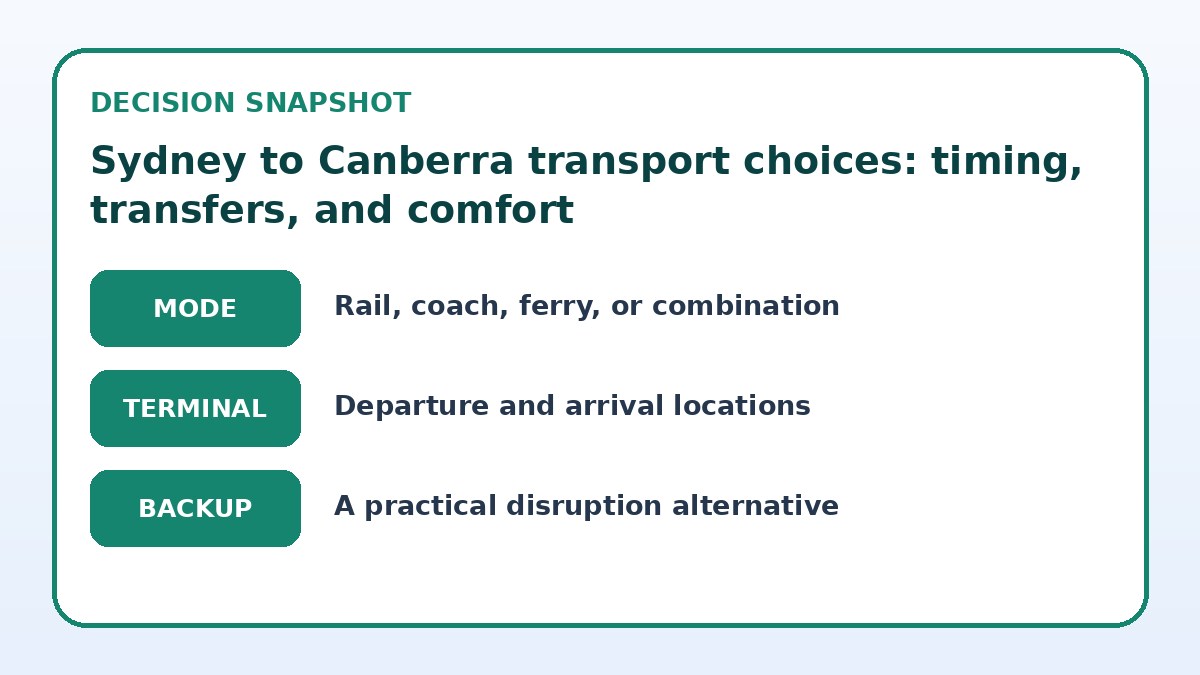
| Journey approach | Best for | Friction to check |
|---|---|---|
| Train-only (intercity rail) | Couples who want a relaxed ride with space to move and arrive at city-centre stations. | May require extra transfers if stations aren’t close to your final address; timetables could be less frequent than roads. |
| Coach-only (intercity bus) | Couples on a budget or who prefer direct pickup from central coach terminals with simple luggage handling. | Comfort varies and traffic can lengthen door-to-door time; verify luggage access and scheduled drop-off points. |
| Private car or rideshare | Couples prioritising maximum door-to-door convenience, flexible departure times and easy luggage handling. | More expensive and responsibility for driving falls to one partner; long-distance road conditions and parking at destination matter. |
| Multimodal (ferry or scenic detour plus road/rail) | Couples treating travel as part of the experience who can absorb extra transfer time for scenery. | Adds transfers, luggage friction and complexity; ferries are a detour and rarely cut total travel time to Canberra. |
Check live intercity options
Look beyond the ride itself and compare terminals, transfers, luggage, and arrival fit.
Luggage, transfers and couple-friendly comfort
Consider how much luggage you’ll realistically want to manage together. Trains and coaches often have onboard storage and overhead racks, but getting bags to and from the platform can involve stairs or distant storage rooms. A private car keeps everything within arm’s reach and lets you store things under the boot, which many couples find more intimate and less disruptive. If one partner prefers to relax while the other handles bags, choose the mode that minimises stairs and long walks.
Think about seating and privacy: a coach or train carriage gives you the option to sit together, stroll, or split into different moods—reading, chatting or napping—without driving. Conversely, driving yourselves or using a rideshare forces both of you to share the front seats unless you pre-book a specific vehicle type. Factor in the emotional tone you want on the trip: social and scenic, private and quiet, or pragmatic and fast. That preference often settles the choice more than small time savings.
Timing flexibility and booking strategy
If your schedule is fixed—checking in at a specific time or attending a timed event—prioritise options with frequent departures or flexible change policies. Coaches and trains usually run on published timetables; check how often they depart and how late the last options run. For couples who want to leave windows open, a private car or a flexible rental with a generous pickup location can be easier to re-time without worrying about missing a single daily departure.
When booking, compare the full door-to-door timeline rather than only the advertised run time. Confirm boarding windows, recommended early arrival and how much leeway carriers allow for late boarding or schedule changes. If you plan to combine modes—say, a scenic coastal ferry segment plus a road leg—make sure you have comfortable transfer buffers and a clear plan for luggage between legs. Always verify final availability and any change conditions on the provider’s booking page before paying.
Compare the practical alternatives
Use the final page to confirm what is actually offered on your dates and save a workable fallback.
Intercity travel checklist
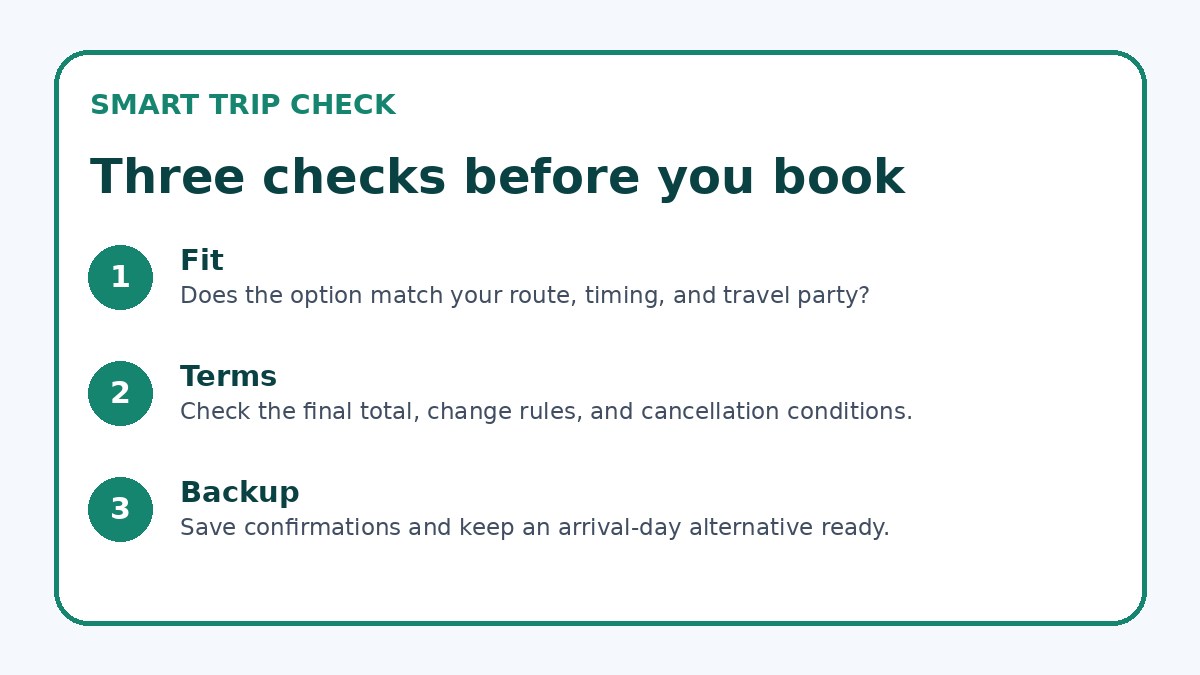
- Map door-to-door time: calculate from your pickup point in Sydney to final address in Canberra, including walking or taxi legs.
- Confirm terminal addresses and step-free access for both departure and arrival locations to avoid unexpected stairs or long transfers.
- Check luggage rules and where bags are stored on trains, coaches or ferries, and plan who carries what between legs.
- Identify at least one same-day backup option (next train/coach, local rental desk, or rideshare coverage) and save contact details.
- Compare the total cost and time of a single vehicle trip versus public modes after adding taxi/rideshare legs at each end.
- Verify departure times, change/cancellation policies and onboard facilities on the provider’s final booking page before payment.
Disruption backups and what to verify before departure
Every couple should pick a disruption backup: an alternate same-day coach or train, a nearby rental car desk, or a ride app with sufficient supply in both cities. Know where to find the next departure times and how to reach customer service quickly. If your trip includes a multi-leg connection, plan a minimum time cushion so one delay doesn’t cascade into a missed onward departure; confirm minimum connection guidance from each operator’s booking page before you travel.
Before you finalize booking, verify a short list of facts that change frequently: current timetables, terminal addresses, luggage allowances, onboard facilities (power outlets, toilets) and any transfer shuttle schedules. Trip.com can be useful to compare real-time availability, but always complete final checks on the operator’s own site or the platform where you will pay. Keep a mobile screenshot or offline note of the backup option and its contact details so you can act quickly if plans change.
Rail & Intercity Transport questions travelers ask
Is there a direct ferry from Sydney to Canberra I can take for scenery?
There is no practical direct ferry route that takes you from Sydney to Canberra without adding significant road or rail legs. Ferries can be a scenic addition if you plan a coastal detour, but that inevitably requires transfers and extra luggage handling to reach Canberra, which is inland. If scenery matters, consider a combined trip where you spend a day on a coastal ferry or harbour cruise and then continue by road or rail; plan generous transfer buffers and confirm connections on the operator booking pages.
Should couples choose train or coach for comfort and privacy?
Both trains and coaches can be comfortable for couples, but the right choice depends on priorities. Trains often provide more space to walk and may feel less bumpy, while coaches sometimes offer direct routes and simpler point-to-point service. If privacy is a priority, reserve adjacent seats when possible and choose departure times with lighter loads. Always check seating arrangements, onboard amenities and whether you can reserve seats together before you book.
What’s the easiest disruption backup if our scheduled service is delayed?
An easy disruption backup for couples is to identify the next scheduled train or coach and a nearby car-rental desk or rideshare zone that can take you onward. Save the customer service and local taxi/rideshare numbers in your phone and note the addresses of alternative terminals. If you rely on timed reservations at your destination, build a time buffer to absorb moderate delays, and confirm rebooking or refund terms on the provider’s booking page ahead of time so you know your options if a delay occurs.
Final decision note
Choosing how to travel from Sydney to Canberra as a couple comes down to priorities: if you value conversation, legroom and a relaxed pace, train or coach travel can be pleasant; if you prioritise door-to-door convenience and control over timing, a private car or rideshare is often the simplest. Avoid planning a ferry-only route unless you explicitly want a scenic detour that adds transfers. Before you book, map door-to-door time, verify terminal access and luggage arrangements, and pick a clear disruption backup. Confirm timetables, seat reservations and change policies on the provider’s final booking page so you’re ready to enjoy the trip together.
Continue planning
Check current options and final conditions
Use the provider page to confirm live availability, the final total, cancellation terms, and every condition that matters to your trip.
This evergreen planning guide was created with AI-assisted drafting and a structured quality review. It does not display live prices, schedules, availability, visa guidance, or provider rankings. Verify current details before booking. Some links are affiliate links; we may earn a commission at no additional cost to you.