If you’re booking Seoul to Tokyo flights for business, the practical question is this: which fare and routing give you the schedule flexibility you need with the lowest risk if plans change? Start by deciding whether schedule certainty or price flexibility matters more. A higher-fare refundable or flexible ticket reduces headaches when meetings move, but lower-fare options can be workable if you pair them with clear protections—corporate policies, travel insurance, or the carrier’s flexible fare rules. Also confirm whether your itinerary is direct or connects, because a connecting itinerary can increase missing-connection risk and complicate refunds or rebooking. Before comparing live options, gather exact travel dates, preferred Tokyo airport (Haneda or Narita), traveler name formats, loyalty numbers and whether you need extra baggage or lounge access. That preparation speeds accurate fee comparisons and prevents surprises on the carrier’s final booking page.
See live routes for your exact travel day
Compare direct and connecting choices with the same baggage and traveler details.
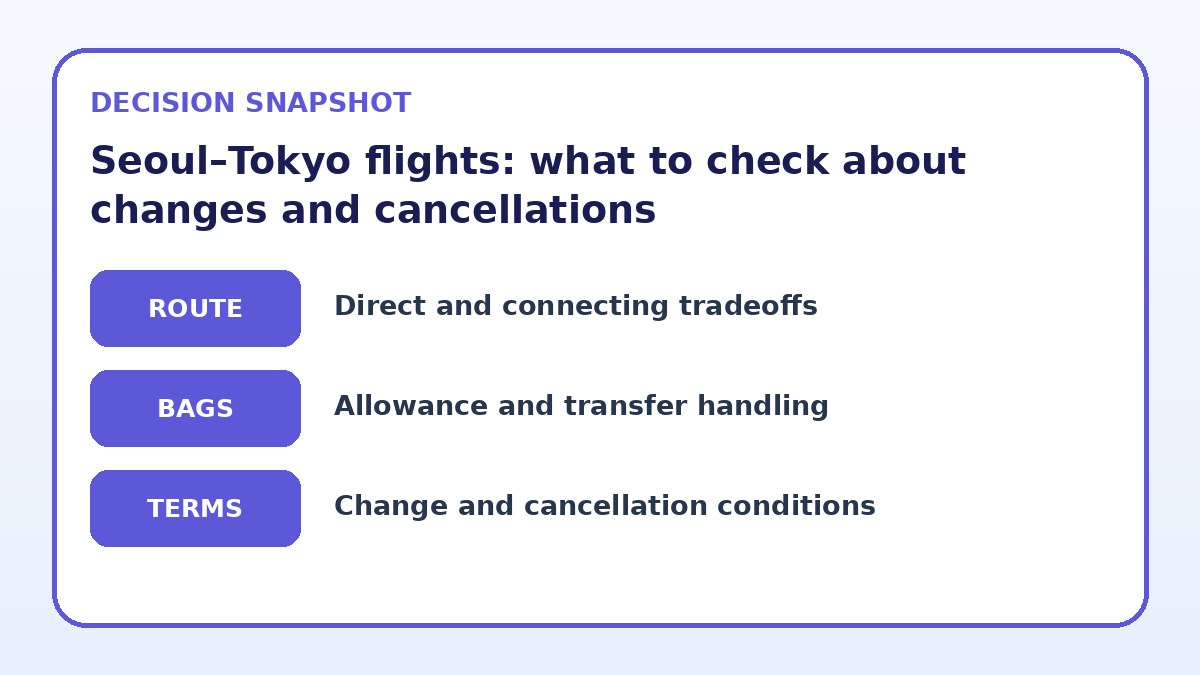
Routing: direct versus connecting on Seoul–Tokyo
Routing shapes almost every practical risk on this short international hop. A direct Seoul–Tokyo flight removes the intra-itinerary transfer point where delays cascade and rebooking rules can become complex. If a direct option exists and fits your schedule, it often simplifies compensation and reissue conversations with the carrier because only one segment is at issue. However, direct flights may be less frequent at times you need, so a connecting itinerary might be necessary—especially outside typical business windows.
When a connection is required, treat the whole itinerary as a single contract only if it’s sold on one ticket; separate tickets increase your responsibility for missed connections. For connecting options, verify the minimum connection time the carrier suggests and whether the airline protects missed connections in their contract of carriage. Also confirm airport transfer steps in Seoul or Tokyo; tight connections between terminals can increase the chance you’ll need reissue or rerouting, so factor that potential cost into your routing choice.
Baggage and connection risk: rules that matter to travelers
Baggage allowance policies vary by fare class; for business travelers moving with work equipment or samples, small differences can translate into significant extra fees. Check whether the fare includes checked bags and whether those bags are protected through connections when the itinerary is booked on a single ticket. If you have separate tickets for legs, you may need to reclaim and recheck luggage during a connection, which extends transfer time and raises missed-connection risk. Know the permitted weight and piece limits for your ticket before you pack.
Carry-on and priority boarding perks tied to higher fare classes also reduce connection stress; priority security lanes and earlier boarding can make a tight transfer manageable. If your schedule demands same-day return or tight turnarounds, confirm whether the fare allows same-day changes or standby eligibility—terms that can be crucial when meetings run long. Always check the carrier’s final booking page for baggage size, weight rules, and whether ancillary purchases like extra bags are refundable if the primary fare is changed or canceled.
Compare flight-selection strategies
| Flight strategy | Best for | Risk to check |
|---|---|---|
| Buy flexible/refundable fare | Meetings that may reschedule or tight corporate approval processes | Higher upfront fare but minimal change penalties and easier refunds |
| Purchase lower nonrefundable fare + travel insurance | Predictable schedules where price is a top constraint | Lower ticket cost but more paperwork to recover nonrefundable losses |
| Book low fare with premium add-ons (priority, baggage) | Short trips needing speed and slightly reduced connection risk | Cheaper than refundable fares but change rules remain restrictive |
| Book two one-way tickets or mixed carriers | Maximizing schedule options across carriers or airports | Higher connection and rebooking complexity, greater risk on missed legs |
Recheck the complete itinerary
Confirm airports, connection handling, baggage, and change conditions before deciding.
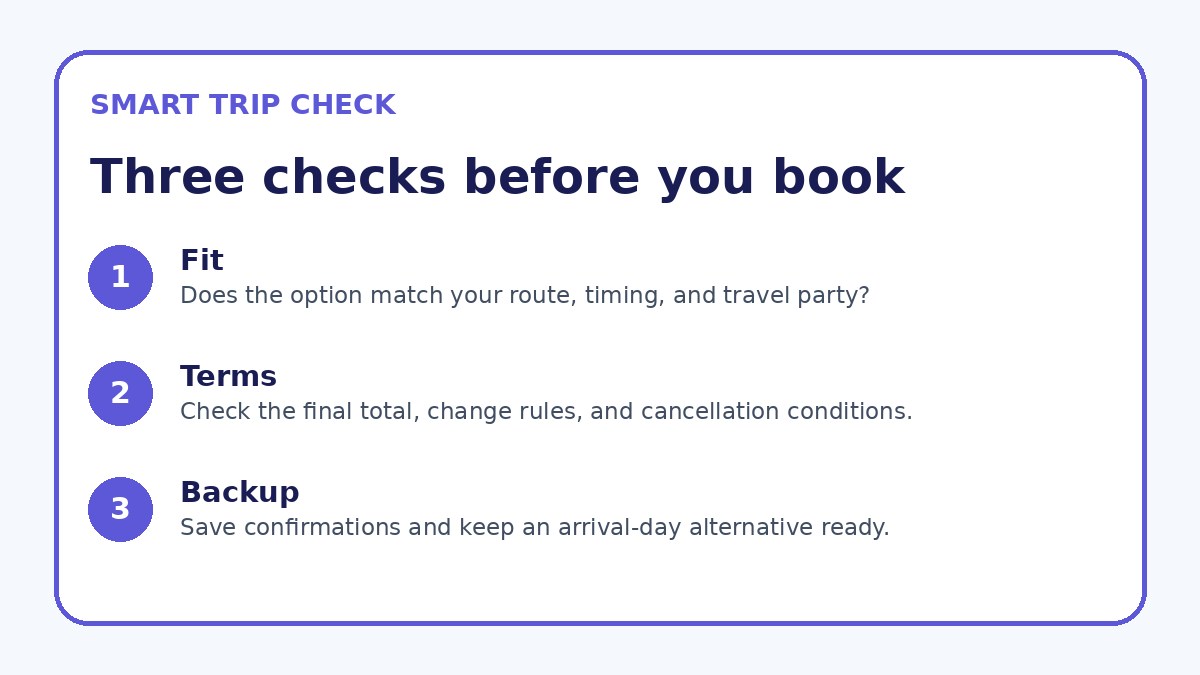
Schedule fit and corporate needs: aligning fare with meeting risk
Match the ticket’s changeability to the meeting’s flexibility. If your itinerary is for fixed, high-stakes meetings or a sequence of calls with little slack, buy a ticket with flexible change terms or refundable value to avoid expensive last-minute reissues. For events where dates can shift, a mid-tier refundable or flexible fare can be less costly than frequent change fees on low-fare tickets. Also confirm your company’s travel policy about permitted fare classes and whether pre-approval is needed for refundable fares or upgrades.
Consider secondary schedule protections such as travel insurance or corporate travel assistance programs. Insurance can cover some non-refundable costs when cancellations are due to certified reasons, but policies differ on what counts and how claims are processed. Before relying on insurance, verify what the carrier will refund directly versus what you must claim from your insurer. Finally, if you travel frequently, factor in loyalty status benefits—some programs waive change fees or provide standby priority, which can make lower fares more usable for business travel.
Flight details to verify
- Confirm exact travel dates, preferred Tokyo airport (Haneda or Narita), and full traveler name as on passport before searching fares.
- Compare change fees, refund rules, and fare-difference policies shown on the carrier’s final booking page for each fare class.
- Verify whether your itinerary is a single ticket or separate tickets; note baggage transfer rules and connection protection details.
- Check corporate travel policy limits on fare classes, pre-approval requirements, and whether company credit covers refundable fares.
- Decide if travel insurance or corporate assistance is needed and obtain policy wording that explains covered cancellation reasons and claim steps.
- Save screenshots of fare rules and the booking page confirmation; record booking reference, contact numbers, and required documents for changes.
Fare conditions: what to verify on the carrier’s booking page
On the carrier’s final booking page, confirm three things: the explicit change fee and how it’s applied, whether the fare is refundable or only refundable as travel credit, and whether fare differences apply on reissue. Some fares allow free changes but require payment of any fare difference; others add a fixed penalty in addition to fare difference. Make sure the displayed rules describe who can issue a refund, timelines for reimbursements, and any processing fees tied to refunds or exchanges.
Also check whether the fare includes same-day confirmed or stand-by options, and which documentation the carrier requires for waiver of fees (for example, medical reasons or bereavement). Look for clear language on cancellation windows and how refunds are returned (original form of payment versus travel credit). If anything in the fare rules is ambiguous, contact the airline’s customer service for a written clarification or save screenshots of the booking page at the time of purchase. Trip.com can be used as one place to compare availability and rules, but always verify the final terms on the airline’s own booking page before you commit.
Flight Guide questions travelers ask
Can I rely on corporate travel policy to waive airline change fees from Seoul to Tokyo?
Corporate travel policies vary. Some companies authorize paying higher flexible fares or reimburse change fees, while others require specific approvals before purchase. Before booking, check your policy for permitted fare classes and reimbursement processes. If your policy allows reimbursement of change fees, retain receipts and booking screenshots. If it doesn’t, consider buying a fare that includes flexibility or add travel insurance that covers business-related cancellations. Always confirm the carrier’s stated change-waiver conditions on the airline booking page because the airline controls fee application.
How do I evaluate the risk of a missed connection on a Seoul–Tokyo itinerary?
Start by identifying whether both legs are on one ticket; single-ticket itineraries are usually protected by the selling carrier. Check minimum connection times and terminal transfer requirements at the departure and arrival airports. For tight connections, prioritize direct flights or itineraries with longer layovers, and consider priority boarding or early check-in to reduce risk. Also review the carrier’s rebooking policy for missed connections and whether they provide hotel or meal support. If your itinerary includes separate tickets, plan longer buffers because you’ll likely be responsible for missed connections.
What should I verify about baggage rules when choosing a fare class for Seoul to Tokyo?
Confirm the allowance for checked and carry-on bags for the exact fare class you plan to buy, not just the general cabin description. Check whether baggage is protected through connections on a single ticket and whether fees are refundable if you cancel. For business equipment or samples, verify weight and piece limits and whether oversize items are allowed. Also confirm if priority or premium-fare benefits include additional baggage or waived fees. Where language is unclear, take a screenshot of the booking page’s baggage rules and ask the airline for confirmation before purchase.
Final decision note
For business travelers, choosing between Seoul to Tokyo flight options is a tradeoff between schedule certainty and ticket cost. If meeting dates are firm or a missed flight would have high consequences, prioritize refundable or flexible fares and direct routing where possible. If your schedule is stable and cost control is paramount, lower fares combined with clear corporate policy coverage or insurance can work—just accept the administrative steps if you need to claim refunds. In every case, gather exact dates, traveler details, and preferred airports before you search. Verify change, refund, and baggage rules on the carrier’s final booking page and save documentation; that due diligence prevents most last-minute headaches and keeps your trip manageable when plans shift.
Continue planning
Check current options and final conditions
Use the provider page to confirm live availability, the final total, cancellation terms, and every condition that matters to your trip.
This evergreen planning guide was created with AI-assisted drafting and a structured quality review. It does not display live prices, schedules, availability, visa guidance, or provider rankings. Verify current details before booking. Some links are affiliate links; we may earn a commission at no additional cost to you.