Practical answer first: choose your Bali hotel area based on how many on-site meetings, client visits or co-working days you will pack into a typical day. If most days are off-site or require back-to-back meetings across different parts of the island, pick a central, low-traffic neighbourhood to cut commute unpredictability. If you’re running long virtual sessions, need quiet concentration or have small team members in-room, prioritise a high-comfort room with good blackout, soundproofing and a dedicated work surface. You can combine both needs by selecting a neighbourhood that minimizes daily friction and then upgrading the room category for sound and ergonomics. Below you’ll find the neighborhood fits, how daily-route friction affects your schedule, room and party needs, and the final booking terms to confirm before you hit reserve.
Check live stays in the areas that fit
Use your dates and party size to compare current rooms after you narrow the neighborhood fit.
Neighborhood fit: map your workday first
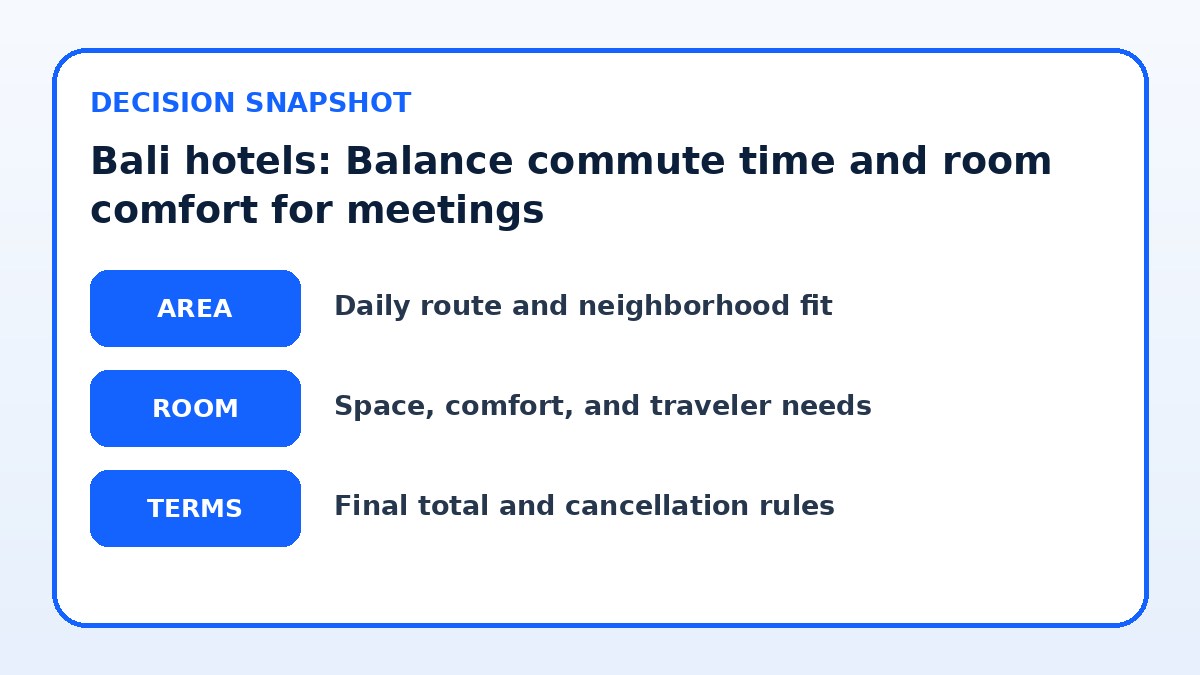
Start by mapping where your meetings, clients, co‑working spaces and conference venues are located. Bali’s business activity is split: Denpasar and Kuta area serve many local services and government offices; South Seminyak, Seminyak and Legian host boutique agencies and hotels with meeting facilities; Nusa Dua and Jimbaran cluster large resorts and MICE (meetings, incentives, conferences, exhibitions) venues; Ubud attracts creative industries, remote retreats and quieter workdays. Choose the neighbourhood that most frequently intersects with your calendar to reduce long, unreliable commutes that fragment a workday.
Consider last-mile factors beyond straight-line distance: typical traffic patterns, peak congestion windows, and the reliability of ride services in that area. If you have recurring late-afternoon calls or evening dinners, favour areas with a good mix of dining and transport options close by. For short, concentrated trips between a hotel and several meetings, an inner-suburban base can outperform a beachfront district despite being less scenic. The goal is to make getting to work as predictable as being at work.
Choose an area-selection strategy
| Area approach | Best for | Tradeoff to check |
|---|---|---|
| Choose a central business-area base (Denpasar/Kuta fringe) | Multiple local meetings across town and quick access to services | May be noisier and offer fewer high-comfort room options compared with resort districts |
| Stay in South Seminyak or Kerobokan (creative hubs) | Agencies, boutique clients and short ride distances to cafés and co-working spots | Traffic can be congested during peak hours; quieter room categories may be limited |
| Base in Nusa Dua or Jimbaran (resort/MICE areas) | Formal events, hotel meeting facilities and predictable resort-style services | Longer transfers to creative hubs or Denpasar office areas; fewer late-night dining options |
| Choose Ubud or quieter inland towns | Creative work, retreats, deep-focus days and less road noise | Not ideal for frequent island-wide client visits due to longer travel times |
Daily-route friction: travel time, traffic and meeting rhythm
Assess how travel time slices into your day. Fifteen to twenty minute transfers are manageable between sessions, but repeated 45–75 minute rides will hollow out your day and increase stress. Factor in buffers: Bali’s roads can be slow during tourist seasons and public events. If your schedule has clustered appointments across different zones, choose a base near the densest cluster. If most commitments are virtual or held at the hotel, then commute becomes less important and the value of a quiet, comfortable room increases.
Also weigh transfer predictability: if you need tight back-to-back meetings, proximity to reliable transport options matters. Some neighbourhoods have dense ride-hailing coverage and consistent pickup points, while others require waiting for a taxi or negotiating with drivers. For airport timings, check realistic transfer windows from your shortlisted areas to the airport and allow additional time for traffic. When in doubt, simulate a typical day’s route on a map at the same time of day you’ll travel to see likely friction points.
Now compare like with like
Keep the same dates, guests, room needs, and cancellation preferences while you compare the final choices.
Room and party needs: what to prioritise inside the door
Once you’ve settled on a neighbourhood, choose a room that supports your working style. Key features: a comfortable, adjustable chair and a proper desk; reliable, high-speed wired or guaranteed Wi‑Fi; effective noise control—either solid walls, soundproofing, or rooms away from nightlife and elevators; blackout curtains for time-zone or midday naps; and a lighting setup that won’t wash you out on video calls. If you need frequent virtual meetings, test for echo and camera angles by asking the property for a recent in-room photo of the desk area.
Consider who you’re sharing the room with. Travelling alone demands different space than hosting a colleague or an assistant. For multi-person stays, look for suites with a separate living area or twin setups that maintain privacy while offering a meeting-friendly layout. Also check in-room amenities that save time: coffee/tea facilities for quick breaks, a minibar setup for client refreshments, and accessible power at desk level. If you’ll print documents, confirm hotel business-centre access or nearby print shops rather than assuming in-room printers.
Hotel booking check before payment
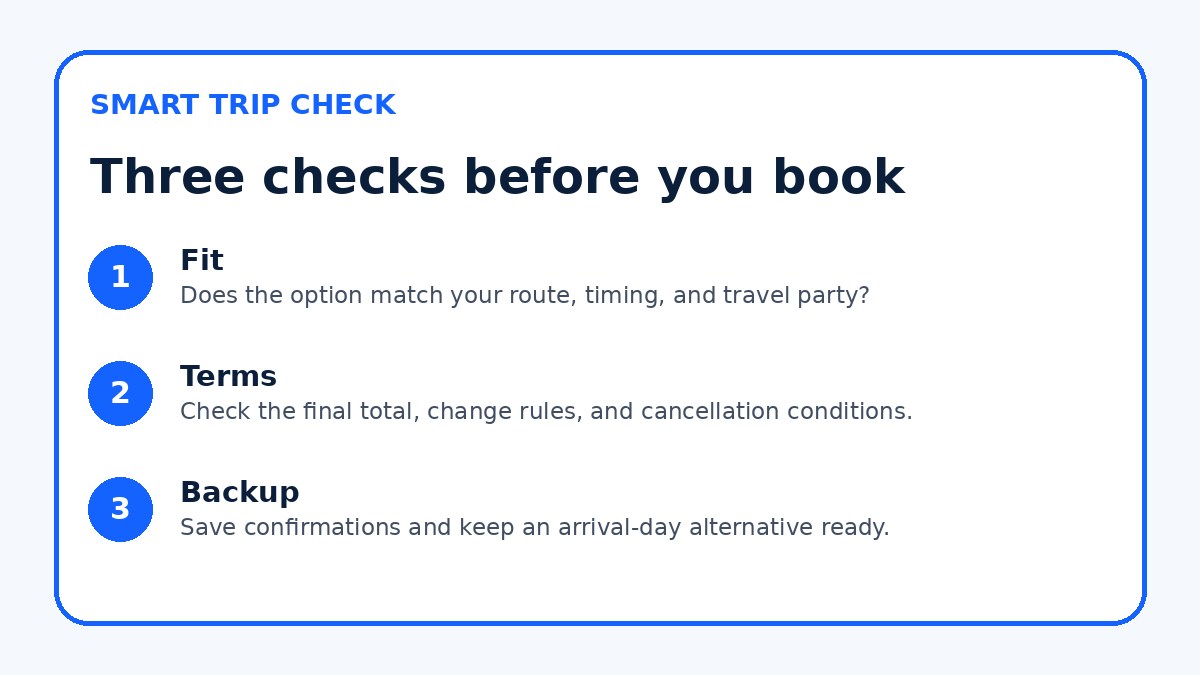
- Map your schedule: mark every meeting, co-working day and major errand and note their neighbourhoods on a single map.
- Estimate peak transfer windows for your travel times and simulate routes to shortlisted hotels for realistic commute times.
- Request a recent in-room desk photo and confirm desk dimensions, outlet placement and natural light direction.
- Ask the hotel for Wi‑Fi upload and download expectations or whether a wired connection is available in-room.
- Verify cancellation terms, early check-in or late check-out policies, and whether meeting-room bookings are included or charged separately.
- Confirm noise factors: room orientation, nearby venues or construction, and whether the property enforces quiet hours that might affect calls.
Final booking terms: what to verify before you reserve
Before you click reserve, read the booking page for details that affect business travel: the property’s stated Wi‑Fi policy (free vs. paid, bandwidth guarantees), cancellation and modification flexibility, check-in and check-out windows, and whether the room rate includes meeting-room credits or access to co-working spaces. Don’t assume amenities listed on the main page are always included—confirm whether the work desk is in-room or part of a shared lounge, and whether there are noise restrictions during early mornings or late nights that could affect calls.
If the hotel’s site or listing leaves questions, contact the property directly and get specifics in writing: ask for confirmed room orientation (quiet vs street-facing), the exact floor for requested rooms, any ongoing renovations, and whether there are power backup measures. If you plan to compare inventory, check live availability and recent guest notes on a booking site such as Trip.com as a convenience, but verify the final terms on the hotel’s own confirmation before you finalize.
Hotel Guide questions travelers ask
How do I decide between a beachfront resort and a central urban hotel in Bali for work?
Think about the ratio of time you’ll spend in-person at meetings versus needing quiet focus for virtual sessions. A beachfront resort often provides superior rest, privacy and resort meeting facilities ideal for retreats or concentrated work blocks; however, it can add commute time to widely dispersed client locations. A central urban hotel reduces daily transfers and gives faster access to local services, but may offer smaller rooms and more street noise. Prioritize the neighbourhood that aligns with the majority of your calendar and then upgrade the room category to secure comfort for calls.
What room features in Bali hotels most reliably protect video-call quality?
For consistent video-call quality, prioritise rooms with a dedicated desk near an Ethernet port or advertised stable Wi‑Fi, strong lighting (natural plus adjustable lamps), minimal echo from hard surfaces or high ceilings, and confirmed quiet hours or soundproofing. If you can, request a room away from lifts, bars or main roads and ask the hotel whether they can provide an internal test of Wi‑Fi speed at the desk location. Always have a backup plan—mobile hotspot capability or a nearby co‑working space—if bandwidth becomes unreliable.
Can I balance cost and comfort effectively when booking a business stay in Bali?
Yes—balance starts with neighbourhood choice: a slightly less central area can offer larger, quieter rooms for the same price as a tiny central room. Compare room categories: sometimes upgrading one level buys a separate sitting area or better sound control. Check whether the hotel includes business perks (meeting credits, co‑working access, free printing) that reduce ancillary expenses. When comparing offers, verify cancellation flexibility and included amenities on the hotel’s booking page before confirming so you’re not paying unexpected fees later.
Final decision note
Balancing location and room comfort for Bali hotels means making the tradeoff that fits the majority of your working hours. Start by matching your calendar to neighbourhoods, then choose a room category that guarantees the practical comforts you rely on—desk setup, sound control, lighting and reliable connectivity. Prioritise predictable commutes when meetings are on the move; prioritise room quiet and comfort when work is mostly virtual or spread across long blocks. Verify Wi‑Fi details, cancellation rules and any meeting‑space access with the hotel before booking. With those checks done, you’ll be able to shortlist an area and room confidently and focus on the work that brought you to Bali.
Continue planning
Check current options and final conditions
Use the provider page to confirm live availability, the final total, cancellation terms, and every condition that matters to your trip.
This evergreen planning guide was created with AI-assisted drafting and a structured quality review. It does not display live prices, schedules, availability, visa guidance, or provider rankings. Verify current details before booking. Some links are affiliate links; we may earn a commission at no additional cost to you.