Practical answer first: before you buy any Gyeongju travel deal for business travel, compare the same dates, the same number of travelers, and the same inclusions (transport, transfers, meals, and meeting facilities) across package and separate options — then read the final terms on the supplier’s booking page. Business travelers often focus on headline savings while overlooking meeting-room charges, airport transfers at odd hours, penalty windows that conflict with schedule changes, or per-person local taxes that add up quickly. That makes a deal look cheaper until the invoice arrives. This guide shows which cost lines to compare, how to judge bundle flexibility for a work trip, and the final contract items to verify before confirming. Following these steps helps you choose the booking approach that matches your schedule constraints, expense policy, and risk tolerance.
Test package value fairly
| Booking approach | Best for | Tradeoff to check |
|---|---|---|
| All-inclusive bundled package (hotel + transport + meeting room) | Teams with fixed dates and clear headcount who want one supplier to manage logistics | Bundle may impose strict change rules and combined cancellation penalties that make adjustments costly |
| Flight/train + hotel booked separately through corporate tools | Travelers needing maximum flexibility per component and specific invoicing | More legwork to coordinate arrivals and transfers; potential higher day-of logistics costs |
| Hotel package plus pay-as-needed local transfers and meeting rooms | Groups expecting schedule tweaks who want predictable accommodation costs | Day-of car hire or meeting charges can fluctuate, requiring contingency budgeting |
| Do-it-yourself bookings for each traveler (individual tickets) | Travelers with varied schedules or last-minute changes where individual flexibility matters | Higher administrative overhead and disparate invoices can complicate corporate expense reconciliation |
Check current package and separate options
Use identical dates, travelers, room needs, baggage, and flexibility so the comparison stays meaningful.
What you must compare before judging a package
Start by lining up the identical baseline across all options: same travel dates, traveler count, and origin-destination points. For Gyeongju business trips that usually means comparing arrival at a nearby airport or train station and any onward ground transport to your hotel. If a package lists ‘transport included,’ confirm which transfer type (shared shuttle, private car, or public rail) and whether it covers late-evening or early-morning arrivals. Mismatched pickup assumptions are a frequent source of hidden cost and schedule risk for meetings.
Next, compare the business-specific inclusions rather than only room type or airline cabin. Meeting-room hours, complimentary Wi‑Fi bandwidth, early check-in or late check-out fees, and breakfast policies affect productivity and expense reports. When an inclusion is vague on the product page, treat it as excluded until you see the supplier’s final booking terms. Take screenshots or save PDF copies of the supplier’s inclusions and terms so your finance or travel manager has the same reference if questions arise.
Inclusions vs. flexibility: where money often hides
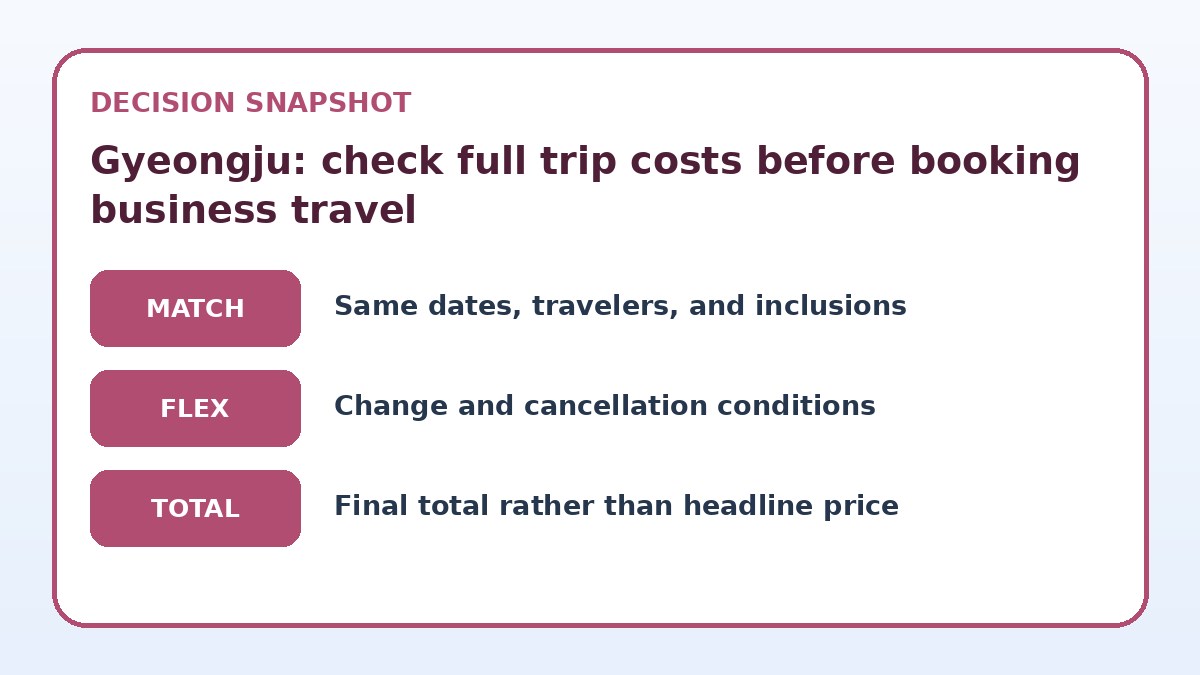
A package that bundles hotel, train, or bus plus a local transfer can look cheaper on paper, but flexibility limits often cause extra charges when plans change. Business travel needs tend to be unpredictable: meeting times shift, participants are added, or flights are rerouted. If the bundle ties you to nonrefundable fares or tight cancellation windows, the nominal saving vanishes the moment you must alter reservations. Quantify the likely cost of changes by checking the supplier’s change fees for each component and treating those potential fees as part of the total cost when comparing options.
Also factor operational details that affect productivity and cost: meeting-room capacity and hours, whether the hotel offers a business center, and local transport options if you need to split the group. A slightly higher room rate with free, flexible meeting space and included transfers may beat a lower package that forces you to hire separate cars or pay overtime for meeting rooms. Always ask suppliers to confirm, in writing on their booking pages, what amounts are refundable and what service fees apply for after-hours requests.
Look past the headline total
Compare inclusions and change conditions before deciding whether a package is genuinely useful for this trip.
Deal comparison checklist
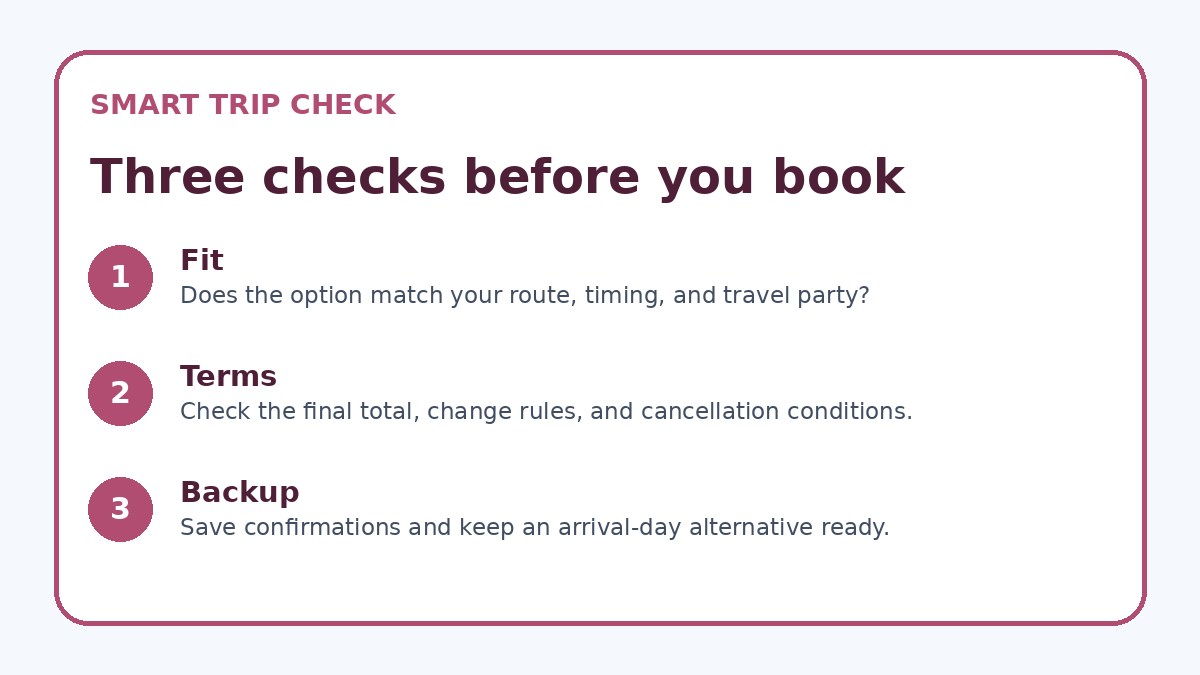
- Match exact travel dates, arrival/departure points, and traveler count before comparing any prices or inclusions.
- List every inclusion (transfers, Wi‑Fi, breakfast, meeting room hours) and price the excluded items to see the true total cost.
- Confirm change and cancellation rules for each component on the supplier’s final booking page and calculate worst-case change fees.
- Request sample invoices or invoice options to ensure they meet your company’s accounting and expense-policy requirements.
- Verify who is responsible for transfer coordination and timing if meetings run late or flights are delayed.
- Save and store screenshots or PDFs of the supplier’s booking confirmation and terms in your travel file for expense reconciliation.
Traveler-specific value: pick the right bundle for your group
Assess who is traveling and what they need. A solo traveler with a fixed itinerary may value a fully prepaid flat package that minimizes day-of logistics. Small teams with tight meeting schedules often need private transfers, guaranteed meeting-room access, and the ability to change reservations without heavy penalties. Large or variable groups may be better served by separate bookings: reserving flexible airline or rail tickets and contracting local buses that allow headcount adjustments without reissuing each traveler’s ticket.
Don’t ignore corporate policies: per‑diem limits, required invoice formats, and preferred suppliers can turn an apparent public-market saving into extra administrative work or out-of-policy expense. If your company requires separate invoices per traveler or specific vendor codes, confirm the package provider can supply those. If not, the administrative time and reconciliation may offset any booking discount.
Final terms to verify on the provider’s booking page
Before confirming a Gyeongju travel deal, check the supplier’s final booking page for precise refund and change rules, invoicing options, included taxes and service fees, and any blackout dates or minimum-stay requirements. Ask for clear wording about arrivals outside typical hours and any extra charges for late check-in or airport meet-and-greet. If you’re considering a bundle, confirm whether each line item (transport, hotel, meeting room) is refundable or changeable independently, because some suppliers treat the bundle as a single nonrefundable unit.
Also verify payment timing and penalties, whether the price is per person or per room, and how local taxes or tourism fees are shown on the invoice. If transfers are marked as ‘subject to availability,’ treat them as not guaranteed until the provider confirms on the booking page. Trip.com can be used to compare current availability and conditions, but always verify the final contractual details on the supplier’s own booking confirmation before approving corporate expenses.
Travel Deals & Booking Strategy questions travelers ask
How do I compare Gyeongju travel deals if my arrival time may change?
If your arrival might change, prioritize flexible transfer and ticket rules when comparing options. For each supplier, check whether airport or station transfers are time‑specific and whether a missed pickup triggers a fee or requires rebooking. Compare change fees for the travel leg and any meeting-room bookings, and treat those fees as part of the total cost. When looking at bundles, verify if transfers are refundable or if the package treats missed services as forfeit. If unpredictability is high, separate flexible tickets plus on-demand local transfer options often reduce risk.
Can a cheaper bundled package still be the best choice for a short business trip?
Yes, a cheaper bundle can be the best choice if its inclusions match your needs and its change/cancellation terms fit your risk tolerance. Short trips with fixed dates and confirmed attendees benefit from the simplicity of one supplier handling logistics and invoicing. However, confirm that meeting-room access, check-in rules, and transfers cover your schedule; otherwise, add projected extras to the package price. The deciding factor is the total expected cost under realistic changes, not just the headline bundle price.
What invoice and expense details should I verify before booking for corporate reimbursement?
Confirm that the supplier can provide the invoice format your finance team requires, including company name, tax ID where necessary, and itemized line entries for transport, accommodation, taxes, and service fees. Ask whether invoices can be split per traveler or consolidated, and whether electronic invoices are issued immediately upon payment. Also verify payment timing and any prepayment requirements, as some suppliers charge full amounts up front which impacts cash flow and refunds.
Final decision note
Business travelers booking Gyeongju travel deals should treat the headline price as only the starting point. By comparing identical dates, traveler counts, and inclusions — then adding likely change fees, invoicing needs, and operational details — you reveal the true total cost and the real tradeoffs among bundles or separate bookings. Prioritize what matters for your trip: if schedule certainty is high, a bundled package may reduce day-of hassles; if flexibility or specific invoicing is essential, separate bookings usually work better. Always verify the supplier’s final booking terms and invoice options on the provider page before approving any corporate payment.
Continue planning
Check current options and final conditions
Use the provider page to confirm live availability, the final total, cancellation terms, and every condition that matters to your trip.
This evergreen planning guide was created with AI-assisted drafting and a structured quality review. It does not display live prices, schedules, availability, visa guidance, or provider rankings. Verify current details before booking. Some links are affiliate links; we may earn a commission at no additional cost to you.