If you and your partner are planning a trip to Busan, the practical first question is not which website has the lowest headline price but which cancellation rules protect both of you. For couples, flexibility matters differently: one partner’s sudden work change, illness, or family need can upend plans. Start by comparing the same dates, the same number of travelers, and identical inclusions (baggage, transfers, breakfast, seat selection) before judging a bundle’s value. A package can simplify logistics and sometimes reduce administrative friction, but bundled savings often rely on stricter or more opaque change and cancellation policies. Read the supplier’s final booking page for exact cancellation windows, penalties, and refund timing. This guide walks through what to compare, where flexibility typically appears, and how to pick the approach that minimizes financial and emotional risk for two travelers.

Test package value fairly
| Booking approach | Best for | Tradeoff to check |
|---|---|---|
| All-in-one package (single supplier handles flights+hotel+extras) | Couples who want convenience and simplified customer service routes | Often less granular flexibility—changes may apply to the whole booking and penalties can be higher for individual traveler adjustments |
| Flights and hotel bundled but extras booked separately | Couples wanting core convenience while keeping excursions or transfers flexible | May reduce some risk, but bundled core components can still carry combined cancellation terms for both travelers |
| Separate bookings for flights and hotel, extras as needed | Couples prioritizing maximum control and per-person refunds | More administrative work and potentially higher upfront costs; requires careful matching of dates and conditions to avoid false savings |
| Hybrid: refundable fare or room with nonrefundable extras | Couples hedging big risks (flight/hotel) while accepting small nonrefundable items | Higher base cost for refundable components; must track multiple cancellation rules and voucher terms |
Check current package and separate options
Use identical dates, travelers, room needs, baggage, and flexibility so the comparison stays meaningful.
What to compare before judging a Busan package
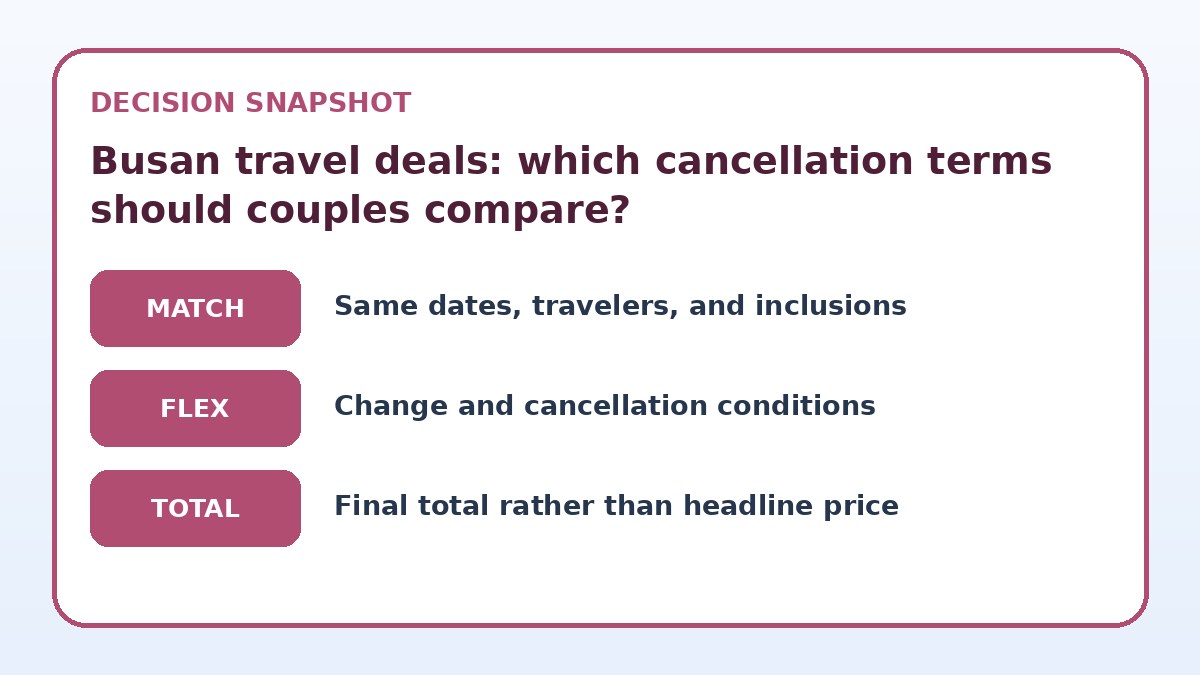
Start any comparison by forcing an apples-to-apples view: pick the exact travel dates, number of travelers, room type, and flight cabin class. If a package advertises baggage, seat selection, or breakfast, confirm whether these are included for both travelers or only one. For couples, small differences add up quickly—one refundable ticket paired with a nonrefundable hotel room may leave one partner bearing most risk. Also check whether ground transfers are shared or private and whether arrival/departure times match your comfort and connection plans.
Next, map the cancellation and change rules for each component. Some bundled offers funnel all cancellation through the tour operator, which can be convenient but may apply uniform penalties even when only one traveler needs to change plans. Separate bookings give you piecewise control, so a single canceled flight might not void a refundable hotel. Finally, establish the refund form—credit vouchers, travel account balances, or direct refunds to a payment card—and the stated timeline for processing, because couples may prefer cash refunds to shared vouchers.
How inclusions affect cancellation flexibility
Inclusions determine both convenience and exposure. If a bundle includes prepaid excursions, these usually carry their own nonrefundable rules independent of flights or hotels, and the supplier often requires canceling them within a specific timeframe. For couples, decide whether both want the same excursions; if only one participates, the other’s cancellation may leave the couple paying for unused bookings. Also examine whether included items are refundable or changeable—some packages label components as 'included' but treat them as nonrefundable extras.
Baggage and seat selection may seem minor but influence change policies: refundable or flexible airfares typically allow name changes or rebooking with minimal fees, whereas deeply discounted fares included in packages often lock both travelers into strict conditions. Check whether the package upgrades to a flexible fare for an extra fee and whether that upgrade applies to both travelers automatically or requires separate purchase. Couples should decide if that extra cost is worth the peace of mind for potential schedule shifts.
Look past the headline total
Compare inclusions and change conditions before deciding whether a package is genuinely useful for this trip.
Deal comparison checklist
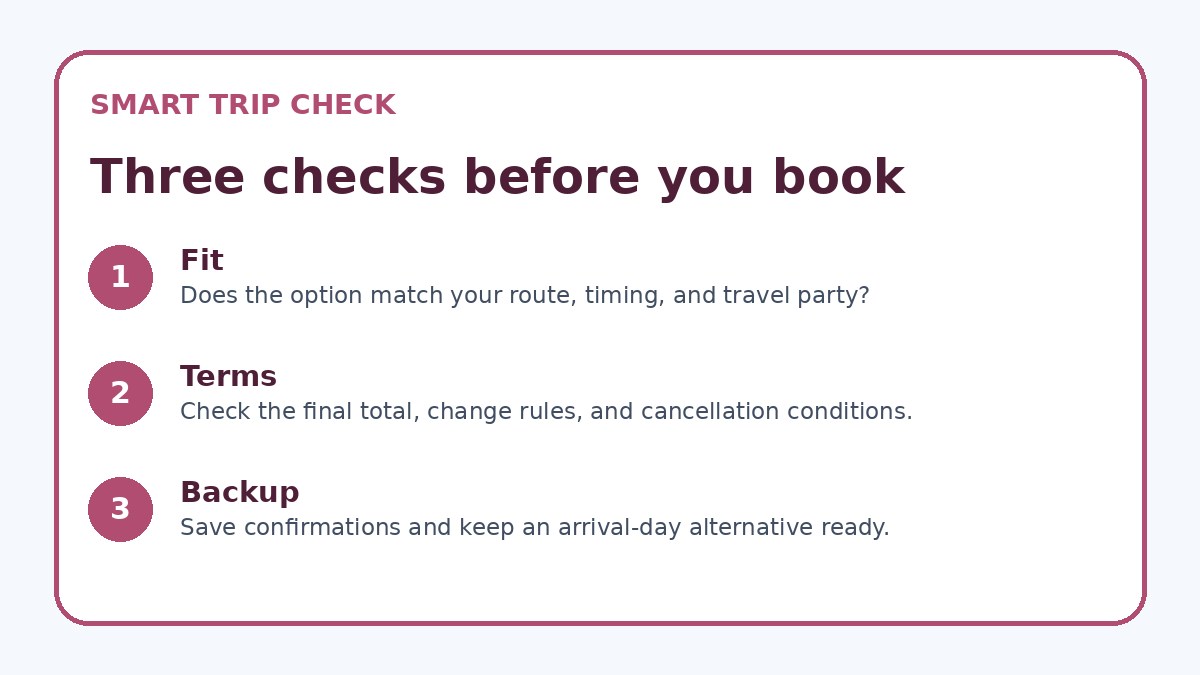
- Match dates, room type, number of travelers and flight times across any package and separate-booking comparisons to avoid false savings.
- Confirm whether cancellation terms are stated per passenger or per booking and save a screenshot of the final terms before purchase.
- Check refund type—cash to card versus travel credit—and verify whether credits are transferable or have expiration dates.
- If buying travel insurance, verify the supplier’s refund policy meets your insurer’s criteria for covered cancellations.
- Ask the provider how name changes are handled and whether administrative fees apply for altering one traveler’s reservation.
- Document customer-service contacts and the exact wording of any special terms or verbal promises before completing payment.
Traveler-specific value: why couples need separate risk assessments
Each traveler brings different risk tolerance and constraints. One partner may have an inflexible work schedule, while the other has variable availability. Discuss who is more likely to request a change and model scenarios: if one cancels, will the other still travel alone? If not, how do refund rules look when the whole booking is canceled versus when a single passenger's reservation is modified? Understand whether refunds are prorated per traveler or if the supplier treats the booking as an indivisible unit.
Another important consideration is name-change policies. Some suppliers allow transferring a reservation to another traveler, while others prohibit changes and demand cancellation plus new booking. For couples who might swap travelers or add a companion later, verify whether the operator charges administrative fees for name updates. Also check whether credit vouchers issued after cancellation are transferable or restricted to the original booker—this affects how useful a refund will be if plans change.
Final terms: exactly what to verify on the booking page
When you reach a supplier's final booking page, read the cancellation policy line-by-line. Confirm cutoff times for free cancellation, the size and timing of penalties, and whether refunds are immediate or issued as travel credits. Look for sections describing force majeure or extraordinary event clauses that might change standard rules, and save screenshots of the terms that appear immediately before you click confirm. For couples, confirm whether the policy language references 'per passenger' or 'per booking'—that wording determines whether one traveler’s change affects the other financially.
Also verify how refunds are processed: some suppliers return funds to the original card only after a processing period, while others issue nonrefundable travel credits that expire. If using a credit card or travel insurance, check whether the supplier’s policy aligns with your insurer’s requirements for reimbursable losses. Finally, note customer-service contact methods and required documentation for disputes—having a direct email or claim form ready can make resolving problems far easier if plans change.
Travel Deals & Booking Strategy questions travelers ask
Should couples always choose refundable airfare and hotel rates when booking Busan travel deals?
Choosing refundable options reduces financial risk but usually increases the upfront cost. For couples, refundable rates make sense when one partner’s schedule is uncertain or the trip is mission-critical, as they allow changes or cancellations with lower penalties. If both travelers are confident in the dates and have low likelihood of change, a mixed strategy—refundable core components and nonrefundable small extras—can balance cost and flexibility. Ultimately, compare the incremental cost of refundable options to the potential loss you’d face if forced to cancel.
How can we avoid being stuck with nontransferable vouchers if one partner cancels?
First, read whether refunds are issued as cash or vouchers and whether vouchers are tied to the original booker. If vouchers are nontransferable, that may be unsuitable for couples who might reassign the reservation. At booking, ask the provider explicitly whether voucher codes can be used by a named companion or applied to future bookings under your account. If the supplier’s policy isn’t acceptable, consider separate bookings or purchasing refundable components. Keep written confirmation of any exceptions the supplier grants at purchase.
When comparing bundles and separate bookings for the same Busan trip, what hidden mismatch should couples watch for?
A common mismatch is differing refund windows and processing timelines between components. For example, a bundled package might advertise free cancellation until a certain date for the hotel but lock flights earlier, or refunds may be paid as credits that expire faster than anticipated. Always compare the exact cancellation cutoff times, the penalties applied at each stage, and how quickly refunds are processed. Ensuring the same refund form and compatible timelines across components prevents unexpected losses if one part of the trip changes.
Final decision note
For couples planning Busan travel deals, the decisive factor is not price alone but how cancellation and change rules allocate risk between two people. Start by comparing identical dates, traveler counts, and inclusions; then prioritize who needs flexibility and which components should be refundable. Bundles can simplify logistics but sometimes concentrate penalties; separate bookings give granular control but require careful matching to avoid hidden mismatches. Always verify the final booking page language—cancellation windows, per-passenger versus per-booking penalties, refund type, and processing time—and document what you see. With those checks, you can choose the approach that protects your plans and your budget.
Continue planning
Check current options and final conditions
Use the provider page to confirm live availability, the final total, cancellation terms, and every condition that matters to your trip.
This evergreen planning guide was created with AI-assisted drafting and a structured quality review. It does not display live prices, schedules, availability, visa guidance, or provider rankings. Verify current details before booking. Some links are affiliate links; we may earn a commission at no additional cost to you.