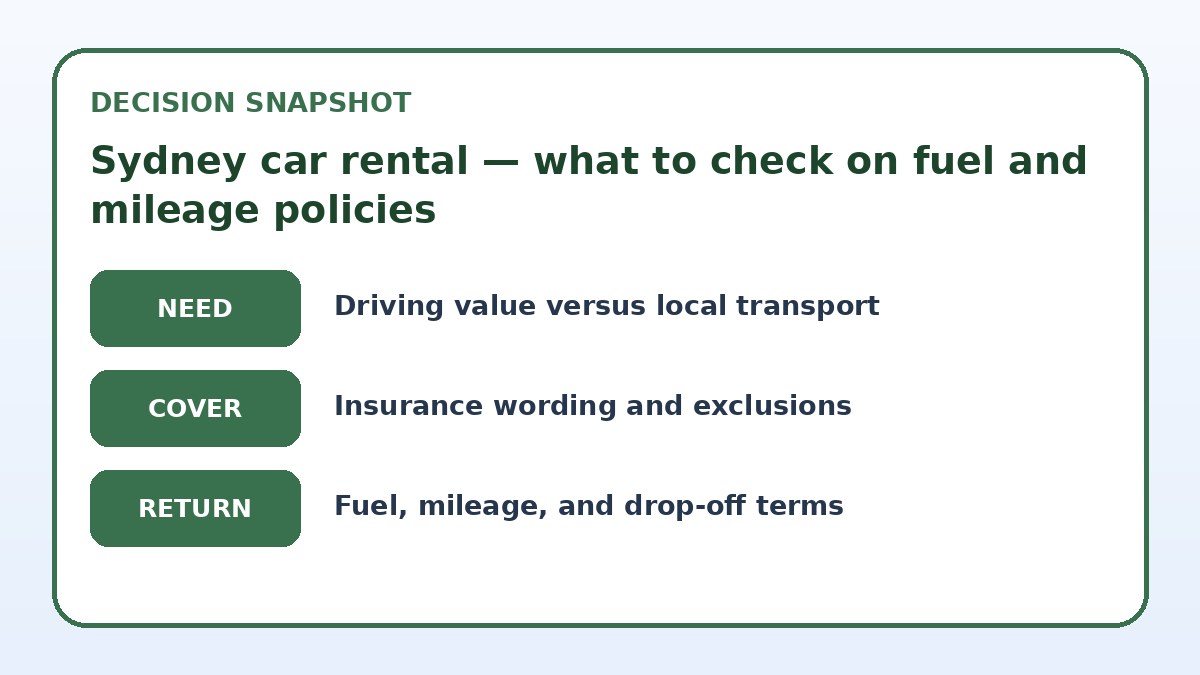
Practical answer up front: driving in Sydney can be useful if your plan includes coastal drives, the Blue Mountains, or moving between suburbs with limited public transit, but only rent a car if you’ve confirmed the fuel policy, mileage limits, and pickup/return requirements. These three contract points affect cost and convenience more than car class. Read the vendor’s exact fuel wording, whether you prepay, and how full the tank must be on return. Check if daily or total kilometre caps apply and whether extra kilometres are charged per kilometre or in blocks. Confirm pickup and return locations—airport counters, off-airport lots, or city depots have different fees and hours. If insurance terms mention exclusions, note them and what proof you must show at pickup. Below you’ll find tradeoffs, what to verify on the booking page, and a clear non-driving fallback for visitors who prefer public transport and rideshares.
Does driving actually improve your Sydney trip?
Deciding whether to drive starts with what you plan to do. If your itinerary is mostly in central Sydney — the CBD, Circular Quay, Darling Harbour, and nearby neighbourhoods — public transport, ferries, and walking usually beat driving because traffic, tolls, and parking can add time and cost. If you plan day trips to the Blue Mountains, Royal National Park, or multiple coastal towns in a short stretch, a car gives you flexibility and can save transit connections. Think in routes: if one or two long drives are core to your experience, renting for those days only might be smarter than keeping a car the whole stay.
Also weigh group size and luggage. A family or a group with surfboards or camping gear will find a car more practical than transit. Conversely, solo visitors or couples staying in inner-city hotels should compare ride-share fares, timed trains, and ferry trips for convenience. Finally, consider where you'll sleep: staying near a park-and-ride or suburban station tips balance toward public transit; staying outside the main public-transport corridor makes a rental more attractive. Use fuel and mileage policies to test the true cost of the drives you plan.
Decide whether driving earns its place
| Mobility strategy | Best for | Cost or friction to check |
|---|---|---|
| Rent a car full trip (full control) | Travelers with multiple day trips and lots of gear | Higher complexity: check fuel policy, mileage caps, insurance excess, and pickup/return hours. |
| Rent only for day trips (hybrid approach) | City stays plus planned long drives | Requires extra pickups and drop-offs; fuel and mileage rules still apply per rental period. |
| Public transport and ferries | Urban-focused itineraries and budget travelers | Less flexibility for remote sites; requires coordination of schedules and possible longer travel times. |
| Rideshares and point-to-point transfers | Short distances, late nights, or when avoiding parking stress | Can be expensive for frequent or long inter-suburban trips; no control over route stops. |
Check live rental choices only after the route test
Use the exact driver, dates, pickup point, and return plan to compare current conditions.
Fuel and mileage: what to verify on the booking page
Fuel policies vary and the booking page is where the precise wording matters. Look for these exact phrases: full-to-full, pre-purchase fuel, and return not full (with defined per-litre or per-fill charges). Full-to-full means you get a full tank and should return it full; it avoids prepay charges but requires time to refill before return. Pre-purchase fuel sells you a tank up front, which can be convenient but is only fair value if you’ll use most or all of the tank. 'Return not full' terms often trigger high administrative fees plus a calculated per-litre rate—watch for both components.
For mileage, confirm whether it's unlimited or limited with a daily or trip cap. If limited, note the exact kilometres allowed and the per-kilometre excess charge. Some contracts use bundled kilometre blocks; others count every kilometre. Calculate expected kilometres across planned drives and allow a buffer for detours and city navigation. The booking page should also list how distance is measured (odometer at pickup/return) and whether crossing state lines affects fees. If the wording is vague, contact the provider before you book or pick an option with explicit unlimited mileage.
Compare the full rental conditions
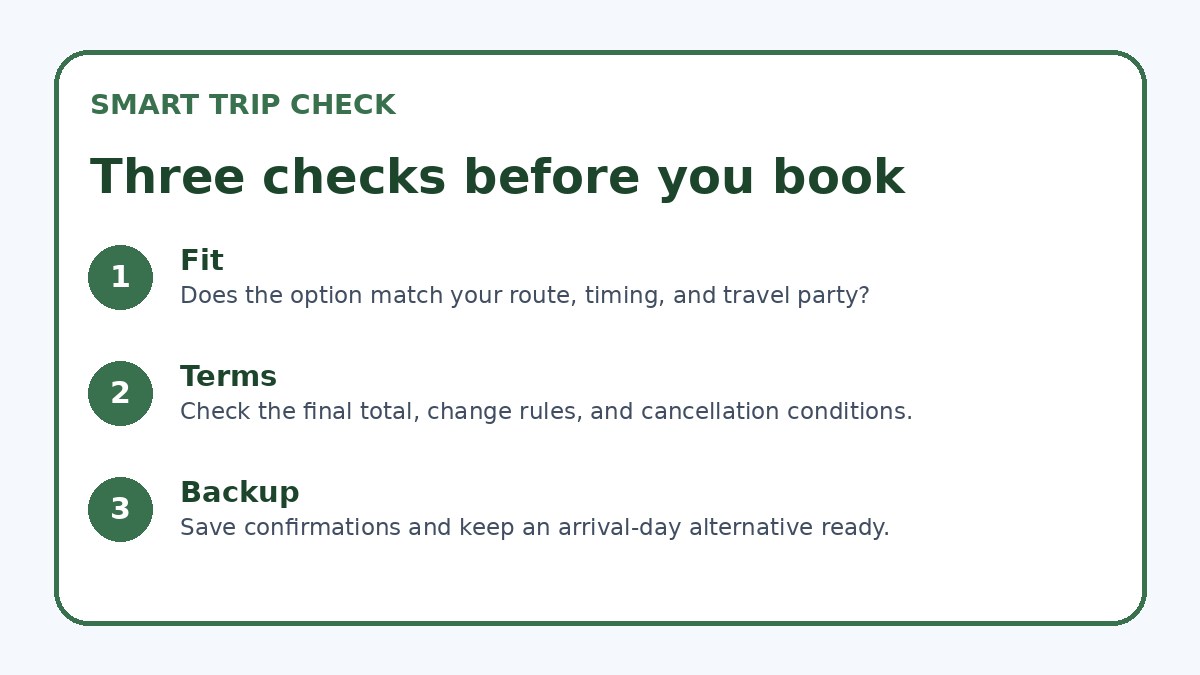
Confirm insurance wording, exclusions, deposit, fuel, mileage, and return terms on the final page.
Insurance, pickup/return friction, and hidden logistics
Insurance terms often hide the cost and headache of an accident or claim. Verify the excess (your liability amount), whether loss/damage waivers reduce that excess, and what exclusions apply — for example, driving on unsealed roads, off-road use, or certain types of damage might not be covered. If you plan to rely on a credit card or third-party insurance, the booking page should state whether that’s accepted and what proof the company requires at pickup, such as a printed policy or specific credit-card imprint. Don’t assume the counter staff will resolve discrepancies; get clear terms before you arrive.
Pickup and return logistics can add time and extra fees. Airport counters sometimes charge location fees and may require a shuttle to an off-airport lot; city depots may have limited hours that complicate late returns. Check whether the provider charges after-hours return fees, requires a fuel receipt for not-full tanks, or enforces a strict return window. If you plan an after-hours drop at a different site, confirm acceptance and the required process. These operational details influence whether a rental really saves time compared with trains, buses, or pre-booked transfers.
Car rental terms to verify
- Read the fuel policy on the booking page and note whether it’s full-to-full, prepaid, or return-not-full with per-litre and admin charges.
- Confirm whether mileage is unlimited or capped; if capped, calculate expected kilometres and the excess per-kilometre charge.
- Check the insurance excess and any optional waivers; verify whether your credit card or third-party policy is accepted and what proof is needed.
- Note pickup and return locations and hours, whether airport pickups require shuttles, and any after-hours drop-off fees.
- Ask the provider whether crossing state lines, driving on unsealed roads, or entering certain parks affects coverage or fees.
- If you plan to return with less than a full tank, find nearby service stations and save fuel receipts in case the company requests proof.
Non-driving fallback: how to plan without a car
Sydney’s public transport and ride-share network cover most visitor needs. Trains and ferries connect the CBD to major attractions, while buses and light rail reach many inner suburbs. For single-day coastal excursions or the Blue Mountains, regular coach services and organised tours remove the need to navigate unfamiliar roads and parking. Rideshares are practical for late-night trips or journeys with luggage, though costs rise for long inter-suburban travel. Plan routes ahead, note interchange stations, and estimate ride-share fares for any journeys where transit would take much longer.
If you decide against driving, map transit times and service frequencies for your must-see spots. Buy an Opal card (or check the local equivalent) to simplify fares and avoid paying per-ride at each operator. For day trips that are impractical by public transport, compare private day tours or regional bus services; these often include commentary and drop-off points near trailheads or coastal lookouts. Having a pre-checked, non-driving plan gives you an immediate alternative if rental fuel or mileage terms make driving unattractive.
Car Rental & Road Trip questions travelers ask
What is the safest way to avoid fuel charges I don’t expect?
The clearest approach is to choose a full-to-full policy and return the car with the tank as full as it was at pickup. On the booking page, confirm whether the vehicle is handed over full and whether the provider requires a receipt showing the last fill. Avoid pre-purchase fuel unless you’re confident you’ll use most of the tank; prepaid fuel can be convenient but may not refund unused fuel. If the policy is vague, contact the provider and request the exact return fuel condition and any administrative or per-litre fees in writing before you finalize the booking.
How do mileage limits usually affect a short Sydney visit?
For a city-centered trip with a few short trips, a daily mileage cap is rarely restrictive; however, if you plan one or more day trips to regional areas, kilometres add up quickly. On the booking page, look for the daily or total kilometre allowance and the excess charge per kilometre. Add planned distances for each day and include a buffer for navigation detours and local driving. If the numbers are close to the allowed limit, opt for an unlimited mileage option or rent only for the days you need the car to avoid unexpected excess charges.
What proof do I need at pickup to ensure my insurance applies?
Insurance acceptance varies and the booking page should state required documentation. Typical requirements include the primary driver’s full driving licence (including any necessary English translation), the credit card used to secure the booking, and proof of any third-party insurance or coverage from a credit card issuer. If you rely on a third-party policy, carry a printed policy summary that states coverage details and emergency contact numbers. Before pickup, contact the provider to confirm acceptable documents so you can avoid being asked to buy additional cover at the counter.
Final decision note
Driving in Sydney can be a great choice when your itinerary includes out-of-town routes or lots of equipment, but the decision hinges less on vehicle type and more on the fuel, mileage, insurance, and pickup/return wording in the rental contract. Before you book, read the fuel policy in full, calculate kilometre needs, and confirm insurance acceptance and required proof. Compare the actual door-to-door time and convenience of driving versus public transport, ferries, or a hybrid approach where you rent only for specific day trips. If the rental terms aren’t explicit, contact the provider for clarification or choose a transportation strategy with clearer, simpler rules.
Continue planning
Check current options and final conditions
Use the provider page to confirm live availability, the final total, cancellation terms, and every condition that matters to your trip.
This evergreen planning guide was created with AI-assisted drafting and a structured quality review. It does not display live prices, schedules, availability, visa guidance, or provider rankings. Verify current details before booking. Some links are affiliate links; we may earn a commission at no additional cost to you.