If you’re arriving in Da Nang with oversized suitcases, sports gear, or multiple bags, the pick-up location for a rented car can shape the first hour of your trip. Practical answer first: airport pickup usually minimizes transfers with luggage, while city pickup can save money and let you start closer to your accommodation if you don’t want to bring bags through the terminal. Which to choose depends on how much you value time versus price, how comfortable you are handling luggage in taxis or shuttles, and whether you plan to drive out of the city immediately. Below you’ll find tradeoffs, insurance and return details to verify before booking, plus a non-driving fallback if a car isn’t the right fit.

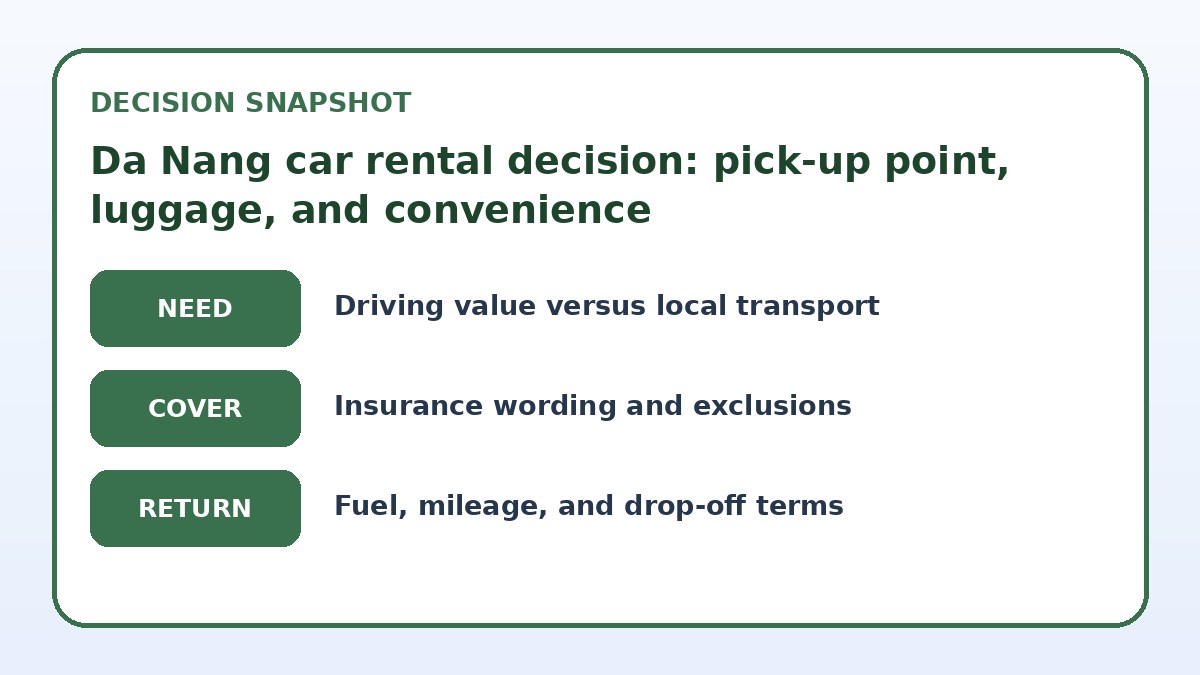
Does driving improve your Da Nang itinerary?
Ask whether having a car genuinely adds value to your plans in and around Da Nang. If your trip focuses on the city center, the Han River bridges, and short walks around beaches, a car can be more hassle than help because parking and traffic near popular spots may be limited. Conversely, if your route includes the Hai Van Pass, rural attractions, or day trips to Hoi An and the Marble Mountains where public transport is infrequent, driving can unlock flexibility and save transit time when you’re carrying bulky luggage.
When weighing the decision, factor in the number of passengers and pieces of luggage. A single SUV or estate can absorb multiple suitcases and equipment, making pickup logistics simpler; two compact cars will complicate transfers. Also consider airport logistics—arriving late or after a long flight increases the value of collecting a car at the terminal so you avoid hauling bags across town. If your schedule includes moving between hotels or overnight trains, a car may reduce repeated door-to-door transfers.
Decide whether driving earns its place
| Mobility strategy | Best for | Cost or friction to check |
|---|---|---|
| Airport pickup | Travelers prioritizing single-step arrival with heavy bags | Often more convenient but can come with higher pick-up fees and limited vehicle selection |
| City pickup (downtown office) | Those seeking lower base rates and more vehicle choices | Requires a luggage transfer from the airport and extra time for pickup |
| Short-term rental or one-way city-to-city hire | Multi-leg trips where you leave the car in a different location | Flexible routing but often includes one-way fees and more complex booking rules |
| No-drive fallback (taxis, shuttles, private driver) | Visitors who prefer to avoid driving with bulky luggage | Less control over schedule and potentially higher per-trip costs |
Check live rental choices only after the route test
Use the exact driver, dates, pickup point, and return plan to compare current conditions.
Insurance, coverage details, and what to check
Don’t rely on summary lines—read the final provider booking page for exact policy wording. Confirm what the basic rate covers (third-party liability, collision damage waiver, theft protection), the size of the security deposit or excess, and whether airport pickup or drop-off changes coverage or adds mandatory fees. Pay attention to exclusions like damage from driving on unpaved roads or carrying certain types of equipment; these are common and could affect claims if you’re hauling surfboards, bicycles, or musical instruments.
Also check requirements for documentation at pickup: an international driver’s permit may be requested, plus proof of onward travel. If you plan to add extras (child seats, roof racks for oversized luggage), verify whether they are covered by the same insurance and whether they must be reserved in advance. If any insurance terms or required deposits are unclear on the booking page, contact the provider directly and get confirmation in writing before arrival.

Compare the full rental conditions
Confirm insurance wording, exclusions, deposit, fuel, mileage, and return terms on the final page.
Pickup and return friction: airport vs city logistics
Airport pickup tends to be the easiest with luggage because you walk from arrivals to the rental desk or meet a shuttle with your bags already in hand. However, airports may charge higher pick-up or drop-off fees and have stricter operating hours—confirm the provider’s terminal meeting point and after-hours policy. If you choose airport pickup, double-check where to return the car: some companies require drop-off at a different lot or terminal processing area that can add time when you’re trying to catch a flight.
City pickup can save money and sometimes offers more flexible vehicle selection, but expect a transfer from the airport to the downtown office with all your bags. That can mean paying for a taxi, shuttle, or ride-hail—factor those costs and the extra door-to-door time into your comparison. For returns, a city office might be closer to your last-night accommodation, avoiding an early airport transfer, but ensure the office’s opening hours match your schedule so you don’t incur after-hours fees.
Car rental terms to verify
- Confirm the pick-up and drop-off locations and exact terminal instructions on the provider’s final booking page.
- Verify insurance coverage details, visible excess amounts, and any exclusions for luggage or rooftop carriers.
- Measure and list your luggage dimensions; match them to vehicle trunk capacity before selecting a car class.
- Check operating hours and after-hours return procedures to avoid late-drop penalties.
- Compare transfer costs—taxi or shuttle from airport to downtown—against any airport pickup surcharge.
- Ask the provider to confirm in writing whether added accessories (roof box, bike rack) are included in the insured booking.
Non-driving fallback: close alternatives when a car isn’t right
If you decide a car isn’t worth the cost or hassle, plan a clear fallback that handles extra luggage. Book a taxi or ride-hail roomy enough for all bags, or use an airport-to-hotel shuttle that accepts bulky items. Many hotels will offer luggage storage if you need to free yourself between check-in and moved plans; confirm size limits and any fees. For day trips, consider booking guided tours that include transport, or a one-way shuttle to destinations like Hoi An to avoid moving bags through multiple transfers.
Also consider short-term luggage storage services at the airport or near the city center if you want to drop heavy bags for a day while you scout car rental options or explore on foot. If mobility is the priority but driving isn’t, look into hiring a private driver for a day—this gives flexibility and avoids local driving responsibilities while still accommodating bulky sports equipment or multiple suitcases. Remember to verify vehicle size and luggage allowances before booking.
Car Rental & Road Trip questions travelers ask
Will picking up a car at Da Nang airport always save me time with heavy luggage?
Not always. Airport pickup removes the need to transfer luggage into a taxi or shuttle, which often saves time and effort, but you should confirm where the rental desk or shuttle meeting point is located within arrivals. If the rental requires a bus to an off-airport lot or long wait times, the time advantage shrinks. Compare expected wait times, terminal meeting instructions, and whether the provider offers a meet-and-greet service on their booking page before deciding.
How do I know what size car I need for my luggage and passengers?
Count people and suitcases, then check vehicle trunk capacity and seating on the rental description page. Look for examples of luggage capacity (e.g., number of large suitcase equivalents) or compare vehicle classes—compact, intermediate, SUV—against your list. If the site lacks clear measurements, contact the provider with suitcase dimensions and request confirmation the selected model fits both passengers and baggage. Reserving a slightly larger class reduces the risk of cramped space with extra gear.
What should I verify about insurance and deposits before booking?
On the final booking page, verify which protections are included (liability, collision, theft), the amount of excess or security deposit, and whether optional waivers reduce or remove that excess. Check exclusions—such as damage from unpaved roads or carrying certain types of equipment—and whether adding accessories affects coverage. Also confirm accepted payment methods for deposits and whether third-party credit card insurance can supplement or replace provider options.
Final decision note
For travelers arriving in Da Nang with extra luggage, airport pickup typically wins on convenience: fewer transfers, immediate access to your vehicle, and less lifting through taxis or shuttles. City pickup can be more economical and offer a wider choice of cars but adds a luggage transfer step that may negate savings if you value time and ease. Before you book, compare total door-to-door time, transfer costs, operating hours, and the precise insurance wording on the provider’s booking page. If driving doesn’t add clear benefits, plan a non-driving fallback—spacious taxis, shuttle services, or private drivers—so your luggage moves smoothly without the responsibility of local driving.
Continue planning
Check current options and final conditions
Use the provider page to confirm live availability, the final total, cancellation terms, and every condition that matters to your trip.
This evergreen planning guide was created with AI-assisted drafting and a structured quality review. It does not display live prices, schedules, availability, visa guidance, or provider rankings. Verify current details before booking. Some links are affiliate links; we may earn a commission at no additional cost to you.