If you’re traveling solo from Seoul to Hong Kong, the central decision is simple but consequential: trade schedule flexibility for convenience, or accept constraints to save money or reduce changes. Practical choices—direct versus connecting flights, flexible fares versus basic checks, departure times that fit your day versus cheaper red-eyes—shape how smooth the trip feels, how much you carry, and how much control you keep when plans shift. This article gives the plain answer up front: pick the approach that matches your tolerance for disruption and how important an easy airport experience is to you. Then use the criteria here—routing, baggage and connection risk, schedule fit, and fare conditions—to evaluate specific flights. Prepare exact travel dates, your baggage needs, and whether you may change plans before searching so you can interpret live availability and the final provider terms accurately.
See live routes for your exact travel day
Compare direct and connecting choices with the same baggage and traveler details.
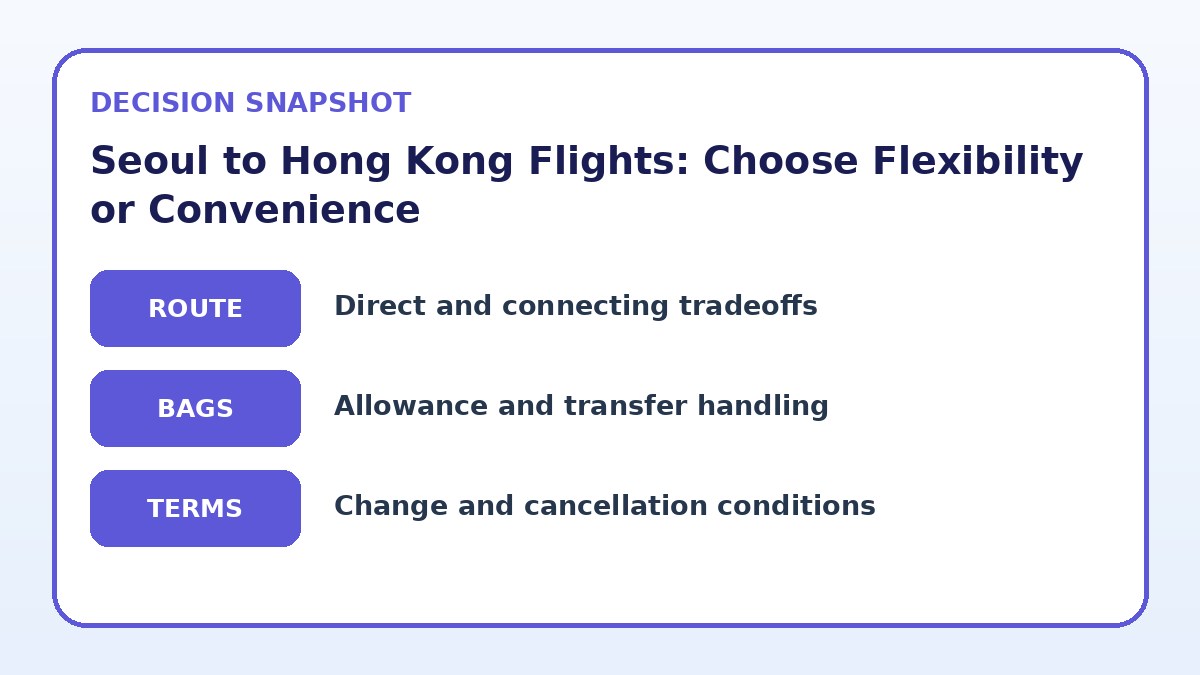
Routing: direct versus connecting options
Start by checking whether direct flights are available on your chosen dates, then compare single-connection itineraries. A direct or nonstop journey minimizes points of failure—no mid-route transfers and no rechecking of baggage in most cases—so it’s naturally convenient for solo travelers who value simplicity. However, direct flights can depart at times that don’t match your schedule, and direct service may operate less frequently on off-peak days, so availability matters. When there are no direct options, prioritize itineraries with a single connection and a reasonable minimum connection time.
For connecting flights, examine airport combinations carefully: the same-operator connection at one airport typically reduces baggage recheck and missed-connection risk compared with an itinerary that requires changing terminals or rechecking at an intermediate city. If multiple carriers are involved, read the fare conditions to see whether the airline accepts liability for missed connections and whether baggage transfers are included. Always compare total travel time and number of transfers rather than just price—spending a few extra hours in transit can add complexity and fatigue that outweighs a modest saving.
Baggage and connection risk: how to protect your trip
Solo travelers carry both physical baggage and the burden of managing transfers alone, so minimizing baggage handling is a strong convenience win. When comparing flights, check whether your fare includes checked baggage and whether luggage transfers are guaranteed on the same ticket. If you need to connect on separate tickets, factor in the time and effort of collecting and rechecking bags, plus the cost of excess-baggage fees if something goes wrong. For those who travel light with a carry-on only, connections are less painful but still require awareness of transfer times and the risk of long waits or missed flights.
Also consider the airport logistics at the connection point—large hub airports can mean long walks, multiple security checks, or inter-terminal transfers that are tiring when you’re on your own. Choose connections with the shortest realistic transfer windows offered by the carrier, but allow personal buffer time based on how comfortable you are navigating unfamiliar airports solo. If you’re risk-averse, prioritize itineraries on a single carrier or alliance where baggage is transferred automatically and the carrier will typically handle rebooking if delays cascade.
Compare flight-selection strategies
| Flight strategy | Best for | Risk to check |
|---|---|---|
| Direct flights | Travelers prioritizing convenience, minimal transfers, and simpler logistics | May offer fewer schedule choices and sometimes higher fares for desirable departure times |
| Single-connection same-carrier itineraries | Solo travelers seeking balance between cost and reduced connection risk | Slightly longer travel time than direct but usually better baggage protection than multi-ticket options |
| Multi-ticket/low-cost separate legs | Budget-first travelers willing to manage baggage and rechecking between carriers | Higher risk of missed connections and extra time or expense to transfer luggage |
| Flexible/refundable fares | Travelers who need the option to change plans without steep penalties | Higher upfront cost that may be worthwhile to avoid stress if plans are uncertain |
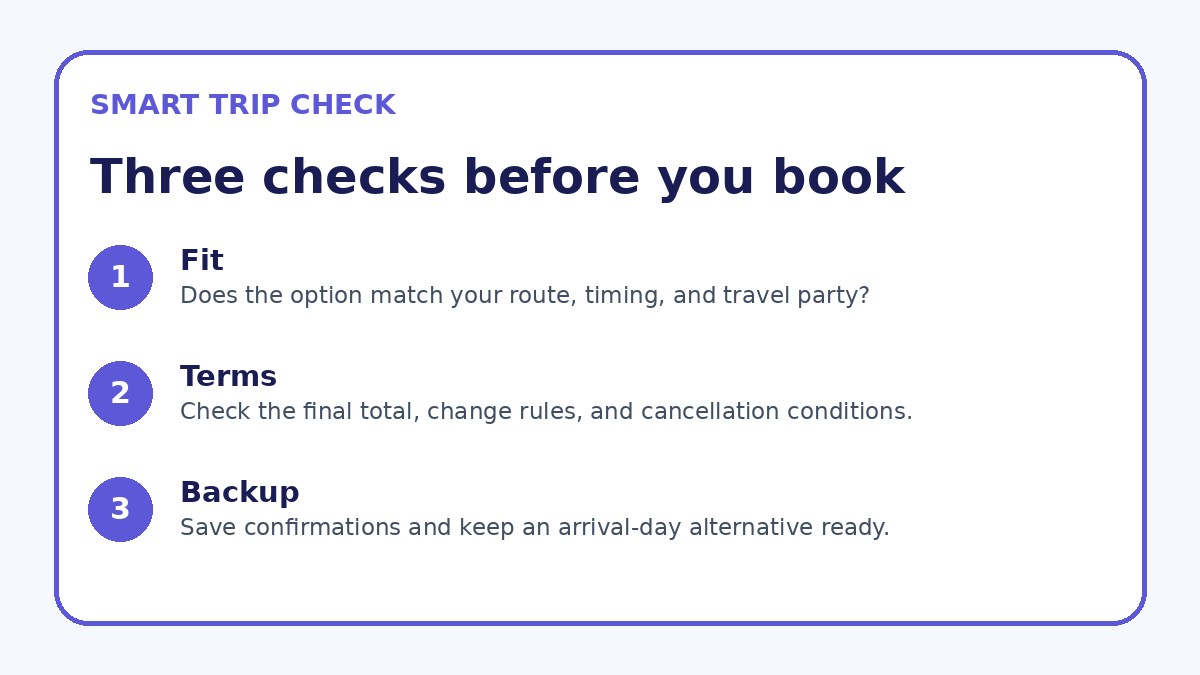
Recheck the complete itinerary
Confirm airports, connection handling, baggage, and change conditions before deciding.
Schedule fit: departure times, layovers, and your day
Match flight times to how you function alone: are you an early riser who prefers morning departures that arrive in daylight, or do you tolerate red-eyes to save a day and possibly money? Consider transport to and from airports in both Seoul and Hong Kong—late-night or very early departures may increase taxi costs or limit public transit options. Solo travelers should factor in arrival time for hotel check-in, safety at the neighborhood level, and how much energy they’ll have to manage immigration and ground transport upon arrival.
Don’t overlook layover length. Short connections can be efficient but stressful if delays occur; long layovers may provide breathing room but extend total travel time and can lead to fatigue. If you plan activities near the airport during a long stop, confirm terminal access and visa rules for the connection city. Ultimately, the right schedule balances your tolerance for risk, comfort with overnight travel, and the importance of arriving at a convenient local time versus minimizing cost.
Flight details to verify
- Confirm your exact travel dates, full name as on passport, and contact details before searching flights.
- Decide whether you need a checked bag and include that requirement in your fare comparisons.
- Check the airline’s published minimum connection time and baggage transfer policy for any connecting itinerary.
- Open and save the fare conditions on the carrier’s official booking page, noting change fees and refundability.
- Compare total door-to-door travel time, including airport transfers at both ends and likely public transport availability.
- If using a third-party site, reproduce the fare and terms on the airline’s website to verify final rules before payment.
Fare conditions: refunds, changes, and the fine print
Fare rules determine how much flexibility you really have, so read them before committing. Look for specifics: change fees, refundability, reissue rules, and fare validity. Some fares allow free changes within a set window or only permit date changes with a fare difference; others are strictly non-refundable. For solo travelers who might adjust plans, flexible or semi-flexible tickets can be worth the extra fare if they avoid a high penalty for a last-minute change. When comparing, open the airline’s full fare conditions on the booking page and save screenshots of the terms you relied on.
Also verify baggage allowance on the fare you intend to buy, because booking a low-fare economy seat and then adding baggage during a later change can be more expensive than selecting a fare that includes luggage from the start. If you’re using a third-party booking site, confirm exactly what the vendor shows versus the airline’s own page; differences sometimes exist in how change and cancellation rules are presented. For live checks, Trip.com can be an option to compare current availability, but always confirm final terms and fare names on the airline’s official booking page before you purchase.
Flight Guide questions travelers ask
Should a solo traveler always pick a direct flight from Seoul to Hong Kong if available?
Not always. Direct flights maximize convenience and reduce the number of moving parts you must manage solo, but they may depart at inconvenient times or be less available on your dates. If a direct option forces an awkward overnight or a costly transfer to your home airport, a single-connection itinerary that better matches your schedule could be preferable. Compare total travel time, ground transport logistics, and fare conditions—choose direct service when the convenience outweighs any schedule or cost compromises.
How much connection time should I allow if I must transfer between flights?
Allow more than the carrier’s published minimum if you’re uncertain about airport layout, immigration procedures, or if you must recheck baggage. Solo travelers should factor in possible queue times at immigration and security, inter-terminal transfer time, and a personal buffer for delays. If both segments are on the same ticket and the carrier handles baggage, you can accept shorter connections; with separate tickets or unfamiliar airports, prefer longer layovers to reduce stress. Verify any minimum times on the airline’s page for the precise airports involved.
Are flexible fares worth the extra cost for solo travelers on this route?
Flexible fares are worth it if you expect schedule changes, value the option to rebook quickly without complex penalties, or want peace of mind when traveling alone. They remove the worry of losing significant money due to changes and often simplify handling after delays. If your dates are fixed and you’re comfortable accepting change penalties or using travel insurance, a less flexible fare may be appropriate. Always read the exact change and cancellation terms on the booking page to decide if the premium matches your risk tolerance.
Final decision note
Choosing Seoul to Hong Kong flights as a solo traveler comes down to where you place value: convenience, lower connection risk, and simpler ground logistics, or greater schedule and price flexibility. Start by deciding whether a direct or single-connection itinerary better fits your comfort with airport navigation and baggage handling. Next, set your tolerance for overnight travel and how much you’re willing to pay for changeable tickets. Before booking, prepare exact passenger details, check the airline’s fare conditions on its official page, and factor in airport transfer times at both ends. Those steps will help you make a practical booking that aligns with both your schedule and your peace of mind.
Continue planning
Check current options and final conditions
Use the provider page to confirm live availability, the final total, cancellation terms, and every condition that matters to your trip.
This evergreen planning guide was created with AI-assisted drafting and a structured quality review. It does not display live prices, schedules, availability, visa guidance, or provider rankings. Verify current details before booking. Some links are affiliate links; we may earn a commission at no additional cost to you.