The quick answer: for most first-time visitors, rail offers the clearest door-to-door balance between frequency, station locations, and transfer ease — but coach or private transfer can win when your start or end address is far from major stations or when luggage and group size are the priority. Before you book, compare where each mode drops you relative to your Osaka accommodation and Kyoto plans, how much luggage-handling you'll tolerate, and how much schedule flexibility you need. This article lays out the decision points you’ll actually use on the travel day — terminal fit, luggage friction, timing flexibility and simple disruption backups — plus a short comparison of four planning approaches so you can select the one that matches your lodging, arrival time in Osaka, and comfort with transfers.
Choosing the mode: rail, coach, or private transfer
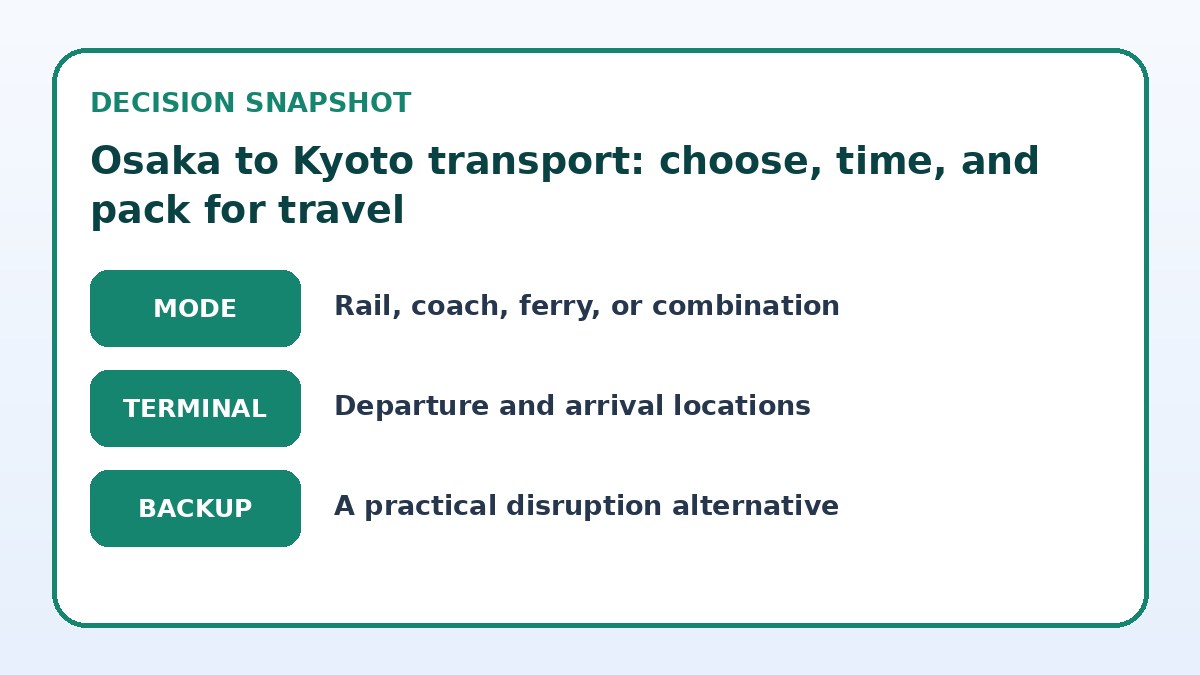
Start by mapping your door-to-door route rather than just the published journey time. Find the walking, subway, or taxi time from your Osaka lodging to the nearest main train station or coach terminal, and do the same for your Kyoto destination. Rail services usually have the highest frequency and drop you inside city centers, which reduces taxi time at the far end. Coaches may have fewer departures but sometimes connect to coach terminals that suit certain hotels. Private transfers give the least handling and the most predictable door-to-door time — useful with heavy luggage or early/late schedules — but you trade that for higher cost and possible city traffic.
When you compare options, list three practical criteria: how far you must walk or transfer at each end, how much luggage you can manage physically, and whether you need a guaranteed seat/space. If you value a stress-free single handover, a private transfer or a reserved-seat train might be worth it. If you prefer flexibility and frequent departures, unreserved rail or frequent coaches will reduce the need to plan every minute. Keep in mind train stations may require stair or elevator use—verify accessibility details on official operator pages before committing.
Choose the end-to-end journey plan
| Journey approach | Best for | Friction to check |
|---|---|---|
| Frequent local rail (unreserved) | Travelers who value flexibility and low walking time to central stations | Can be crowded with luggage during peak hours and may require platform transfers |
| Reserved express rail | Those who want predictable seating and a clear schedule for onward plans | Often requires walking to main stations and may be less frequent than local options |
| Coach between terminals | Groups or travelers with bulky luggage prioritizing simple luggage handling | Terminal locations can add taxi time at either end and services may be less frequent |
| Private transfer or taxi door-to-door | Travelers with lots of luggage, mobility needs, or early/late schedules | Subject to road traffic and typically higher out-of-station cost |
Check live intercity options
Look beyond the ride itself and compare terminals, transfers, luggage, and arrival fit.
Terminal fit and transfer friction
Terminal fit is the practical match between where a service stops and where you actually need to go. A fast train that lands at a station a long taxi ride from your hotel may be worse than a slower service that stops right next to your accommodation. Look at station exits and which side of the station faces your destination; large stations have multiple exits that can add 5–20 minutes of walking or connecting transit. If you have mobility limitations or heavy luggage, prioritize services that minimize platform changes and avoid long underground transfers.
Transfer friction also includes luggage handling: count pieces and consider dimensions. Many local trains allow standard suitcases but require stairs to platforms at smaller stations. Coaches often load luggage into underfloor bays, removing carry distance but requiring larger curbside access at terminals. If you expect to use elevators, confirm their locations in station maps or on operator pages. If the terminal fit looks poor for your situation, consider a short taxi segment to or from a better-located station — sometimes a small taxi fee buys a much simpler overall journey.
Timing flexibility and travel-day pacing
Decide how rigid your schedule is before you choose a product. If you must arrive in Kyoto by a set time for a reservation or tour, pick a service with a buffer — aim to arrive at least 45–90 minutes earlier than needed so you can handle delays, restrooms, or a quick coffee. If your plan is flexible and you want to maximize sightseeing time in Osaka that morning or Kyoto that evening, choose more frequent departures or unreserved seats so you can adapt on the day. Remember that peak commuter periods can fill local trains; for comfortable travel with luggage, look for non-peak slots or reserved seating options.
Factor in check-out and luggage options: some Osaka hotels offer early luggage storage or delivery services to Kyoto hotels — verify these possibilities with the accommodation. If you plan a full morning in Osaka, confirm luggage storage availability at your departure station. Also build micro-padding for walking across large stations, buying tickets, and restroom breaks. These small margins make travel feel calm rather than rushed, especially on a first intercity trip in Japan where efficient but busy systems can be unfamiliar.
Compare the practical alternatives
Use the final page to confirm what is actually offered on your dates and save a workable fallback.
Intercity travel checklist
- Map door-to-door time from your Osaka lodging to the departure point and from arrival point to your Kyoto accommodation before booking.
- Count all bags and confirm elevator or escalator availability on station maps to avoid unexpected stairs with luggage.
- Decide whether you need a reserved seat or private transfer, then compare options for frequency and door-to-door convenience.
- Save screenshots of the next three departures for your chosen route and take note of an alternate station or coach terminal.
- Confirm luggage storage or hotel delivery options with your Osaka accommodation if you plan to sightsee before departure.
- Set aside a small cash amount and confirm taxi pickup spots at arrival stations as a quick disruption fallback.
Simple disruption backups to keep your day workable
A disruption can be anything from platform crowding to minor service delays. Keep a realistic fallback plan: know at least two later departures on different services, the nearest alternative station or coach terminal, and a taxi estimate for the final leg. Save screenshots or bookmarks of operator pages and a map of nearby stations so you can act even with limited connectivity. If you rely on a reserved seat and it’s missed, ask staff at the ticket office about rebooking options — they are generally helpful but need your ticket and identity to assist.
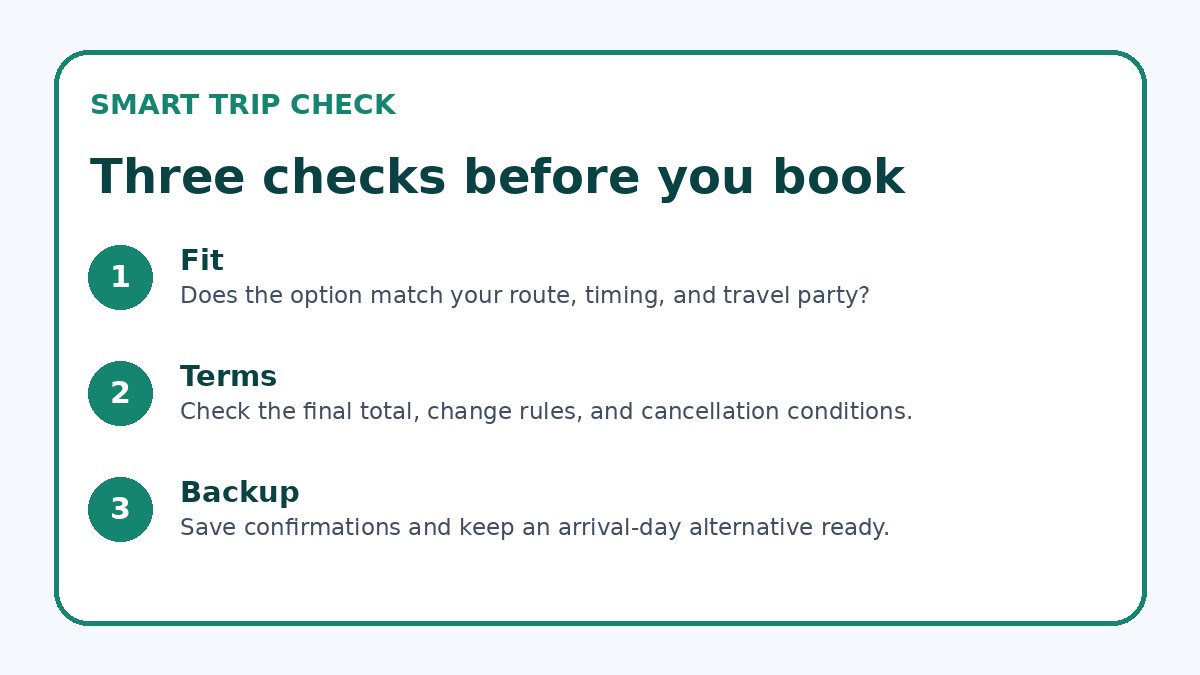
For peace of mind, choose a flexible booking where possible and note refund or change policies on the provider’s final booking page before you pay. If you’re traveling with others, agree in advance on what constitutes a go/no-go decision window (for example: if delayed more than 30 minutes, take the next express). Finally, have a low-friction taxi fallback and a modest cash buffer accessible; a short taxi may be the fastest way to preserve the rest of a tightly planned day.
Rail & Intercity Transport questions travelers ask
Is taking the train from Osaka to Kyoto always the fastest option?
Not necessarily. Trains often have higher frequency and direct station-to-station routes, but “fastest” depends on your start and end addresses. If your Osaka hotel is near a coach terminal or your Kyoto destination is far from the main railway station, a coach or private transfer that shortens door-to-door time could be quicker overall. Check walking and taxi times at both ends, and compare the required transfers. Verify schedules and station exit locations on official operator pages or on Trip.com before booking to confirm connection details.
How much earlier should I leave Osaka to be safe for a midday check-in in Kyoto?
Build a conservative buffer: plan to arrive in Kyoto at least 45–90 minutes before any appointment that matters, which covers small delays, walking across stations, luggage collection, or a taxi. Factor in time to reach your departure point from your lodging and time to buy tickets if needed. If you require a guaranteed arrival window, choose reserved seating or an earlier departure and confirm the operator’s change policy on the final booking page. Always check station layouts in advance so you don’t add avoidable minutes on the day.
What should I verify on provider pages before finalizing my booking?
Confirm departure and arrival stops with exit numbers if available, luggage allowances and accessibility features, and the provider’s change or refund policy. If you reserve a seat, check the exact train/service name and car/seat allocation. For coaches or transfers, verify pickup and drop-off points and whether there’s onboard luggage storage. Only the provider’s final booking page carries current operating details, so use it to confirm any element that would affect door-to-door convenience before you commit.
Final decision note
Planning the Osaka to Kyoto travel day is mostly about matching the service to your specific door-to-door needs: where you’re staying in Osaka, where you need to end up in Kyoto, how much luggage you have, and how rigid your timing is. Prioritize terminal fit and low transfer friction for the calmest experience, choose reserved or private options when timing certainty matters, and save simple backups like later departures and a taxi fallback. Before you book, check operator pages (or compare availability on Trip.com) for station exit details, luggage policies and change rules so your chosen option behaves the way you expect on the day.
Continue planning
Check current options and final conditions
Use the provider page to confirm live availability, the final total, cancellation terms, and every condition that matters to your trip.
This evergreen planning guide was created with AI-assisted drafting and a structured quality review. It does not display live prices, schedules, availability, visa guidance, or provider rankings. Verify current details before booking. Some links are affiliate links; we may earn a commission at no additional cost to you.