If you’re a solo traveler deciding between direct and connecting Busan to Jeju flights, start with the route-versus-fare tradeoff: direct flights save time and simplify connections at the potential cost of higher fares, while connecting itineraries may lower the ticket price or open different schedules but add baggage handling and missed-connection risk. Practically, pick the travel attribute that matters most to you — speed, cost, redundancy, or schedule flexibility — and use that as your tiebreaker. Before you search, have exact travel dates, departure window, and baggage needs ready. Also decide how much buffer time you want for connections, whether you need checked luggage, and how you’ll get to Busan’s airport. This guide walks solo travelers through routing choices, baggage and connection risk, schedule fit, and fare conditions so you can book with more clarity.

See live routes for your exact travel day
Compare direct and connecting choices with the same baggage and traveler details.
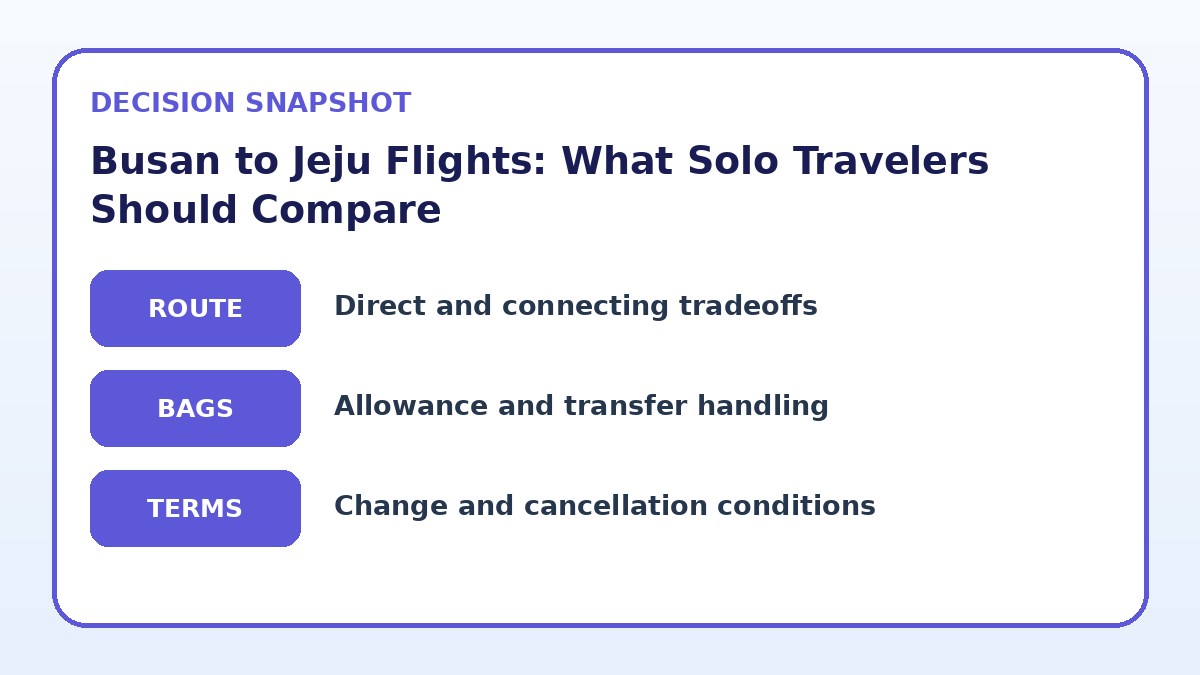
Routing: direct vs connecting explained
Direct flights between Busan and Jeju are point-to-point services that put you on a single aircraft from your departure airport to Jeju. For many solo travelers this is the simplest choice: you check in once, drop any checked bag, board, and disembark at your destination without worrying about transit terminals or re-clearing security. When direct options are available on your chosen dates, they eliminate the need to plan for an intermediate airport experience. However, do not assume a direct option exists every day or at every hour; you’ll need to check schedules for your exact travel dates and confirm the route listed on the booking page.
Connecting itineraries route you through another city or airport and require at least one change of aircraft. These can appear because direct seats are sold out, because you’re combining different carriers for schedule or cost reasons, or because a multi-leg routing fits your time preferences better. While connecting flights can increase flexibility in departure or arrival times, they also introduce transfer tasks such as moving between gates or terminals and rechecking baggage if flights are not on the same ticket. For solo travelers, weigh the potential savings or schedule benefits against the added logistical complexity of the connection.
Baggage and connection risk for solo travelers
Checked baggage handling is a major practical difference between direct and connecting flights. On a single direct flight, your checked items are in one custody chain until arrival at Jeju. With connections, baggage may be tagged through to the final destination if both segments are booked on the same ticket and carry compatible rules; otherwise you may need to collect and recheck baggage during the layover. Solo travelers should verify baggage transfer rules on the booking page or with the carrier; check whether lower-fare booking classes restrict checked bags or require separate baggage purchases for each segment.
Connections also increase the chance of missed connections due to delays, especially on tight layovers or when different carriers are involved. If a missed connection occurs on a single ticket, airlines typically rebook affected passengers, but if segments are on separate tickets you may be treated as a new customer for the second leg. Solo travelers who prefer to avoid dealing with rebooking should factor in buffer time and consider travel insurance or flexible tickets. Always confirm minimum connection times at the transfer airport and read the provider’s policy on missed connections before committing.
Compare flight-selection strategies
| Flight strategy | Best for | Risk to check |
|---|---|---|
| Book a nonstop daytime direct flight | Solo travelers prioritizing speed and simplicity | Often less flexible schedule choices and possibly higher base fare |
| Choose a connecting itinerary with longer layovers | Those seeking lower fares with manageable transfer time | More time in transit and additional planning for baggage and transfers |
| Book different carriers on separate tickets | Travelers chasing specific departure times or price gaps | Higher missed-connection risk and little recourse if first flight delays |
| Select a flexible or refundable fare on any routing | Solo travelers valuing changeability and peace of mind | Higher fare cost in exchange for easier rebooking or cancellation |
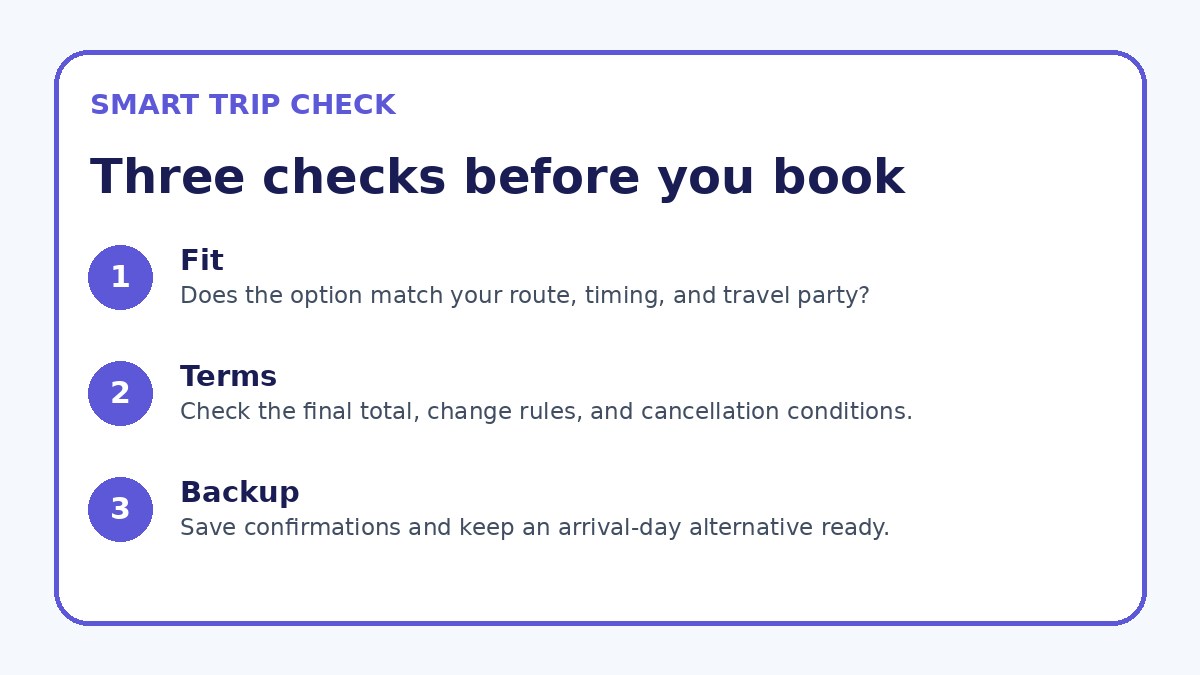
Recheck the complete itinerary
Confirm airports, connection handling, baggage, and change conditions before deciding.
Schedule fit and day-of travel considerations
Schedule fit matters more for short domestic routes like Busan to Jeju because smaller timing differences can change whether you arrive with daylight or late at night. Direct flights generally present clearer total door-to-door planning: you know the single departure and arrival times and can coordinate ground transportation or activities accordingly. If your schedule is fixed — for example, a business meeting or a late ferry — choosing a direct flight that departs within your preferred window reduces the stress of potential delays snapping into a connecting sequence.
Connecting routes can offer alternative timings that a direct service doesn’t, which is useful when direct flights are full or depart at inconvenient hours. But on connection days you must also plan how to spend layover time, how to navigate transfer signage or terminal changes alone, and whether you can access lounges or seating areas if the layover is long. Check whether the transfer airport requires airway changes or additional security checks; solo travelers should plan reachable layover buffers and account for local airport layouts when choosing a connecting itinerary.
Flight details to verify
- Confirm exact travel dates, preferred departure window, and whether you require a round-trip or one-way ticket before searching.
- Decide if you need checked baggage and verify whether baggage is included on each fare and for each segment.
- Check whether itinerary segments are on a single ticket and confirm the carrier operating each leg on the booking page.
- Compare total travel time, layover length, and minimum connection times when considering connecting options.
- Read the fare conditions for change and cancellation fees and note any rules about refunds or travel vouchers.
- Plan ground transport to and from airports, including buffer time for check-in, security, and any terminal transfers.
Fare conditions, refunds, and what to verify before booking
Fare conditions determine flexibility: refundable fares, change fees, and included services such as meals or baggage can differ sharply by booking class and between direct and connecting options. When comparing itineraries, read the fare rules on the booking page for each option — look for how changes are handled, whether seat selection is included, and whether checked baggage is part of the fare or sold separately. Solo travelers who need certainty about return plans or who have tight onward connections should favor fares that offer straightforward change policies, and should note exactly what penalties apply for modifications.
Because policies and add-ons can change, always verify the final price breakdown and policy language on the provider’s confirmation before paying. Confirm which carrier will operate each segment, whether the itinerary is on a single ticket, and how refunds or rebookings are handled if a delay affects your plans. If you find options on an aggregator, follow through to the airline’s or travel agent’s final booking page to check baggage allowances, seat rules, and change penalties. Trip.com is one place to compare live availability, but verify provider-specific facts directly on the seller’s final page before you complete the purchase.
Flight Guide questions travelers ask
How much buffer time should I allow for a connecting flight between Busan and Jeju?
Allow more buffer time than the published minimum connection if you want low stress as a solo traveler. Consider at least one hour for domestic-to-domestic transfers if flights are on the same ticket and within the same terminal, and longer if you must change terminals, re-clear security, or collect and recheck luggage. If the connection is on separate tickets or uses different carriers, add ample extra time to reduce the risk of missing the second leg. Check the airport’s recommended minimum connection times and then add the margin you need for personal comfort.
If I book a connecting flight on a single ticket and the first leg is delayed, who rebooks me?
When both segments are on one ticket, the operating carrier or the ticketing carrier typically handles rebooking for missed connections caused by delays. That can include putting you on the next available flight to reach your destination at no or limited extra cost, depending on the fare rules. Still, policies vary, so confirm the carrier’s missed-connection and rebooking policy before booking. If you prefer guaranteed support, consider flexible fares or add travel protection that covers additional costs or accommodation if a delay forces an overnight stay.
Can I trust aggregator search results when comparing direct and connecting Busan–Jeju flights?
Aggregators are useful for initial comparison because they show many options at once, but you should always follow through to the airline’s or agent’s final booking page to verify the exact fare conditions, baggage allowance, and operating carrier. Aggregators may not display fees for checked bags or seat assignments clearly, and some pricing details change between the aggregator and seller. Use the aggregator to shortlist itineraries, then confirm that the ticket is on a single booking reference, that baggage will transfer if promised, and that the fare rules meet your needs before you complete payment.
Final decision note
For most solo travelers, the practical question when choosing Busan to Jeju flights is whether you value a straightforward, time-saving direct routing or the potential schedule flexibility and lower fares that connecting itineraries can offer. If minimizing stress and transit time matters most, prioritize nonstop daytime options that match your schedule and include the baggage you need. If cost or departure times are the main constraints, evaluate connecting routes carefully: confirm single-ticket baggage transfer, allow comfortable layovers, and pick fares with clear change policies. Always prepare your exact dates and traveler details, verify carrier and fare conditions on the final booking page, and choose the approach that aligns with your tolerance for complexity versus savings.
Continue planning
Check current options and final conditions
Use the provider page to confirm live availability, the final total, cancellation terms, and every condition that matters to your trip.
This evergreen planning guide was created with AI-assisted drafting and a structured quality review. It does not display live prices, schedules, availability, visa guidance, or provider rankings. Verify current details before booking. Some links are affiliate links; we may earn a commission at no additional cost to you.