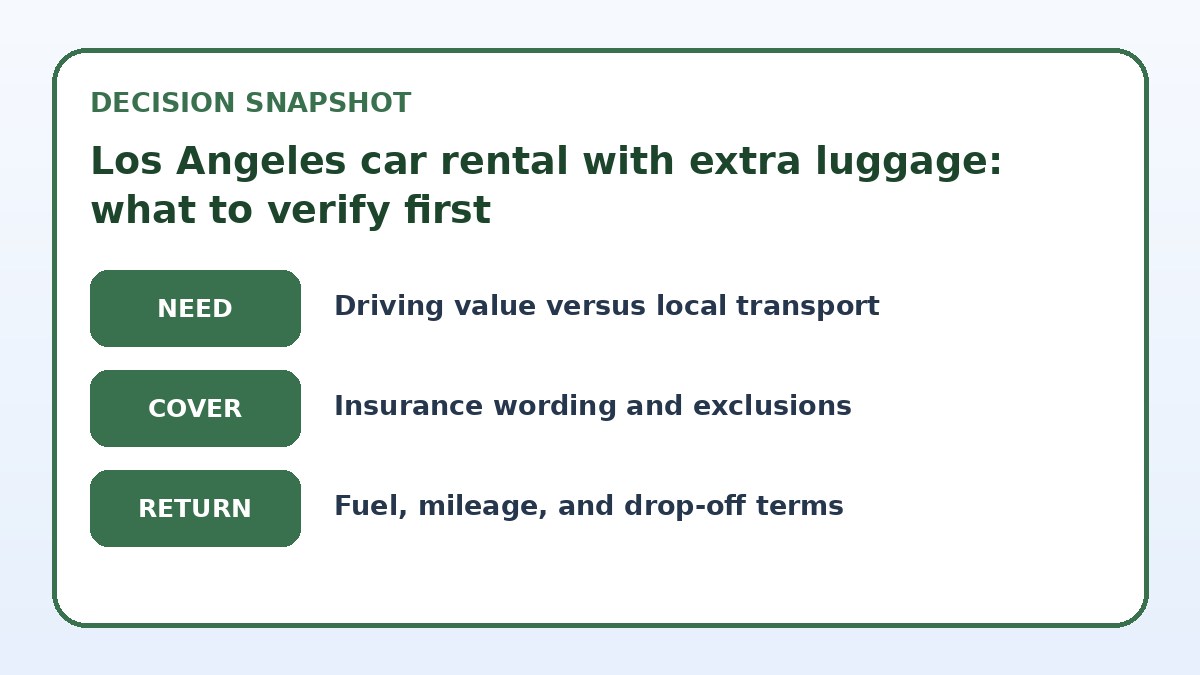
Practical answer first: if your Los Angeles trip depends on carrying bulky or heavy luggage—sports gear, long-term movers’ boxes, or several large suitcases—renting a car can still be the simplest option, but only after you confirm fuel and mileage policies and vehicle trunk capacity. Driving adds convenience for airport-to-hotel transfers and day trips along the coast or to the mountains, but hidden fuel rules, pre-paid refueling options, and restrictive mileage caps can change the cost and hassle calculus. This guide helps you decide whether to drive, what exact contract lines to read at booking and pickup, and which non-driving alternatives to compare. Read the checklist at the end before you finalize anything, and note exactly what to verify on the rental company’s final booking page, including vehicle class, fuel options, mileage allowance, and any fees for extra weight or oversized items.

Decide whether driving improves your Los Angeles itinerary
Start by weighing route value: Los Angeles is highly spread out, and driving often saves time between neighborhoods and attractions that public transit connects poorly. If your plan includes multiple destinations in different parts of the metro area—Santa Monica to Griffith Park to a U.S. Route 101 coastal drive—having a car can be a real time-saver. But if you’re staying mainly in one neighborhood or plan to rely on rideshares for a handful of short trips, the parking costs, traffic stress, and luggage handling may outweigh the benefits.
For travelers whose primary concern is extra luggage, ask whether your luggage needs change the value of driving. If you must transport many heavy suitcases or bulky sports equipment, a car avoids repeated rideshare fees and complicated transfers. Conversely, if you can consolidate bags into one large trunk-friendly set or ship items ahead, public transit plus an occasional shuttle may prove simpler and cheaper. Calculate door-to-door times, number of transfers, and the physical effort of moving luggage through stations and stairways.
Decide whether driving earns its place
| Mobility strategy | Best for | Cost or friction to check |
|---|---|---|
| Full-time rental car | Travelers needing daily access and frequent luggage transfers. | Highest convenience but includes parking hassles and responsibility for fuel, mileage, and damage. |
| Rent only on high-luggage days | Those with a few bulky transfers who otherwise prefer public transit or rideshare. | Lower cost overall but requires planning pickup/return logistics and possible extra one-way fees. |
| Rideshare/taxi throughout | Short stays focused in one neighborhood without long excursions. | No parking or refueling responsibilities, but multiple large-item trips can become expensive and awkward. |
| Public transit plus shipping/storage | Budget-conscious travelers who can pre-ship items or use local storage temporarily. | Lowest driving stress and cost for long stays, but requires lead time and coordination to ship or retrieve baggage. |
Check live rental choices only after the route test
Use the exact driver, dates, pickup point, and return plan to compare current conditions.
Insurance wording, coverage, and what to verify on the contract
Insurance descriptions often use similar language but conceal critical limits. When checking the rental contract, verify what is actually included and whether your personal auto policy or credit card offers primary or secondary coverage. Look specifically for wording about liability, collision damage waivers (CDW/LDW), and loss-damage waivers: check whether they exclude damage caused by overloaded trunks or unsecured cargo, since extra luggage increases risk during sudden stops or accidents.
Also search the terms for equipment coverage and approved cargo transport. Some companies limit coverage if you attach roof racks, stow items on external carriers, or load above stated weight limits. If you plan to carry bikes, surfboards, or other bulky kit, confirm whether the rental firm requires additional waivers, approved racks, or professional installation—then verify whether those additions affect insurance or create extra charges.

Compare the full rental conditions
Confirm insurance wording, exclusions, deposit, fuel, mileage, and return terms on the final page.
Pickup and return friction: fuel rules, mileage caps, and practical handling
Pickup and return are the moments where fuel and mileage choices affect your experience the most. Confirm whether the rental uses full-to-full, full-to-empty (pre-paid fuel), or another policy. Full-to-full is usually clearest: you pick up a full tank and return full, avoiding refuel charges. Pre-paid options promise convenience but often bill per gallon at marked-up rates; if the contract says the vehicle will be charged for any returned fuel deficit at a set rate, check exactly how that rate is calculated and compare it to local pump prices.
Mileage caps vary: some contracts include unlimited miles within a geographic area, others limit daily or total mileage, especially for specialty vehicles. Calculate your expected airport transfers and day-trip distances in advance. Also ask about additional fees for late returns, refueling, and cleaning if luggage soils the interior. Document the fuel level and any existing damage on pickup photos or signing the vehicle condition report to avoid disputes at return.
Car rental terms to verify
- Measure or list your luggage dimensions and weight, then compare to vehicle trunk volume and roof-rack allowances before selecting a class.
- On the rental booking page, read the exact fuel policy wording and note whether it’s full-to-full, pre-paid, or charged by the company at return.
- Calculate expected trip miles, add a buffer for detours, and confirm whether unlimited mileage applies or if daily/total caps and overage fees exist.
- Search the terms for any weight, oversized-item, or roof-rack fees and whether such loads affect your insurance coverage or require extra waivers.
- Take timestamped photos of the vehicle’s fuel level and interior condition at pickup, and keep the vehicle condition report copy until the final return is confirmed.
- If using a rideshare alternative, confirm vehicle type availability for large luggage and estimate cumulative costs for every planned transfer before cancelling a rental.
Non-driving fallback and how to plan if you skip the rental
If you choose not to drive, plan how to handle extra luggage without a car. Book airport shuttles that allow large items, check hotel luggage assistance and early check-in options, and confirm baggage allowances on buses or trains for oversized items. Rideshare and taxi services in Los Angeles accept luggage but compare per-trip costs for heavy or multiple bag transfers. If you expect frequent short hops inside the city, rideshares can be simpler and avoid parking fees and insurance concerns.
Consider hybrid options: rent a car only for selected days when you need to move bulky items, and use public transit or rideshare otherwise. Another option is short-term storage or shipping: ship non-essential baggage ahead to your accommodation or a local storage provider. Whichever alternative you pick, verify cancellation terms, luggage limits, and the cost of last-mile handling before forgoing a rental—these can offset perceived savings.
Car Rental & Road Trip questions travelers ask
Does pre-paid fuel save time or money when renting in Los Angeles?
Pre-paid fuel can save time because you can return the car without refilling, but it often costs more per gallon than local stations. It may be worthwhile if you absolutely cannot stop to refill before returning the vehicle—such as late-night returns with limited pump access. Before choosing it, compare the rental company’s pre-paid per-gallon equivalent to local fuel prices and consider whether you can refill on the way back without significant detour. Verify the exact refund or no-refund policy on the booking page, because unused pre-paid fuel may not be refundable.
Will my personal car insurance or credit card cover a rental if I carry a lot of luggage?
Coverage depends on your insurer and card issuer wording; many policies cover damage to the rental vehicle but may exclude claims tied to overloaded cargo or non-approved external attachments. Contact your auto insurer and credit card company before booking to ask whether transported items or roof-rack use affect coverage. On the rental agreement, look for clauses that void damage waivers if the vehicle is overloaded or if cargo was not secured according to the company’s instructions. Keep written confirmation of any coverage promises for your records.
How do mileage limitations typically work and how can I avoid overage fees?
Mileage rules vary: some rentals include unlimited miles within certain geographic boundaries, while others set daily or total caps, especially for specialty vehicles. To avoid overage fees, estimate your full itinerary mileage—including airport transfers and any planned day trips—then add a safety buffer. If the estimate exceeds the allowed miles, ask the rental company about upgrading to an unlimited-mileage option or a higher class. Always get the mileage allowance and overage rate in writing on the final booking page so you can compare options accurately.
Final decision note
For travelers with extra luggage, the decision to rent a car in Los Angeles hinges on practical checks: trunk capacity, fuel policy wording, mileage allowances, and insurance limits related to cargo. Drive if your schedule and routes demand door-to-door flexibility and you confirm acceptable fuel and mileage terms; otherwise, consider renting only when you need to move heavy items or use rideshare and public transit combined with shipping or storage. Before booking, read the final rental contract carefully and verify the exact fuel pricing method, any mileage caps, and rules about oversized or heavy items. If you prefer a place to compare live availability and terms, consider checking Trip.com as one option, but always confirm the provider’s own final page for the definitive contract.
Continue planning
Check current options and final conditions
Use the provider page to confirm live availability, the final total, cancellation terms, and every condition that matters to your trip.
This evergreen planning guide was created with AI-assisted drafting and a structured quality review. It does not display live prices, schedules, availability, visa guidance, or provider rankings. Verify current details before booking. Some links are affiliate links; we may earn a commission at no additional cost to you.